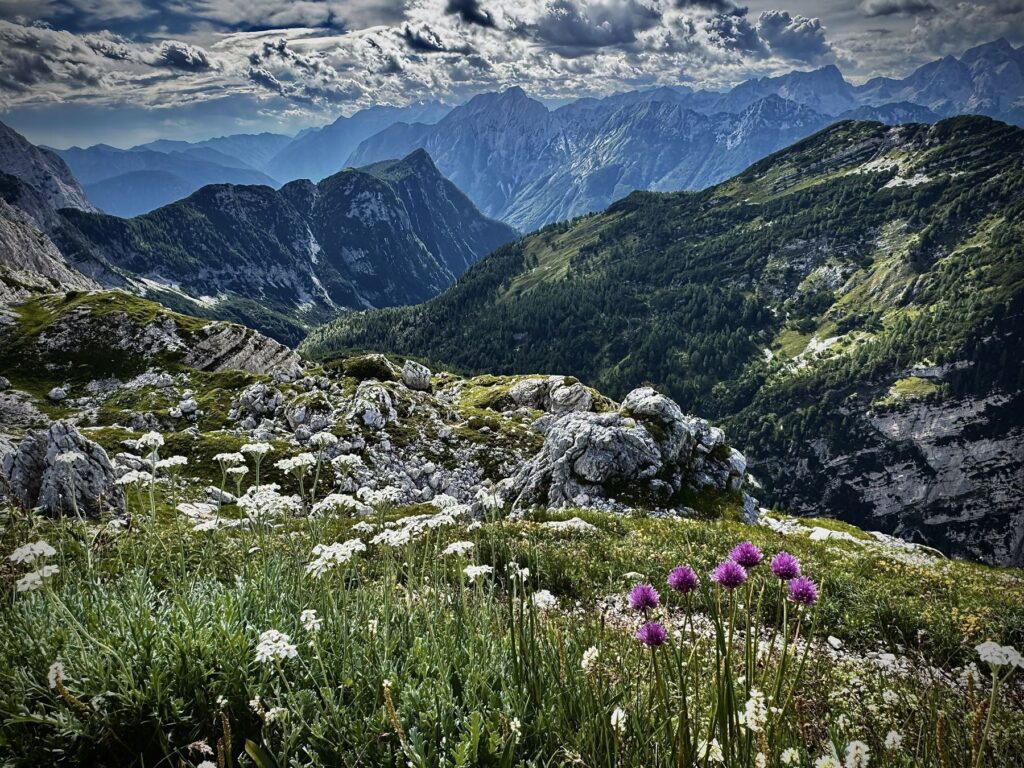
Slovenia first appeared on my travel radar in 2019 while I was planning a hiking trip to Switzerland. During my research, I came across a company that specialized in Swiss hiking adventures. While browsing their itineraries, I noticed references to both the Dolomites and the Julian Alps. At the time, I knew little about either mountain range, so I began researching them further. Colin and I eventually hiked in the Dolomites in September 2024, and upon returning home, my curiosity about the Julian Alps only grew. Ever since, I have been eager to experience Slovenia’s spectacular mountains for myself.
In 2025, I embarked on my first adventure with the U.S.-based company Explorer Chick. I selected their Croatia Multi-Adventure Tour because Croatia had long occupied a prominent place on my travel bucket list, particularly for the opportunity to visit Plitvice Lakes National Park. While exploring the company’s offerings, I also noticed they offered a hiking trip in Slovenia. During our Croatian adventure, our guide, mentioned that her favorite European Explorer Chick itinerary was the Slovenia hiking trip, which she had recently led. That recommendation was all the encouragement I needed. Shortly after returning home from Croatia in September 2025, I booked the Slovenia Hiking Adventure for July 2026.
Day 1 Arrival into Ljubljana
My Slovenian adventure began on Thursday, July 2, 2026 departing from Boston’s Logan Airport, transiting through Amsterdam and eventually arriving the following afternoon in Ljubljana, Slovenia. Before the trip, I had been somewhat apprehensive about arriving in Amsterdam because of the newly implemented Entry/Exit System (EES). Fortunately, the process was far easier than I had anticipated. We spent about 30 minutes in the immigration line, but we were neither fingerprinted nor photographed. Despite landing nearly an hour behind schedule, our two-hour and 45-minute layover gave us ample time to make our connection.
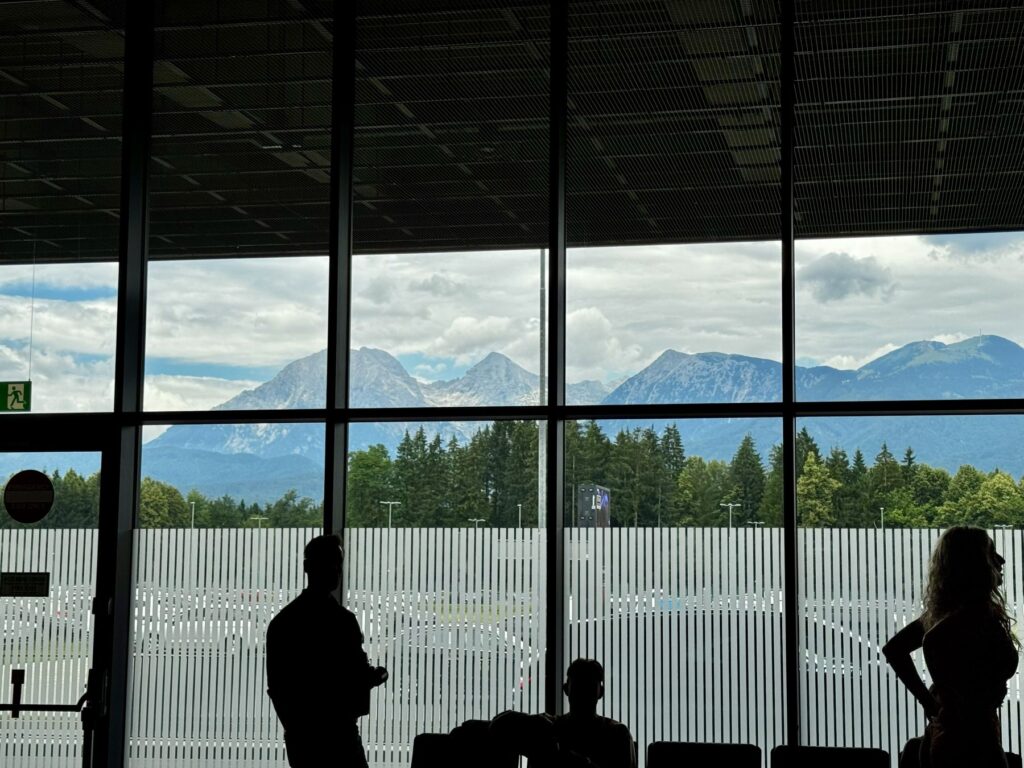
I had arranged an airport shuttle in advance, and it was waiting to take us to the City Hotel in Ljubljana. We arrived around 2:30 p.m., and thankfully our room was already available. After dropping off our luggage and changing into shorts, we set out to explore the city’s charming Old Town, just a few blocks from the hotel. From the moment we arrived, Ljubljana’s Old Town captivated us. Its cobblestone streets, colorful storefronts, and inviting outdoor cafés created an atmosphere that felt both lively and relaxed. One gently curving street immediately reminded me of Victoria Street in Edinburgh. Flowing through the heart of the Old Town is the Ljubljanica River, crossed by numerous picturesque pedestrian bridges that add to the city’s unmistakable charm.
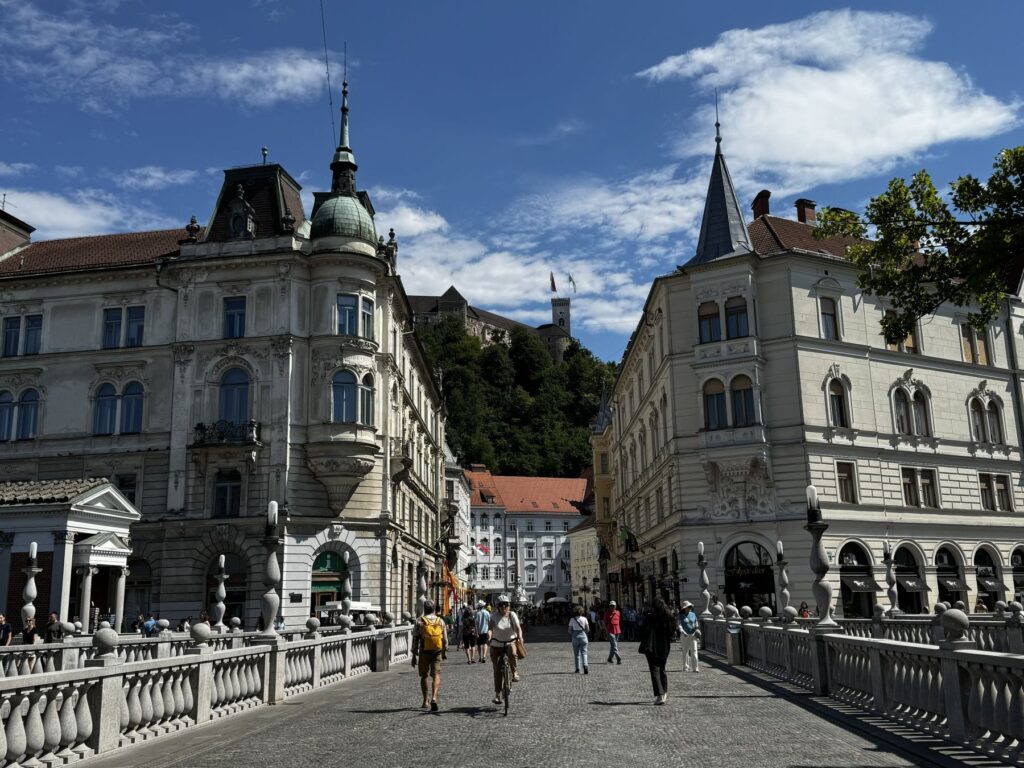
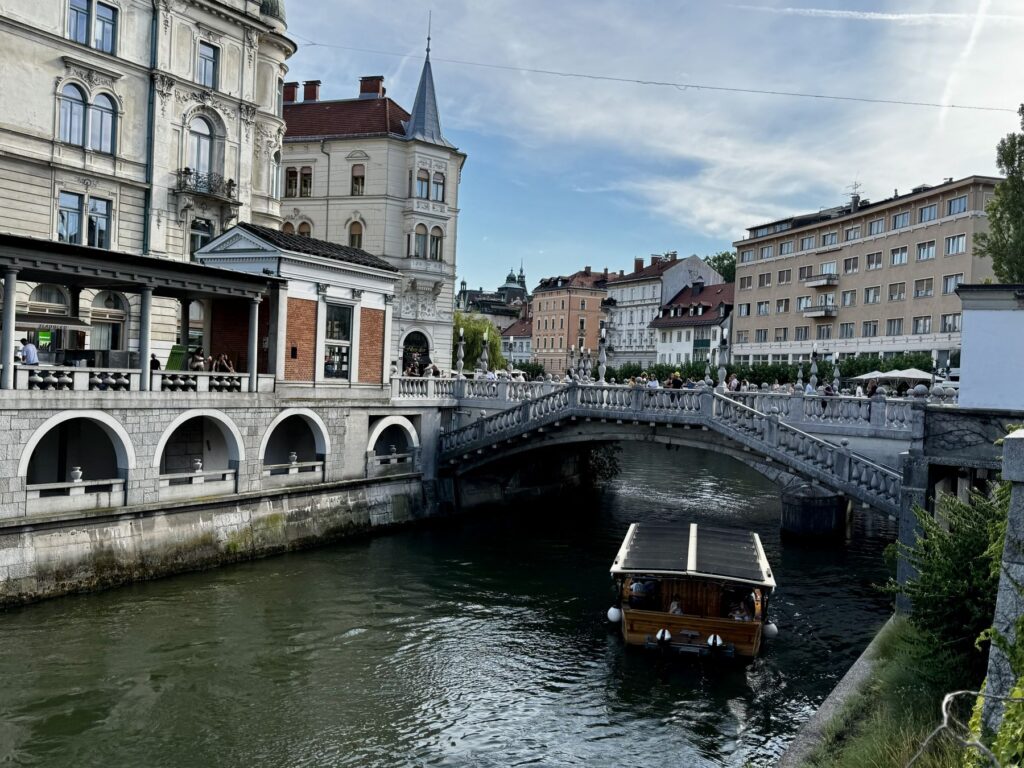
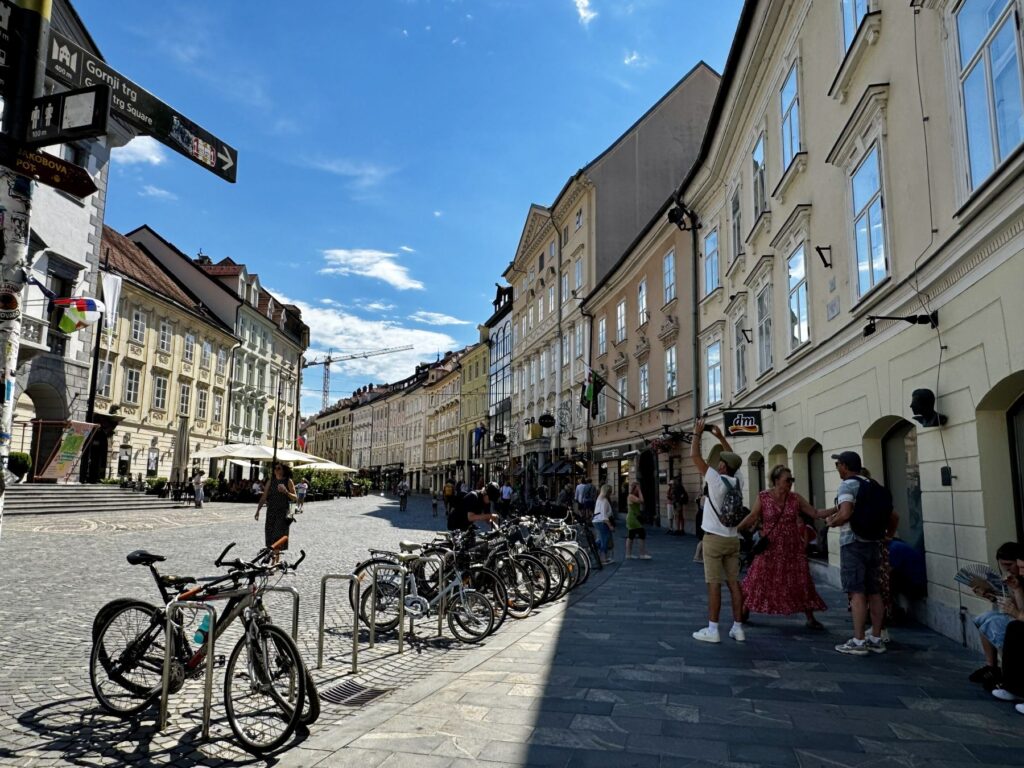
We spent the afternoon wandering through the narrow streets, browsing local shops as we went. At one point, the irresistible aroma drifting from a nearby pastry shop lured us inside, where we purchased a potica to share. Potica is Slovenia’s traditional festive pastry, made from a rich, sweet yeast dough rolled paper-thin, spread with a flavorful filling, and carefully rolled into a spiral before being baked in a special tube pan similar to a Bundt pan. Fillings range from walnut, poppy seed, and hazelnut to raspberry, tarragon, and cinnamon. We chose the cinnamon variety, and it was absolutely delicious.
Because it was Friday evening, we were fortunate to experience Odprta Kuhna (“Open Kitchen”), Ljubljana’s popular open-air food festival. Every Friday during the warmer months, Pogačar Square transforms into a vibrant culinary marketplace where dozens of Slovenia’s finest chefs, restaurants, and street food vendors showcase an impressive array of local and international cuisine. The festive atmosphere was enhanced by live music from a DJ, making it a wonderful place to soak in the city’s energy. For dinner, I chose a flavorful shawarma plate, followed by a refreshing scoop of lemon gelato for dessert. As the evening came to a close, we made our way back to the hotel. By then, the effects of jet lag were catching up with us, and an early bedtime was the perfect way to end our first day in beautiful Slovenia.
Day 2 Ljubljana Castle
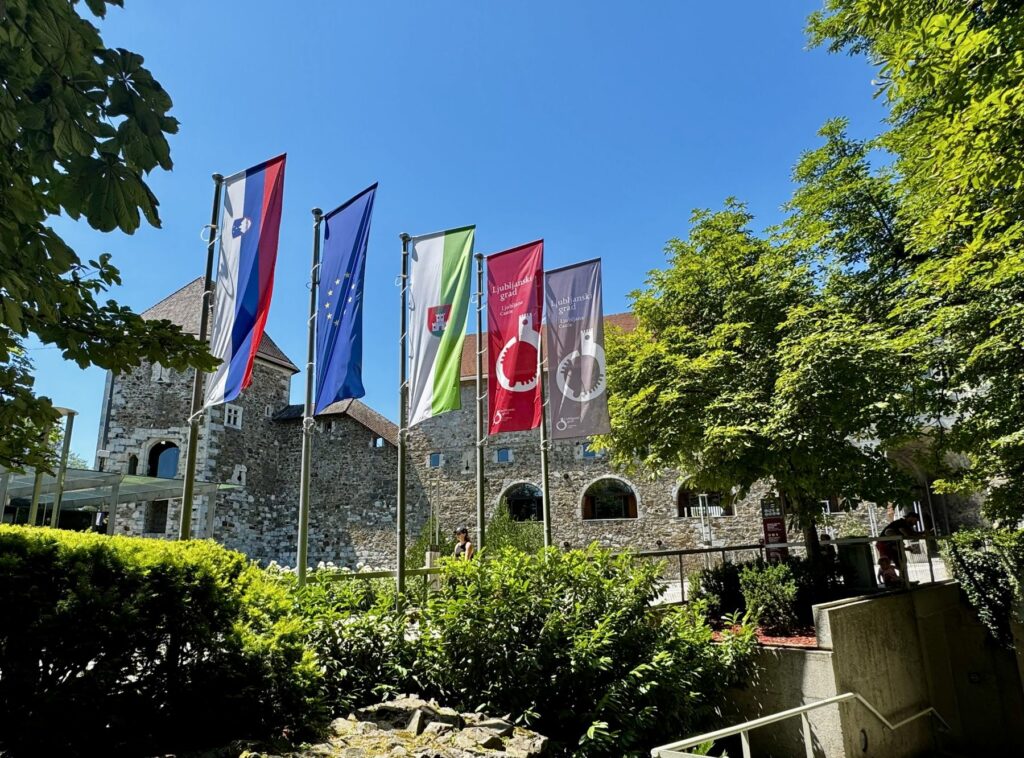
Today was a welcome day of leisure, with no scheduled activities until 5:00 p.m., when we would meet the rest of our Explorer Chick group. We began the morning by enjoying the hotel’s excellent complimentary breakfast buffet before deciding to visit Ljubljana Castle, which sits atop a hill overlooking the city.
It was a beautiful, sunny day, with temperatures climbing into the 80s. The uphill walk to the castle provided an early taste of the climbs that awaited us later in the trip. We purchased the comprehensive admission ticket for €19, which included access to all of the exhibits as well as an audio tour.
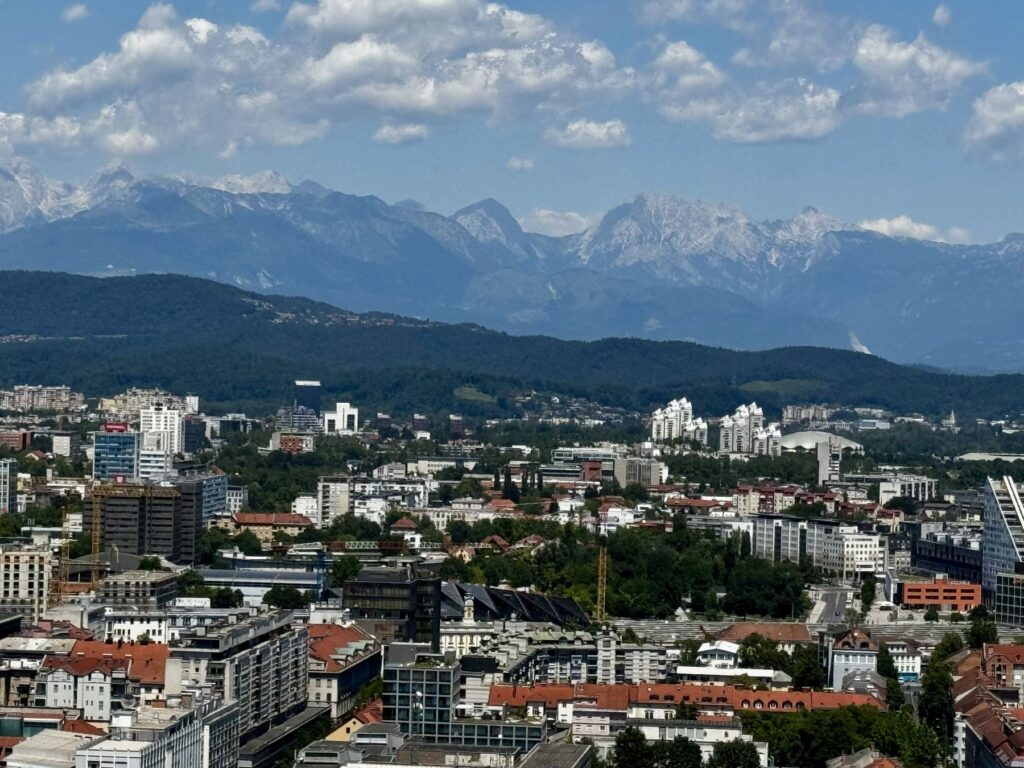
The castle offered sweeping panoramic views of Ljubljana and the surrounding mountain ranges, making the climb well worth the effort. Near the entrance stands a grapevine planted in 1990 as a symbol of friendship between the cities of Ljubljana and Maribor. The vine is a cutting from the world’s oldest cultivated grapevine, which is more than 400 years old and still bears fruit today.
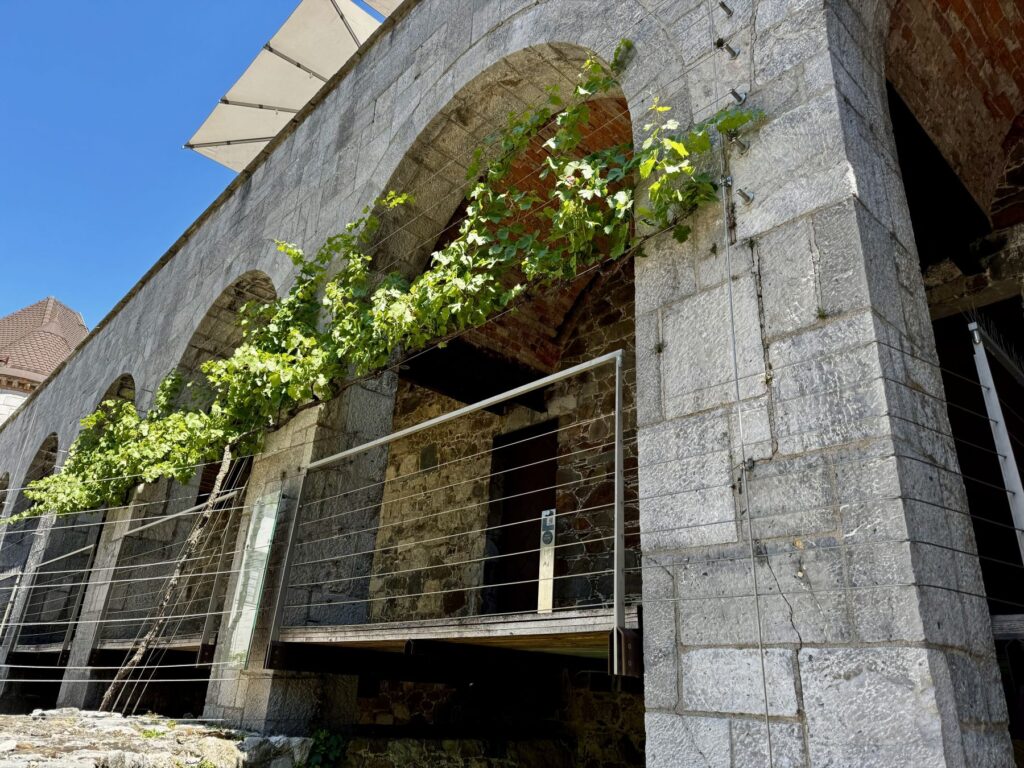
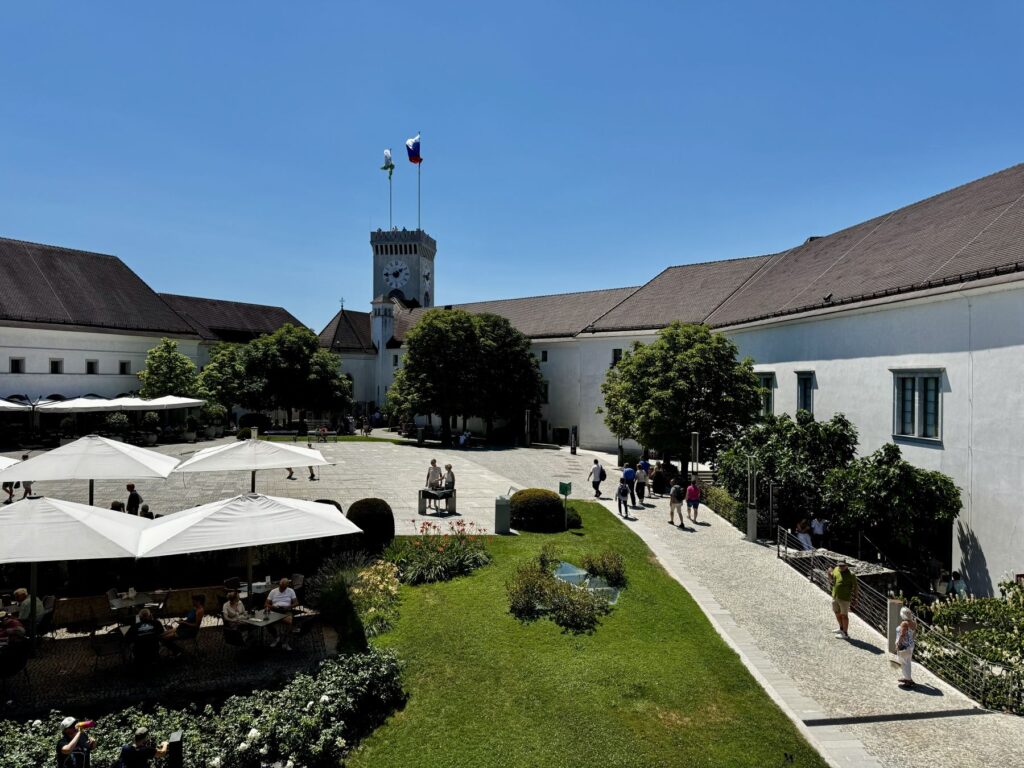
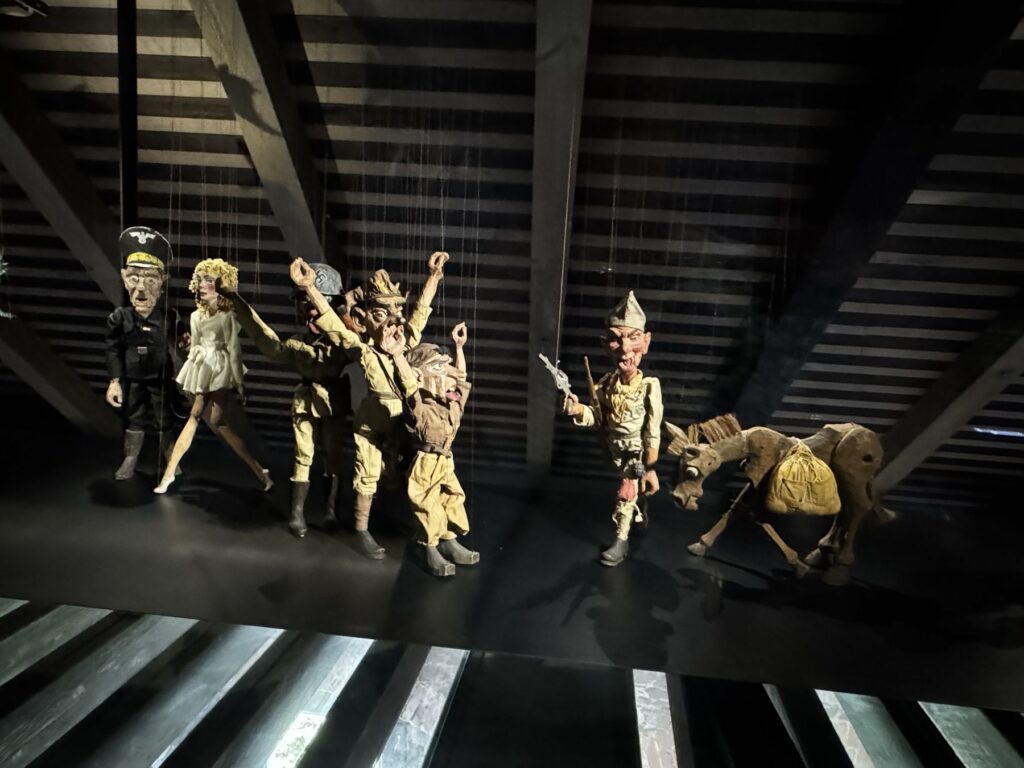
Inside the castle, we explored several fascinating exhibits, including a small history museum, a charming chapel, and the former prison cells. There was even a Museum of Puppetry—something I never imagined could fill an entire museum. Surprisingly, it was both engaging and informative, offering an appreciation for an art form I had previously overlooked.
My favorite exhibit, however, was a photography collection by renowned Slovenian photojournalist and expedition photographer Arne Hodalič. Hodalič was the first Slovenian photographer to have one of his images featured on the cover of National Geographic. His work documents indigenous communities, social issues, and human rights, while he is also internationally recognized for his breathtaking photography taken deep inside caves and at submerged archaeological sites. His images were both visually stunning and deeply thought-provoking.
Later that afternoon, we treated ourselves to gelato before returning to the hotel. I took advantage of the cool, air-conditioned room for a short nap while Sandy remained in the Old Town to do a little shopping. The hotel’s air conditioning was an unexpected luxury, as many European hotels do not offer it, and it was especially welcome after spending the afternoon in the summer heat.
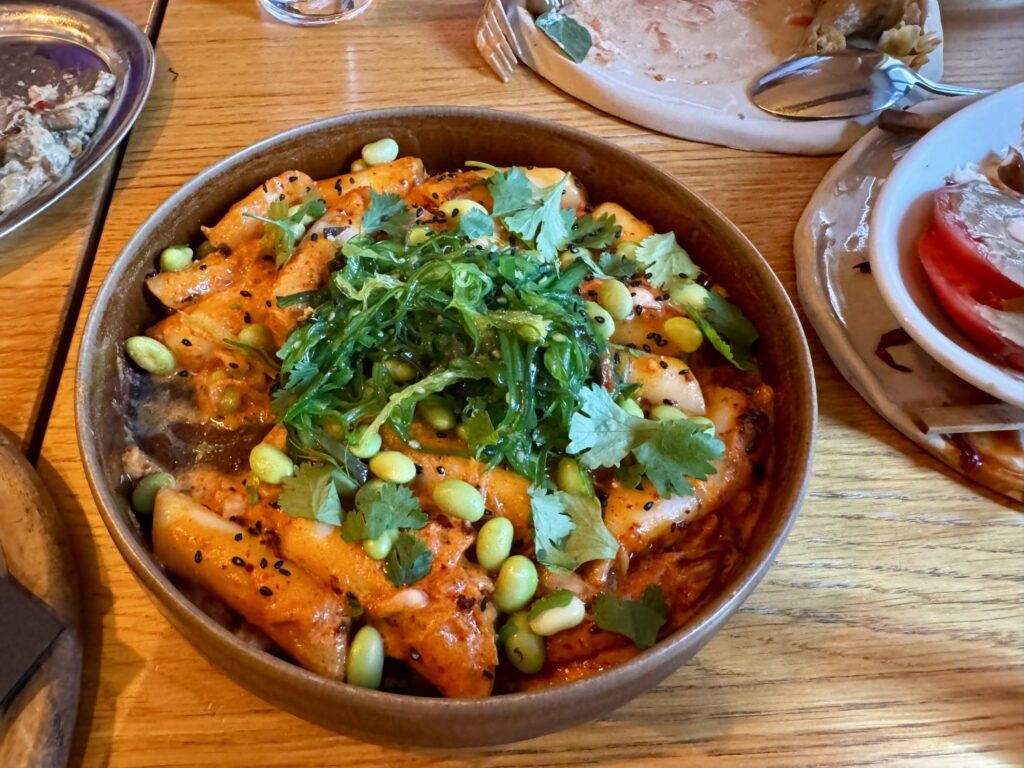
At 5:00 p.m., we gathered in the hotel lobby to meet our Explorer Chick group. We headed up to the second-floor terrace, where we introduced ourselves and received an overview of the adventures awaiting us over the next eight days. Following our introductions, we hiked back up to Ljubljana Castle by a different route, stopping along the way for a few group photos before descending into the Old Town for dinner. That evening’s meal was at Veganika, a vegan restaurant. As a self-proclaimed carnivore with very little experience eating vegan cuisine, I was admittedly a bit apprehensive. Fortunately, my concerns quickly disappeared. Dinner was served family style, beginning with a vibrant beet soup, followed by an assortment of creative tapas-style dishes. Although I couldn’t identify many of the ingredients, everything was flavorful and beautifully prepared. Dessert was a delicious vegan pistachio ice cream served with mango—a fitting end to an unexpectedly enjoyable meal. After dinner, we returned to the hotel, where Mary offered to do quick backpack checks to ensure everyone was properly packed for the trek ahead. With everything in order, we turned in early, excited for the beginning of our three-day trek the following morning.
Day 3 Blato Trailhead to the Vodnikov Dom mountain hut (6.5 miles)
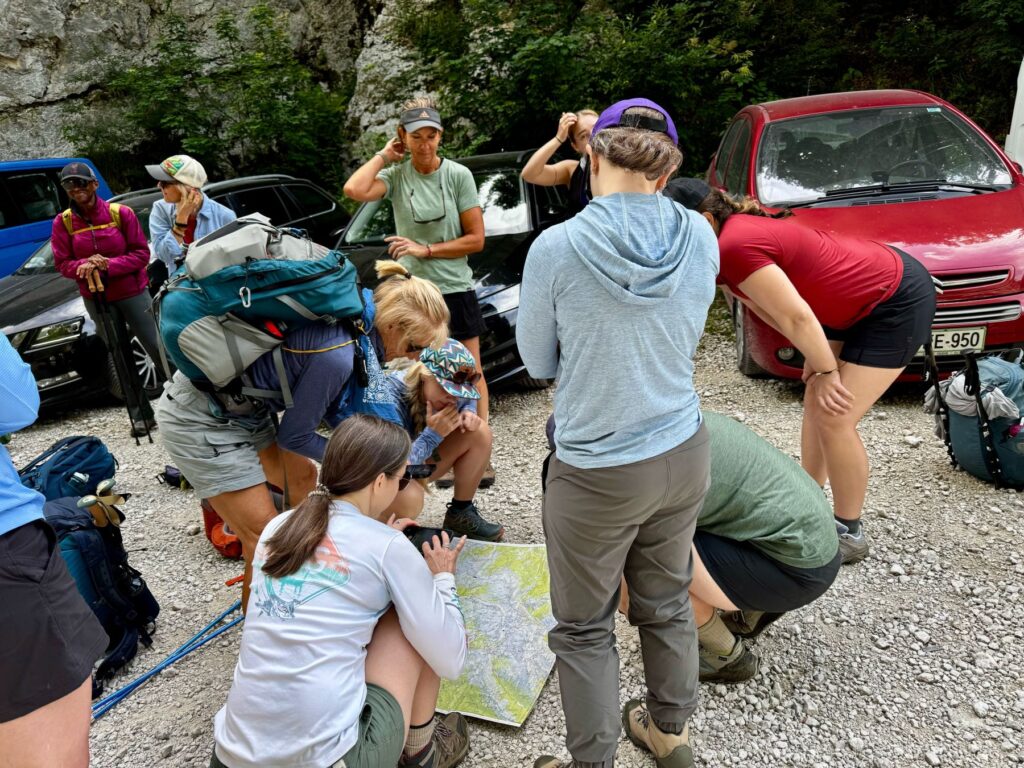
Our first trekking day began with an early wake-up call at 6:30 a.m. By 8:00 a.m.we had departed Ljubljana on our way to Lake Bohinj. After dropping off our luggage at Hotel Bohinj, we continued another 20 minutes up a steep, winding mountain road to the Blato Trailhead, where our adventure truly began. Shortly after 10:00 a.m., we took our first steps onto the trail.
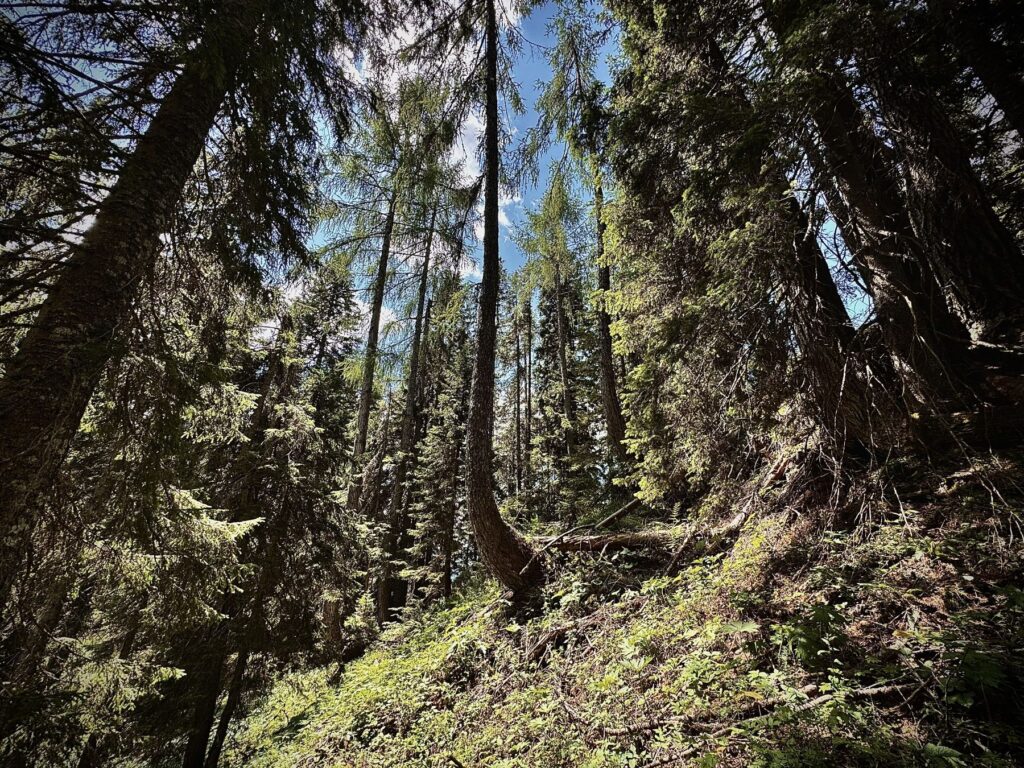
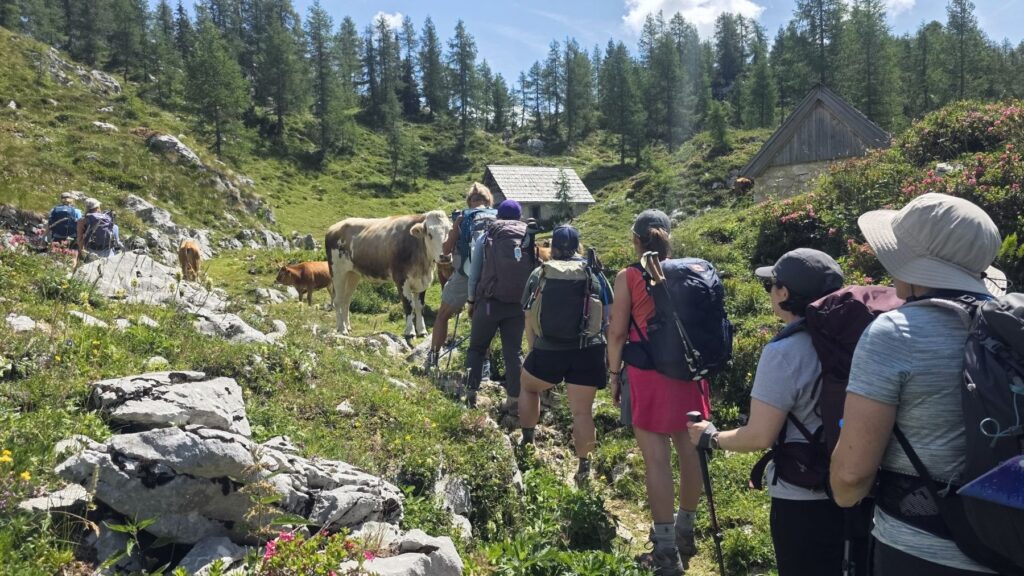
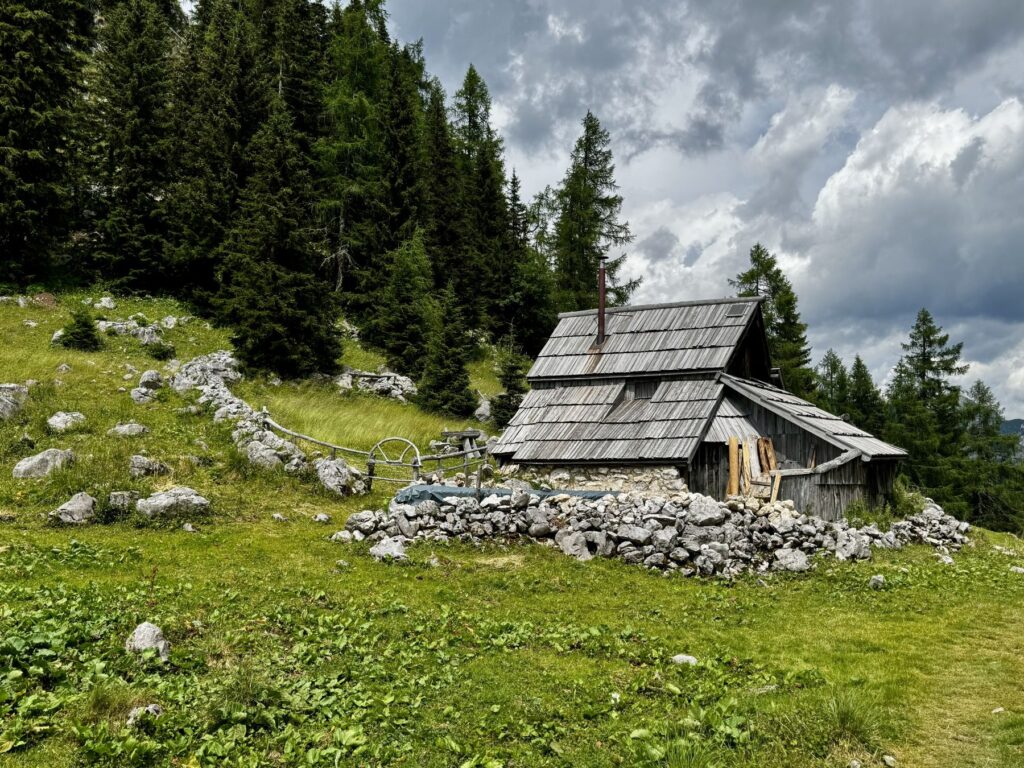
The hike began beneath the cool canopy of a forest, and almost immediately we were greeted by an abundance of colorful wildflowers. It didn’t take long to realize why Slovenia is considered one of Europe’s botanical treasures. We stopped for lunch at the Krstenica Dairy Hut, beautifully situated in the middle of a vibrant alpine meadow. While we were eating, a nearby water trough was filled, and before long cows began appearing from seemingly every direction, making their way across the meadow for a drink. Watching them slowly gather around us added a memorable touch to the lunch stop. Before we continued on our way, the owner of the dairy hut gave us a fascinating demonstration explaining the traditional methods used to produce the cheeses made there.
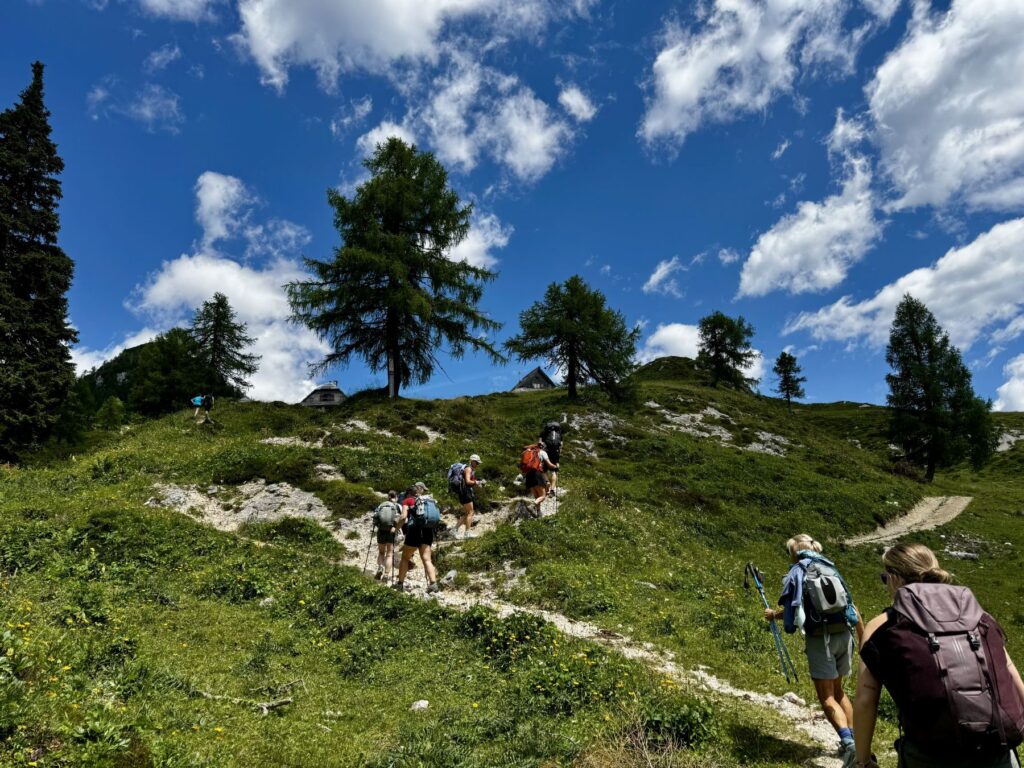
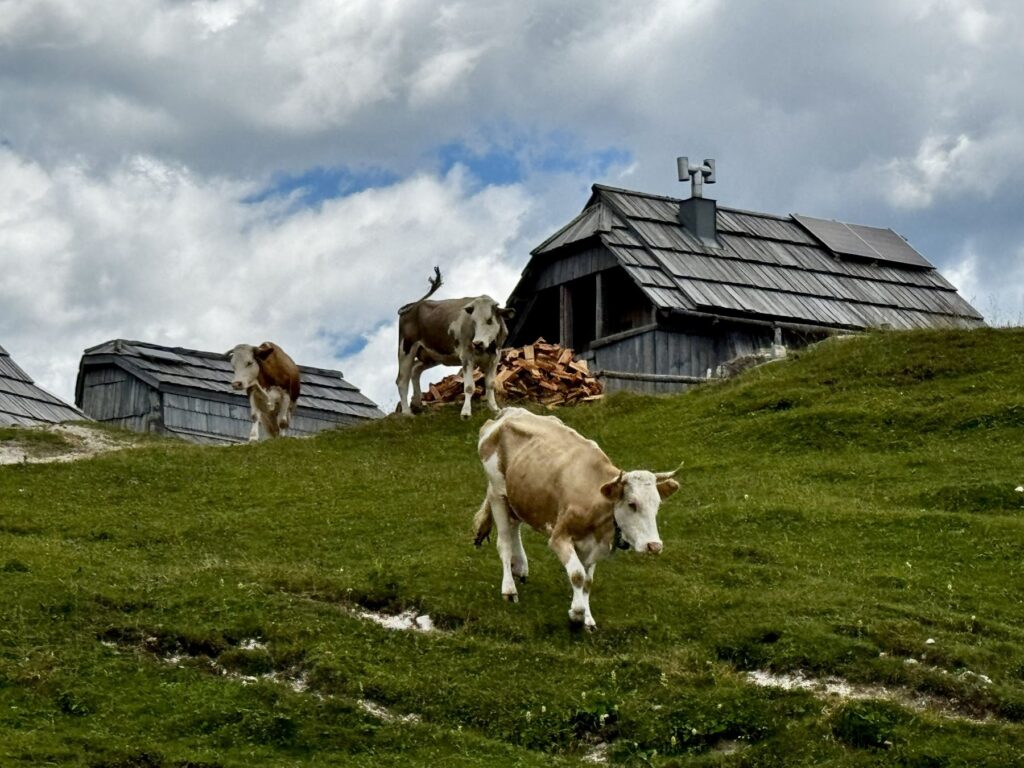
The afternoon’s hike carried us through one spectacular wildflower meadow after another, punctuated by several more encounters with grazing cows. Although the scenery was breathtaking, there was still a considerable amount of elevation to gain before reaching our destination. After tackling a long series of steep, grassy switchbacks, most of our group chose to take a short detour to a rocky summit. The extra climb was rewarded with magnificent panoramic views of the surrounding Julian Alps, including our first glimpse of Vodnikov Dom, the mountain hut where we would spend the night.
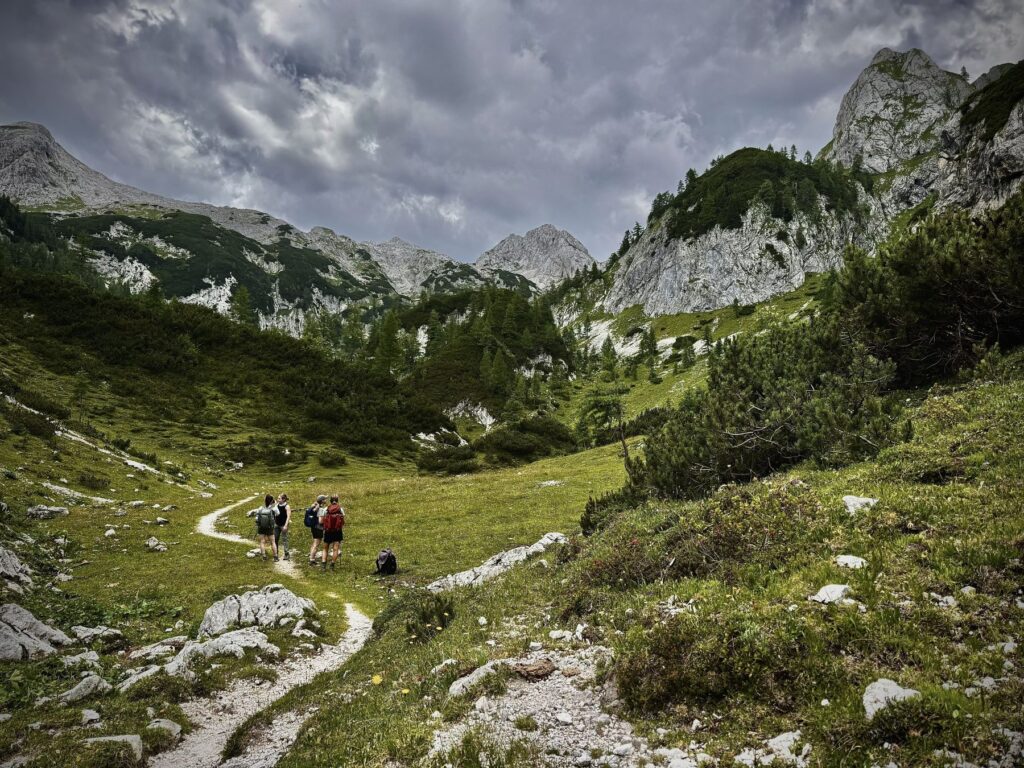
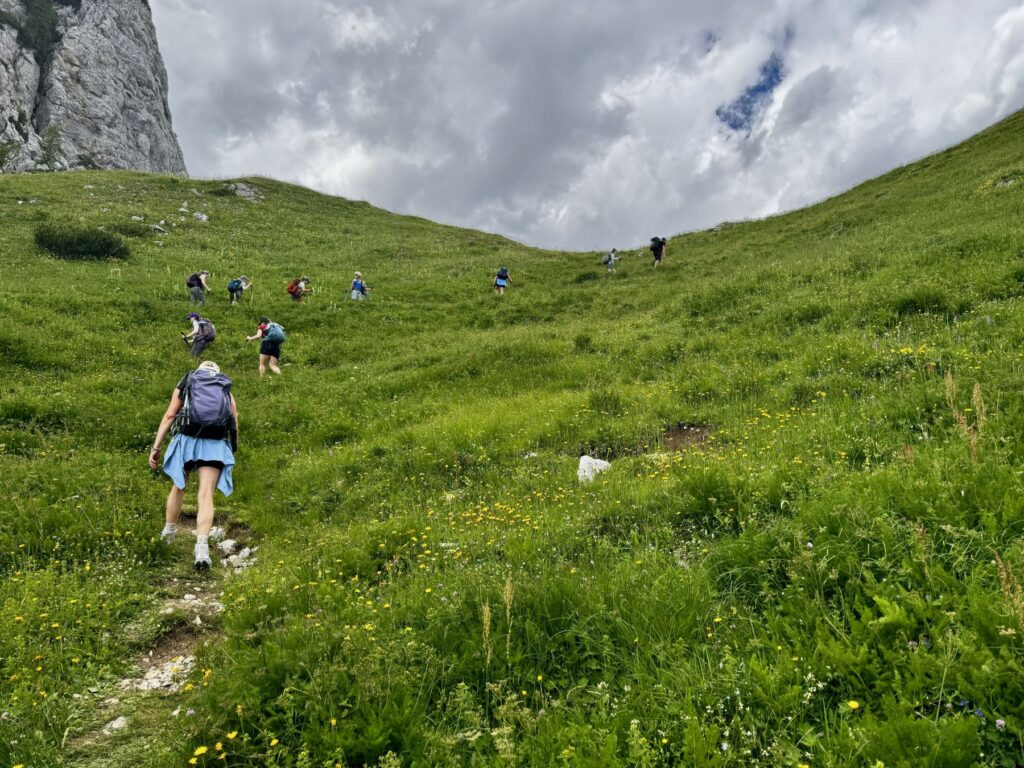
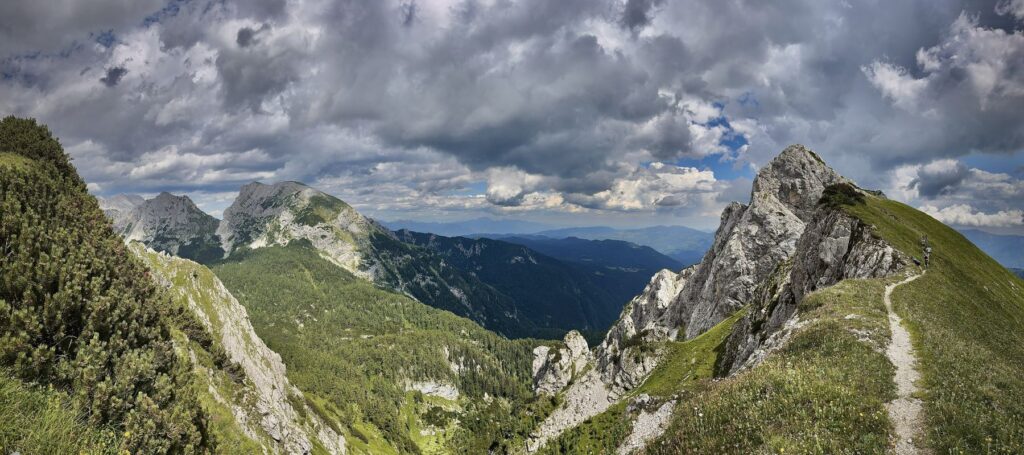
From there, the trail descended for a time before leveling out, offering a welcome reprieve. Eventually, however, we reached one final steep climb that tested our tired legs before delivering us to Vodnikov Dom at approximately 5:45 p.m.
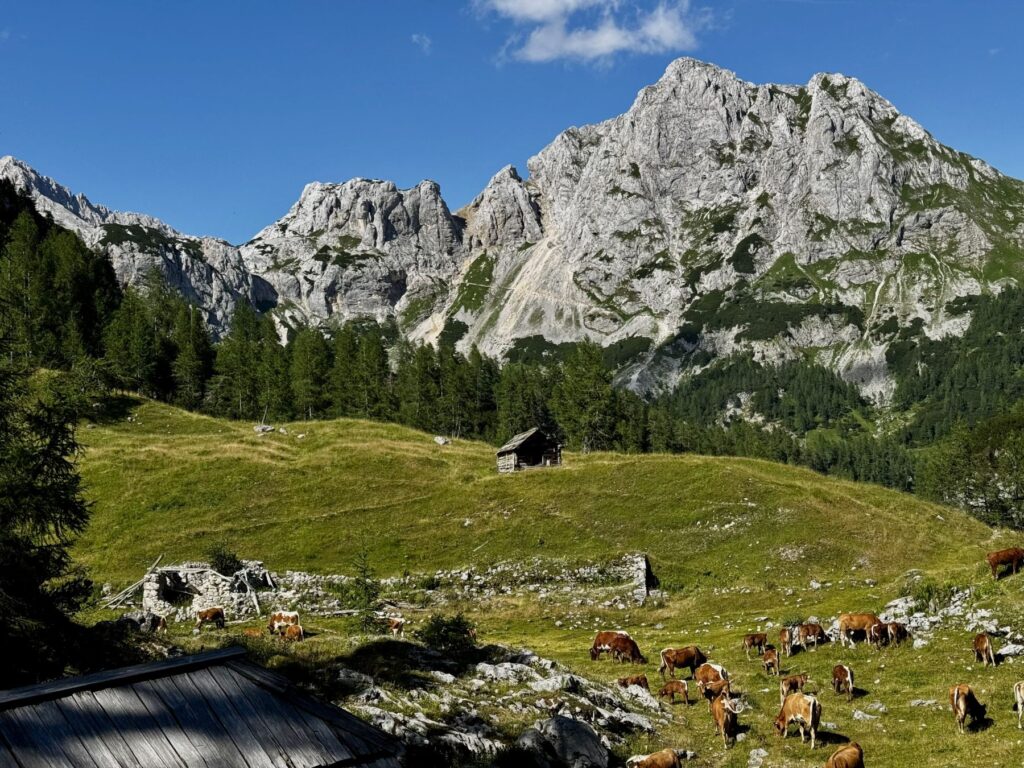
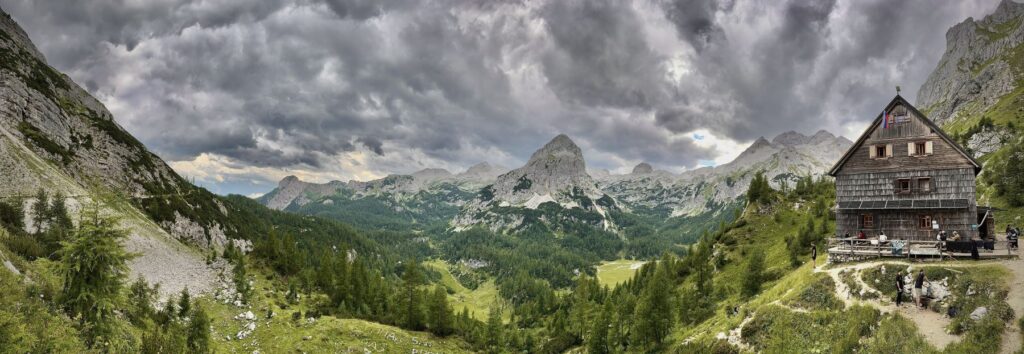
After settling in, dinner was a hearty plate of pasta with meat sauce, followed by a slice of delicious poppy seed cake for dessert. The accommodations were simple but comfortable by mountain-hut standards. We stayed in dormitory-style rooms, each furnished with three sets of bunk beds. The hut also featured two flush toilets and a shared washroom. Hot showers were available costing €10 for four minutes.
Day 4 Vodnikov Dom to Prehodavcih Mountain Hut (8 miles, 2800′ gain, 2100′ loss)
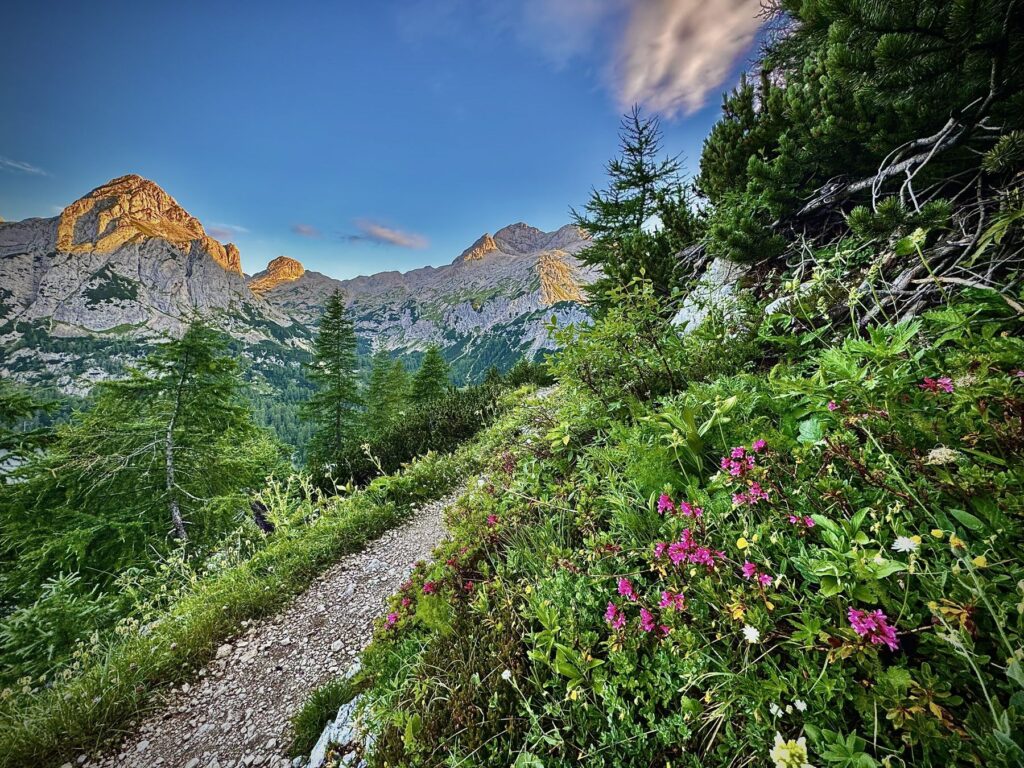
I woke at 5:45 a.m. and, unable to fall back asleep, decided to take a solo half-mile walk from the mountain hut. The early morning views were breathtaking. Wisps of low-lying clouds drifted through the valley below, while the surrounding peaks glowed softly in the first light of day. It was a peaceful start to what would become one of the most challenging days of our trek.
After a standard mountain hut breakfast of fresh bread, cured meats, cheeses, and scrambled eggs, we set back out on the trail at 8:00 a.m. Today’s route would lead us into a landscape that looked remarkably like the surface of the moon. The morning began with familiar forests and alpine meadows, and during one of our rest stops, Aljaž shared the Slovenian legend of the Goldenhorn—a magnificent white chamois (or Alpine ibex) whose blood gave rise to the magical Triglav flower. Today, the Goldenhorn serves as the emblem of one of Slovenia’s most popular beers, Laško, which was available at every mountain hut we visited.
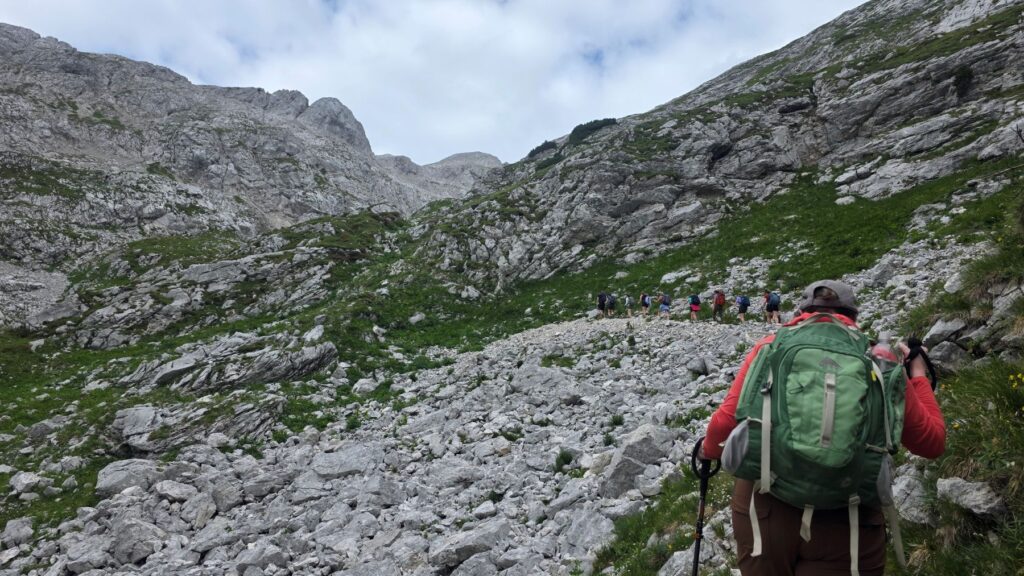
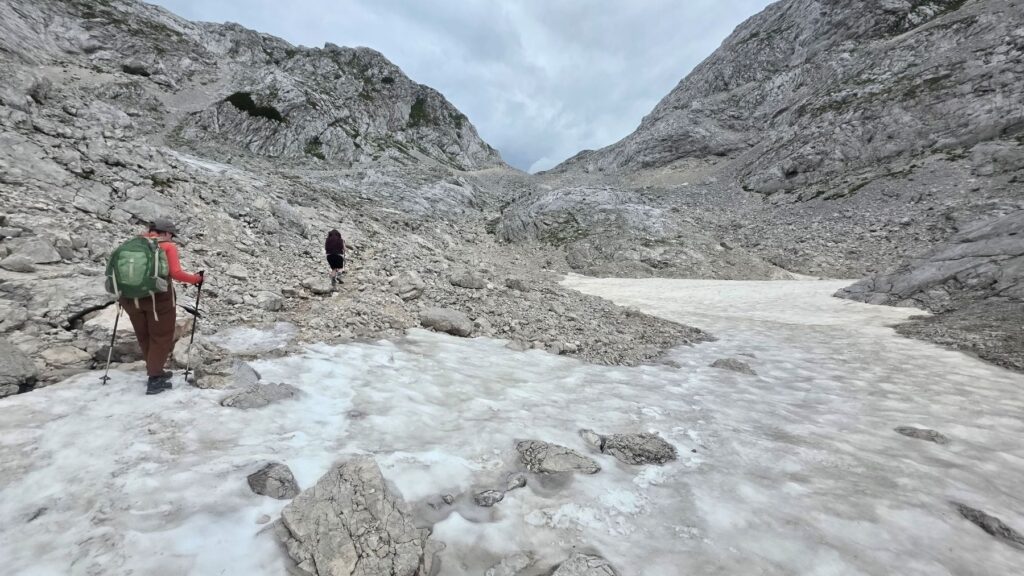
As we continued climbing, the scenery gradually transformed. The lush green meadows gave way to barren slopes of loose rock, patches of lingering snow, and expansive scree fields. At one snowfield, several of the women couldn’t resist the opportunity to go body sledding, adding a bit of laughter to the day’s increasingly rugged terrain.
By midday we reached Koča na Doliču, where we stopped for lunch. I enjoyed a hearty bowl of barley soup with ham, followed by another slice of poppy seed cake. Unfortunately, this version wasn’t nearly as good as the one I’d had the previous day. The hut overlooked the stunning Soča Valley, where we would be hiking later in the week, offering us our first glimpse of the landscape that lay ahead.
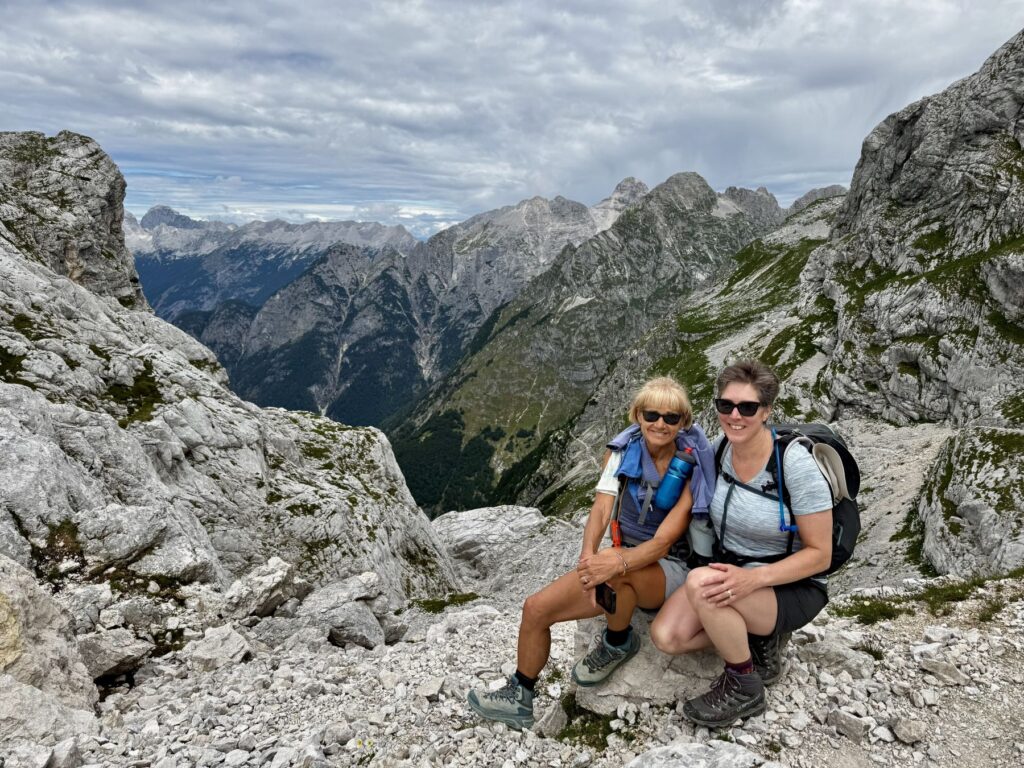
The afternoon promised to be the most demanding section of the entire trek as we climbed over the Čez Hribarice Pass at 7,736 feet. By now we were well above the tree line, traversing steep slopes covered almost entirely in loose scree. Up to this point, Aljaž had been leading our hikes, setting a wonderfully steady pace while Mary brought up the rear. After lunch, however, they switched positions, and Mary’s pace was noticeably quicker.
Almost immediately we found ourselves tackling an exceptionally steep series of switchbacks carved into the unstable scree. For every two steps I managed to climb, it felt as though I slid back a foot. It was exhausting work. The reward came when we spotted our first ibex of the trip—a magnificent male standing high on a rocky ridge, his enormous curved horns silhouetted against the sky.
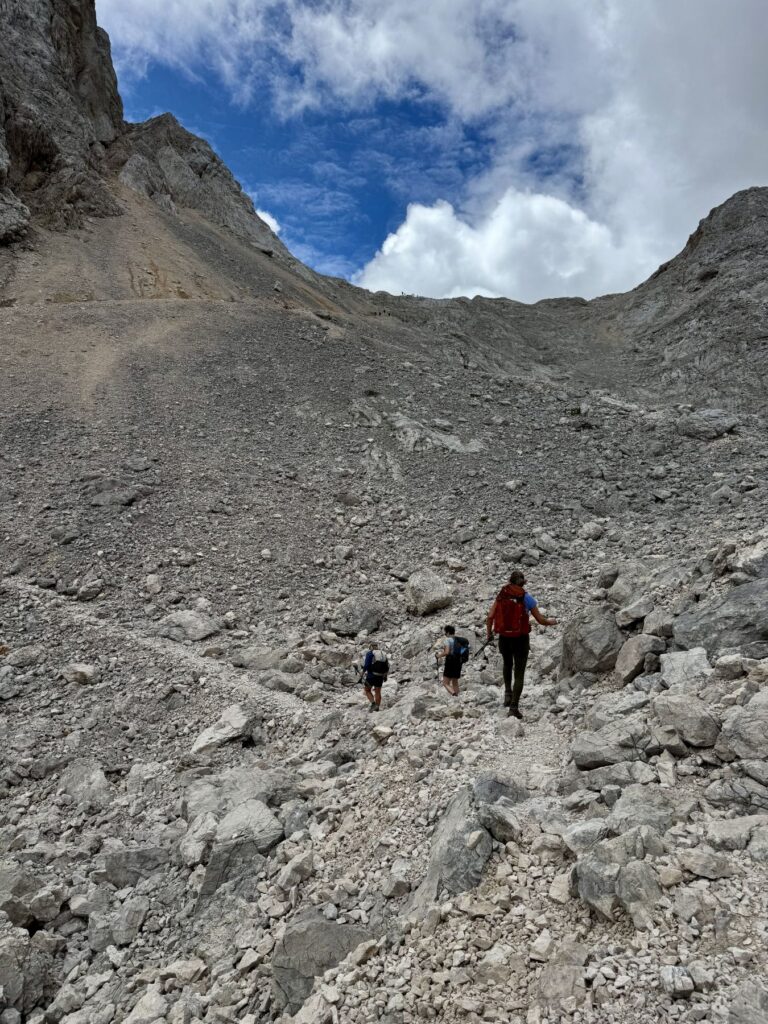
When we finally reached the top of the pass, our group divided in two. Aljaž led five of the Explorer Chicks along the lower route, while Mary guided the remaining nine of us on an optional ascent of Mount Kanjavec, Slovenia’s 14th-highest peak at 8,428 feet. I chose the summit route.
The climb to Mount Kanjavec was tremendous fun, involving several sections of scrambling that made the ascent both challenging and exciting. Once on the ridge, we were rewarded with spectacular panoramic views, and the ridge walk itself was one of my favorite parts of the entire trek.
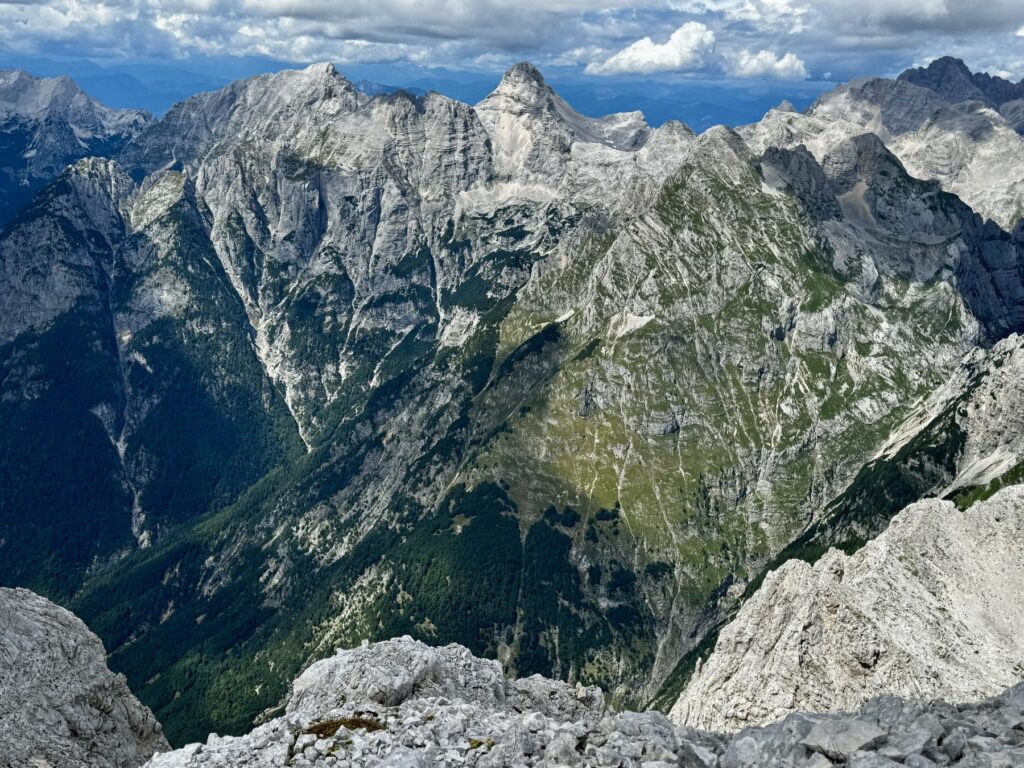
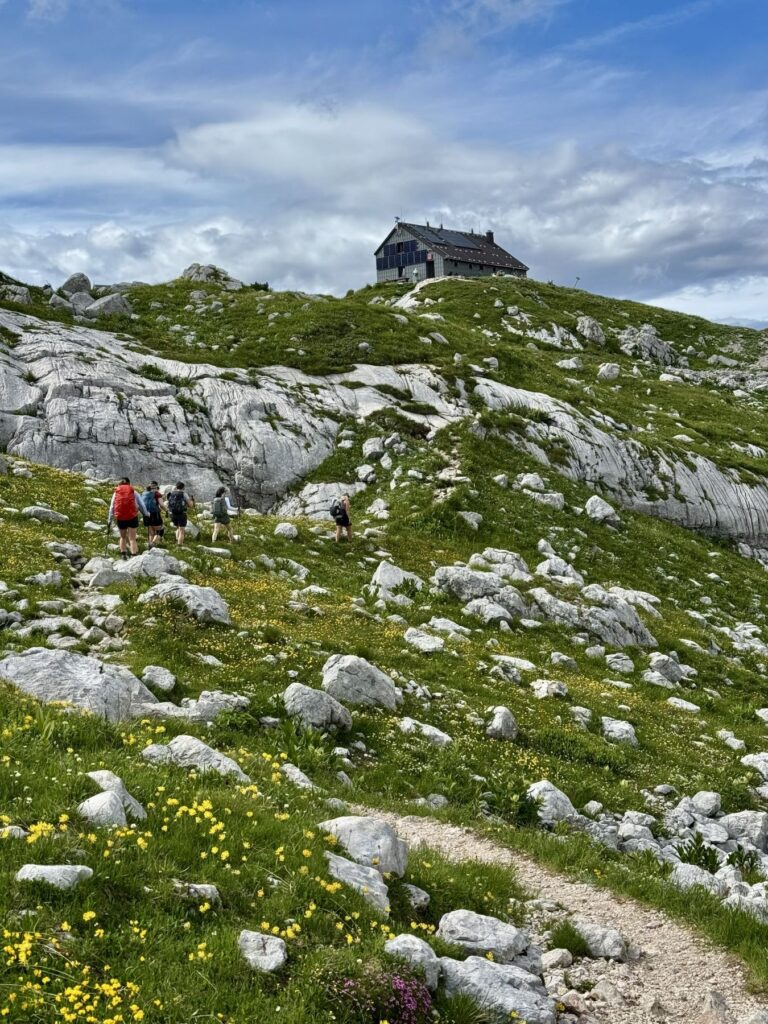
Eventually it was time to descend, and the long, punishing downhill seemed to go on forever. About halfway down, we encountered roughly fifteen minutes of light rain before tackling one final steep ascent to our lodging for the night, Zasavska koča na Prehodavcih. The Prehodavcih Mountain Hut was considerably more rustic than the hut where we had stayed the previous evening. The sleeping quarters consisted of a single large room on the second floor with about thirty bunk beds. There was no running water, and the pit toilets were located a fair distance from the hut. Between 10:00 p.m. and 6:00 a.m., however, there was a small indoor bathroom available on the first floor.
Day 5 Valley of the Seven Lakes Hike (9 miles, 3450′ loss)
Our earliest morning of the trek began with a 5:30 a.m. wake-up call. By 6:00 a.m., we were back on the trail, setting out along the Valley of the Seven Lakes Trail for the return journey to the Blato Trailhead, where our adventure had begun.
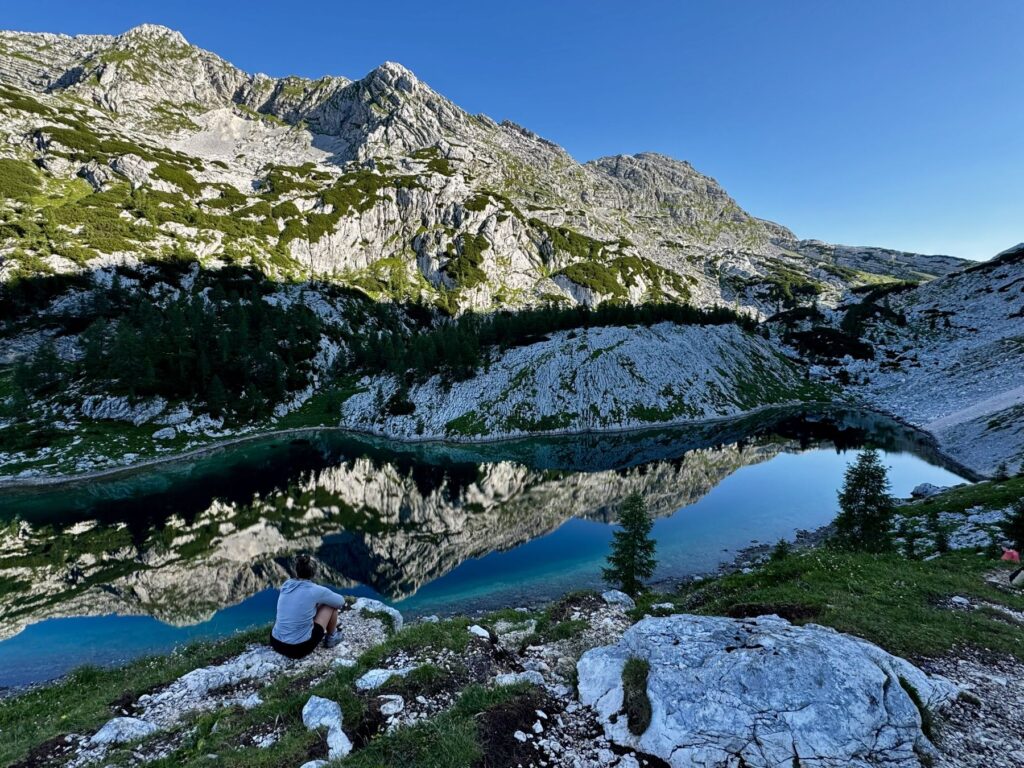
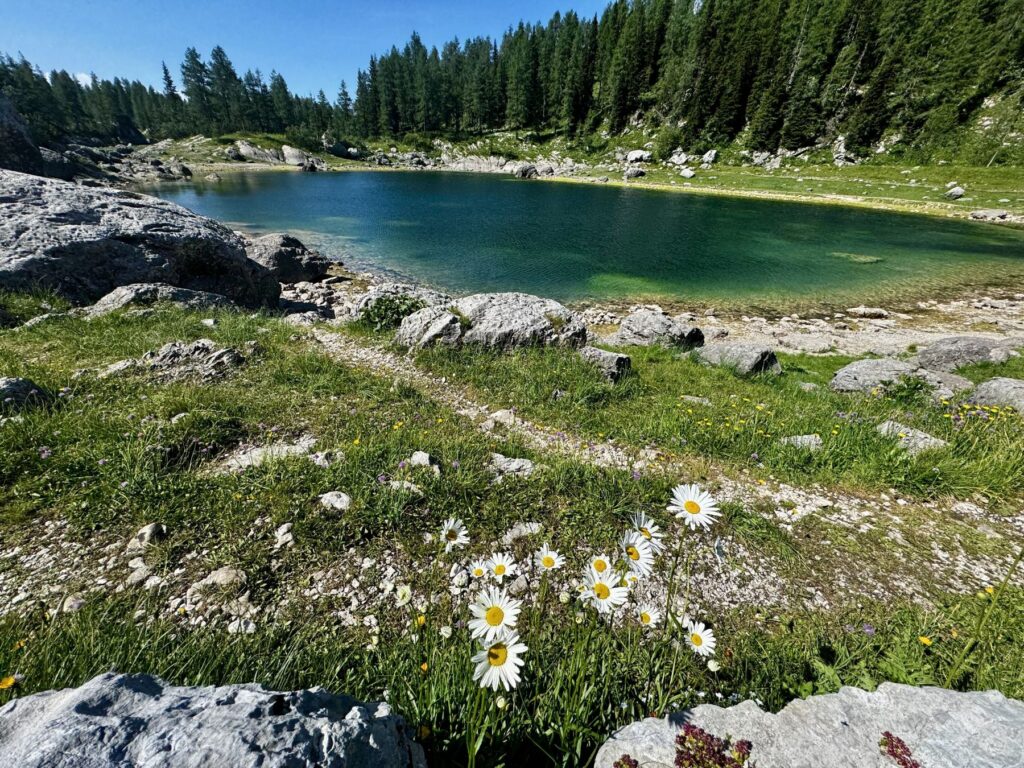
The first two lakes, visible from our mountain hut, were noticeably smaller than usual due to lack of rain and a relatively light snowfall during the previous winter. The trail began in open alpine terrain, offering sweeping vistas in every direction. For the first stretch, the walking was gentle, with mostly level ground and a gradual descent.
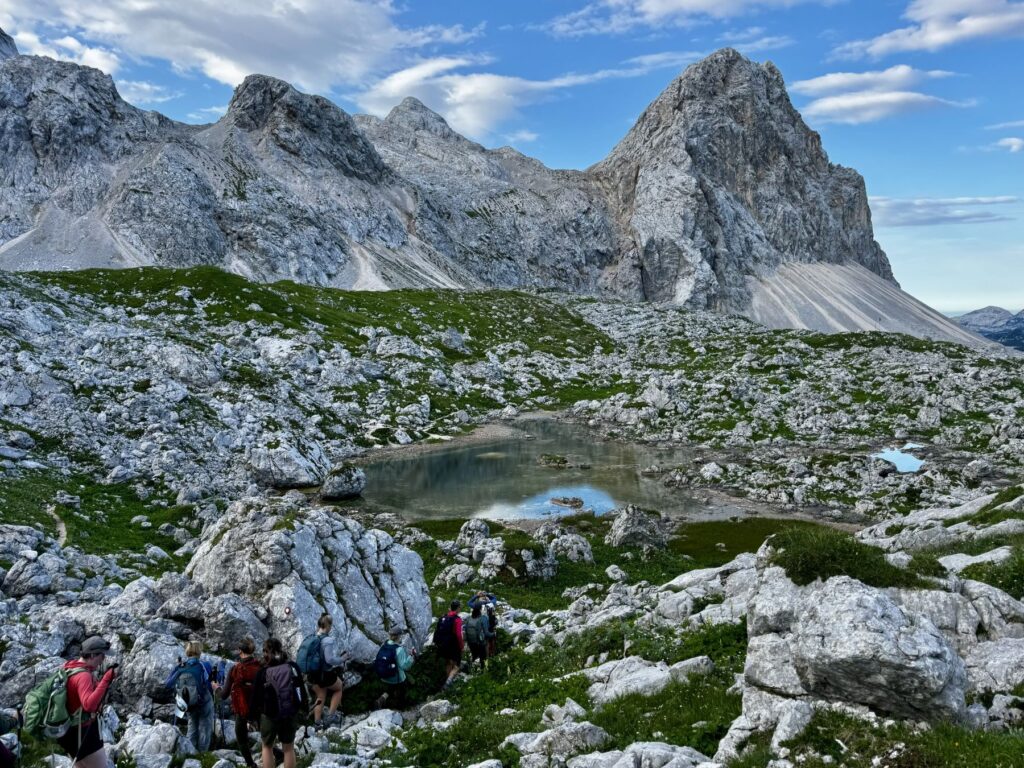
The fourth lake was the largest and, in my opinion, the most spectacular of the seven. Its crystal-clear waters perfectly mirrored the surrounding mountains and forests, creating breathtaking reflections from every angle. We lingered there for quite some time, soaking in the scenery and capturing countless photographs.
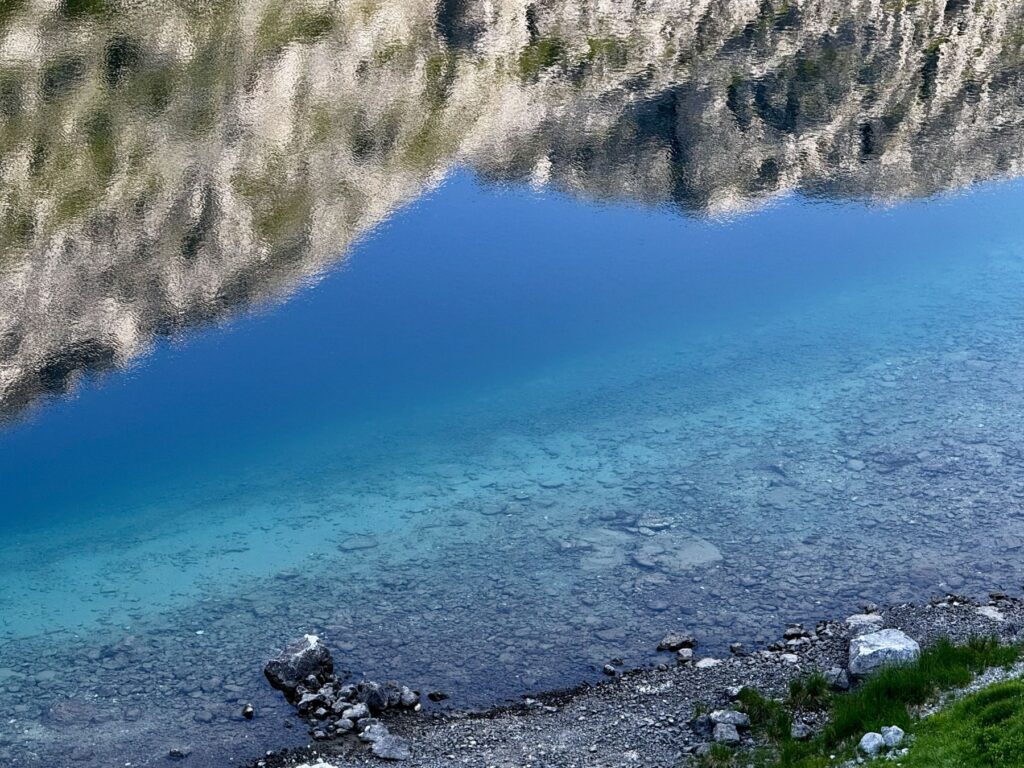
Roughly three hours into the hike, we arrived at the fifth lake, situated beside the Koča pri Triglavskih jezerih mountain hut. We reached the hut just before 9:00 a.m.—perfect timing for breakfast. Fresh coffee and an irresistible assortment of pastries awaited us. Mary ordered a generous selection of tiramisu, apple strudels, and blueberry strudels for everyone to share, and every bite was delicious. Equally exciting was the discovery that this hut had flush toilets—a luxury we had all come to appreciate.
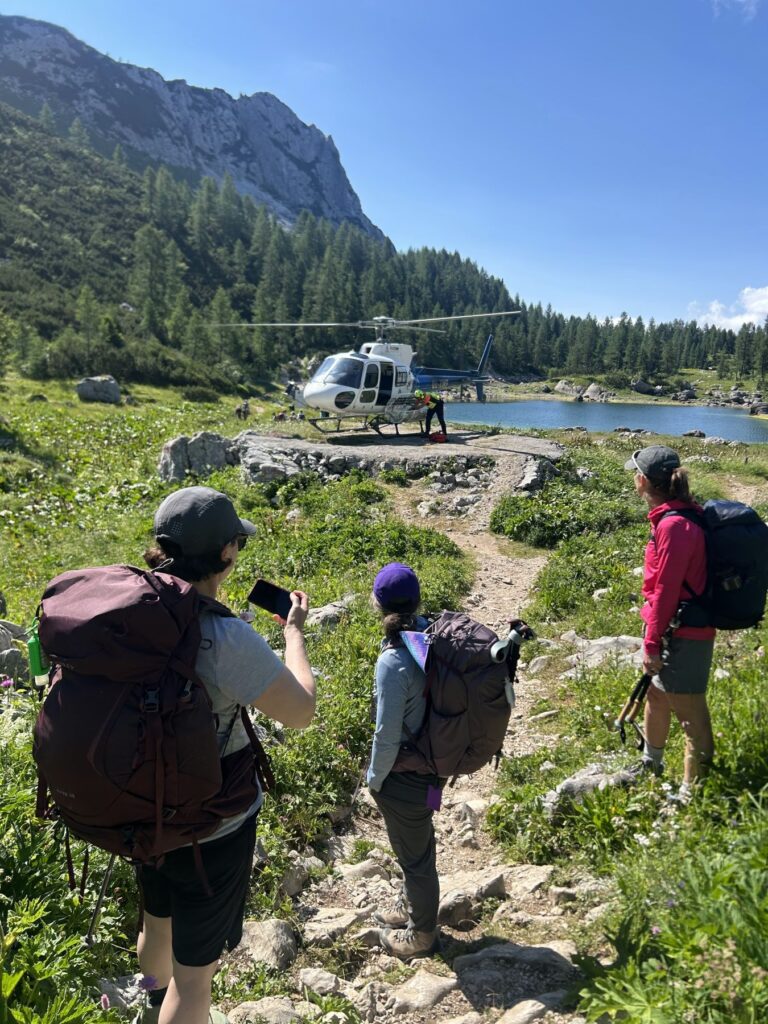
After an extended break, we resumed our descent. The trail crossed directly over the hut’s helicopter landing pad, and just as our group was making its way across, a supply helicopter suddenly descended to land, splitting our group in two. Mountain huts receive deliveries by helicopter once a week, as there are no roads leading to them. Flight time is extremely expensive, and the pilots do not delay landings for hikers.
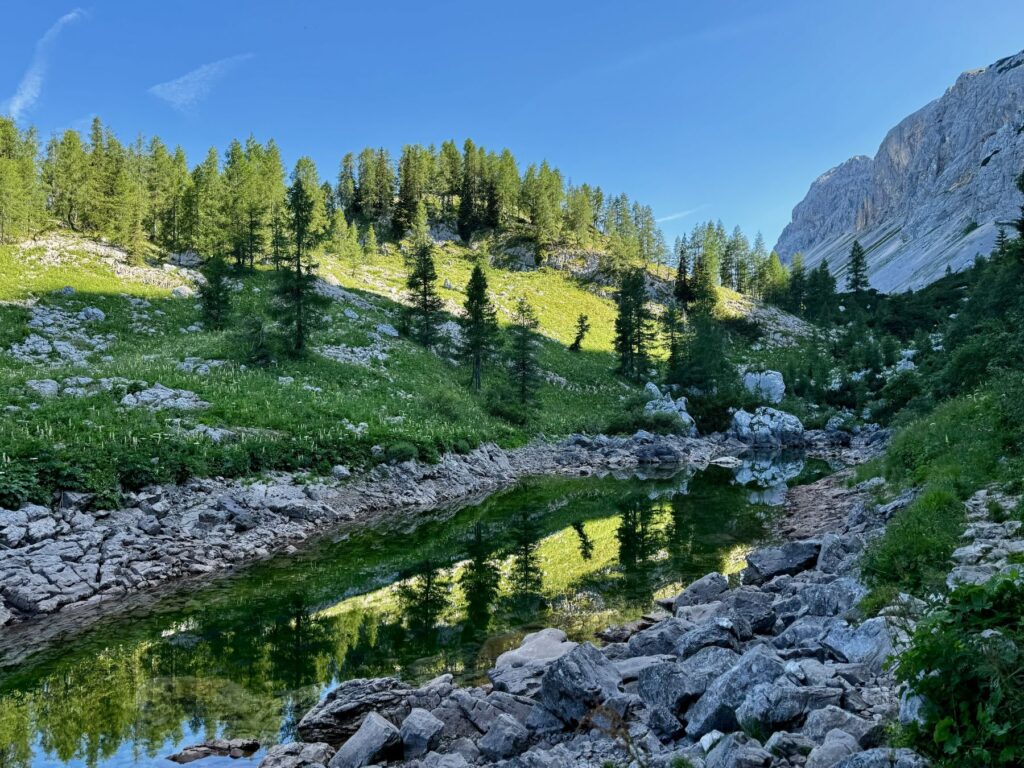
Beyond the hut, we passed the 6th lake, whose brilliant emerald-green waters contrasted beautifully with the surrounding fields of wildflowers. The trail meandered through colorful alpine meadows before descending once again into the forest. We later crossed a mountain pasture, where our group enjoyed a memorable—and very close—encounter with a herd of curious cows.
After another 2¾ hours of hiking, we arrived at Bregarjevo zavetišče na Planini Viševnik hut for lunch. The meal began with hearty barley soup with meat—far more soup than I ever imagined eating during the summer! Dessert, however, more than made up for it, with delicate crêpes topped with either warm chocolate sauce or berries. Over dessert, Aljaž treated us to a fascinating history lesson on Slovenia, adding another layer of appreciation for the country we had spent the past several days exploring.
We left the hut shortly after 2:00 p.m. The final stretch of the trek began through open meadows, where we passed the seventh and final lake before descending into the forest. From there, we followed a dirt and gravel road back to the Blato Trailhead. After a short twenty-minute drive, we arrived back at the four-star Hotel Bohinj and checked in around 4:00 p.m. We had several hours of free time before our 7:00 p.m. dinner reservation. A few of the women took advantage of the hotel’s spa facilities, but I had only one thing on my mind—a long, hot shower after three unforgettable days on the trail. Dinner was at the hotel’s restaurant and before long, it was off to bed once again. Another early morning awaited us, this time for a sunrise paddle across the tranquil waters of Lake Bohinj.
Day 6 Lake Bohinj, Lake Bled, Garden of Tastes, & Slap Peričnik
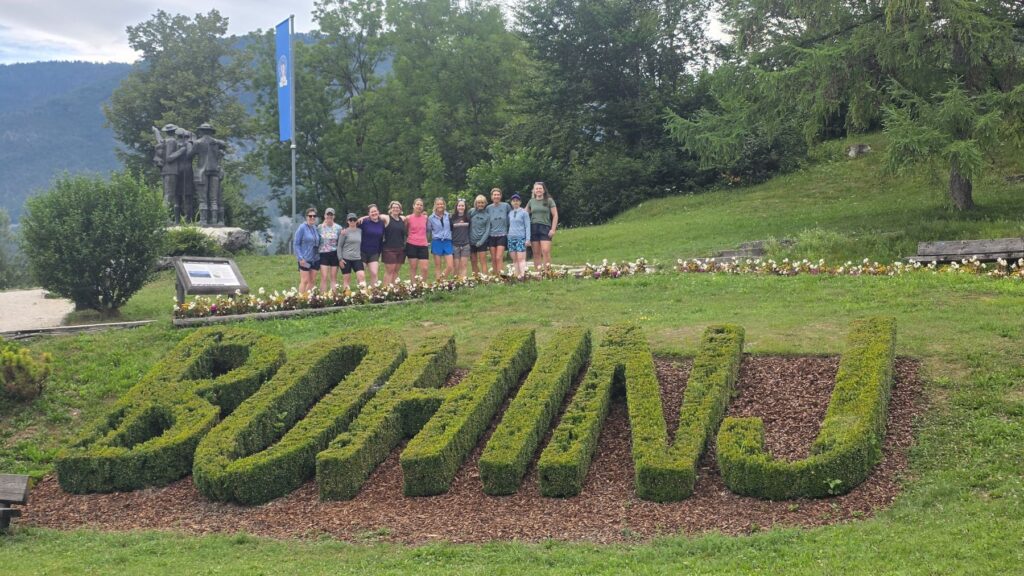
This morning brought yet another early start as we gathered along the shores of Lake Bohinj at 6:30 a.m., ready for a morning on the water. Everyone did remarkably well on the paddleboards, and impressively, not a single person fell into the water. Although the morning sky was overcast and the sun remained hidden behind a blanket of gray clouds, the lake was perfectly calm, creating a peaceful atmosphere.
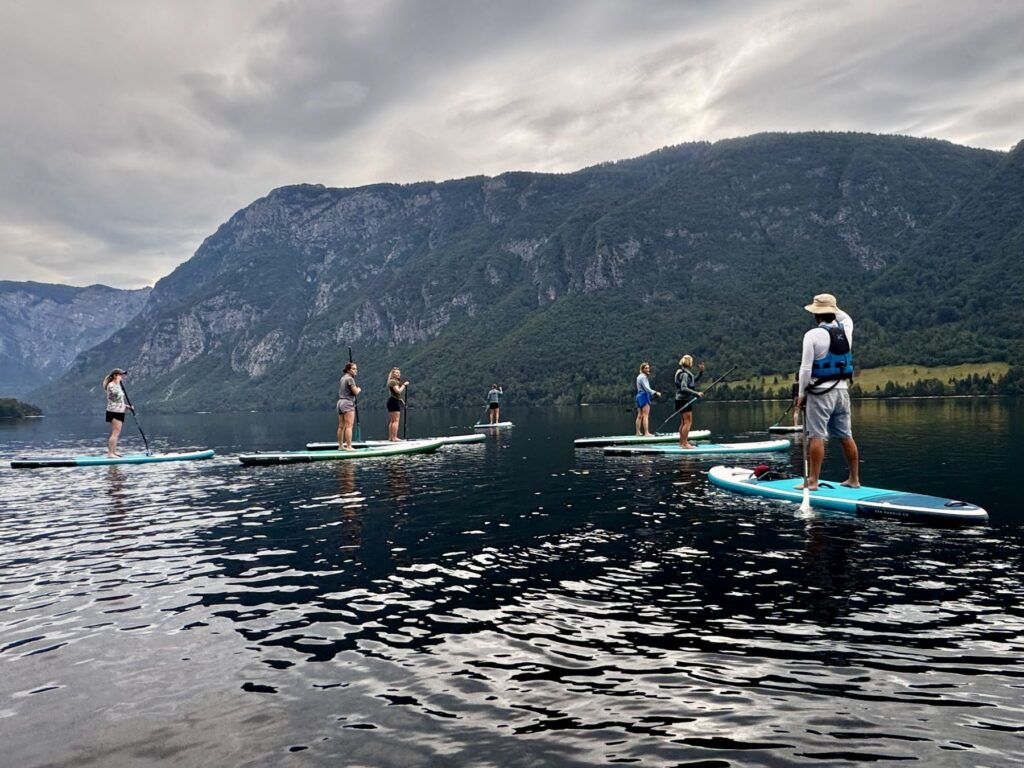
Our paddling adventure concluded around 8:00 a.m. We returned to the hotel to change clothes and enjoy breakfast, where another exceptional buffet awaited us. By 9:30 a.m. we had packed our bags and departed for Lake Bled, about a 45-minute drive away.
After arriving at the Lake Bled parking area, we made a quick stop at the restrooms before setting off on a paved lakeside path that circled the lake in a counterclockwise direction. Soon we reached the trail leading up Mt. Ojstrica. Though relatively short, the climb was exceptionally steep as it wound through the forest to one of Slovenia’s most iconic viewpoints. This was by far the busiest location we encountered during our entire eight-day journey through Slovenia. After spending plenty of time admiring the breathtaking panorama of Lake Bled and its picturesque island while taking countless photographs, we descended back to the lakeshore.
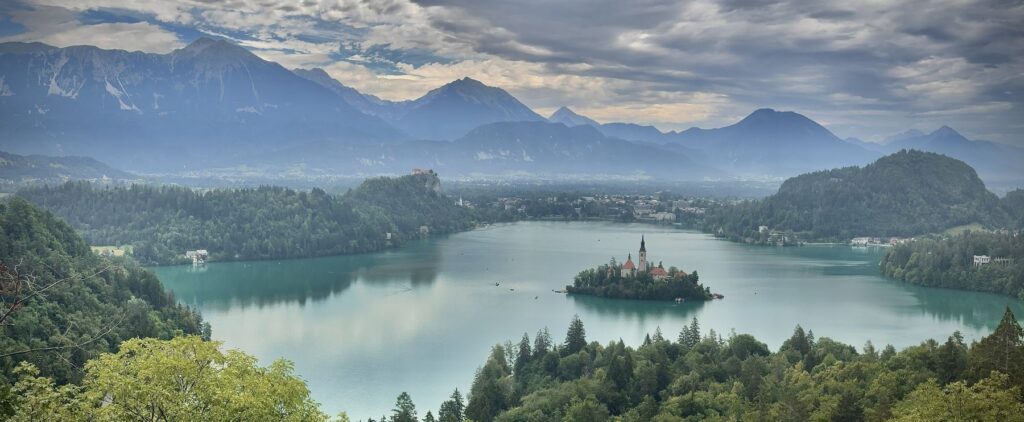
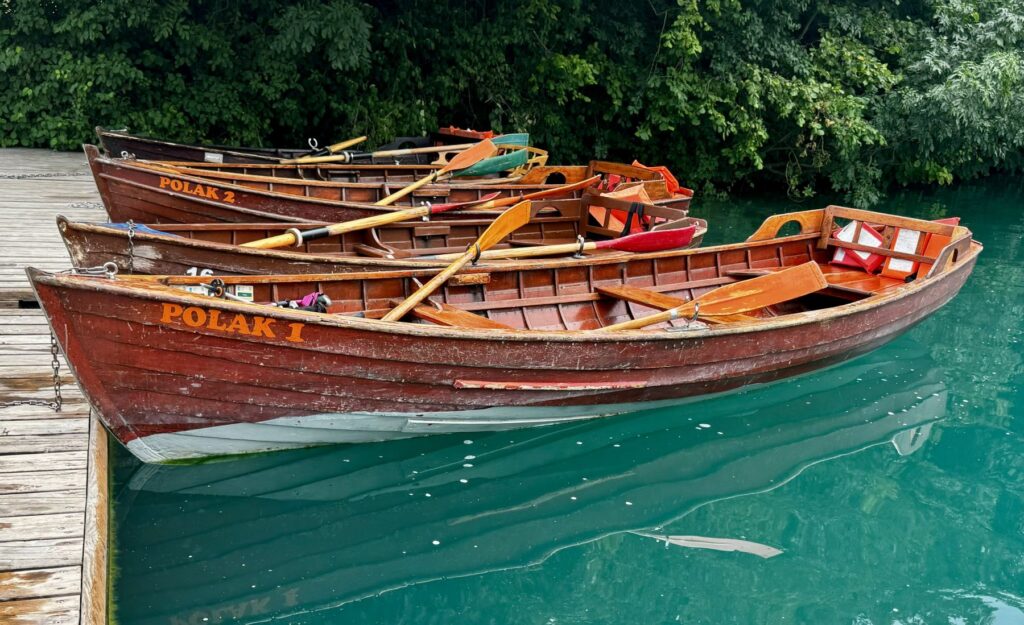
Continuing along the shoreline, we arrived at a dock. There, we boarded rowboats and rowed across the lake to Bled Island, where we spent about forty minutes exploring the Church of the Assumption and browsing the charming gift shop. Legend has it that ringing the church bell grants the ringer’s wish. Throughout our visit, the bell rang almost continuously. I couldn’t help but think that the only wish consistently coming true was the church’s, which collected €5 from every hopeful visitor.
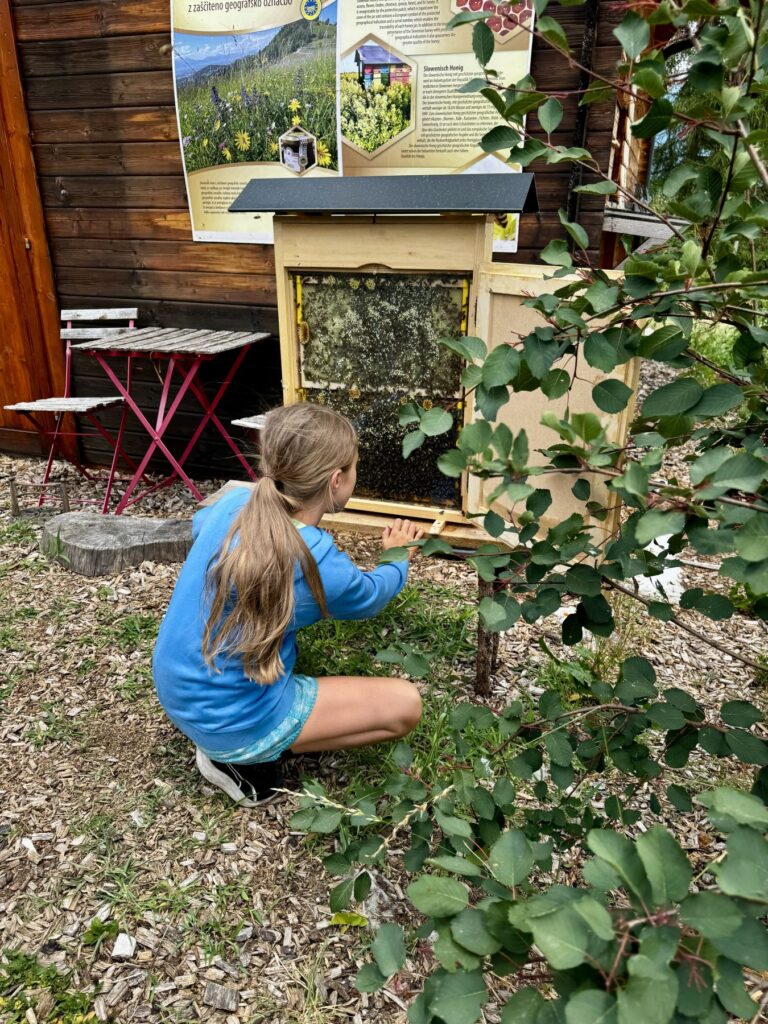
After rowing back to shore, we left Lake Bled and enjoyed a scenic twenty-minute drive through the countryside to Vrt Okusov, or the “Garden of Tastes.” This remarkable farm-to-table experience is owned and operated by Mateja Reš, often affectionately referred to as the “Martha Stewart of Slovenia.” Mateja has authored six cookbooks devoted to healthy eating and sustainable living. Before lunch, we wandered through her beautifully maintained gardens and visited the bee house. Slovenia is world-renowned for its rich beekeeping heritage and is the only European Union country that exclusively permits the breeding of its native Carniolan honey bee (Apis mellifera carnica). Celebrated for their gentle temperament, efficient foraging abilities, and distinctive hive traditions, these bees produce exceptional honey. Slovenian honey is prized worldwide for its remarkable purity, diverse botanical varieties, and rigorous quality standards.
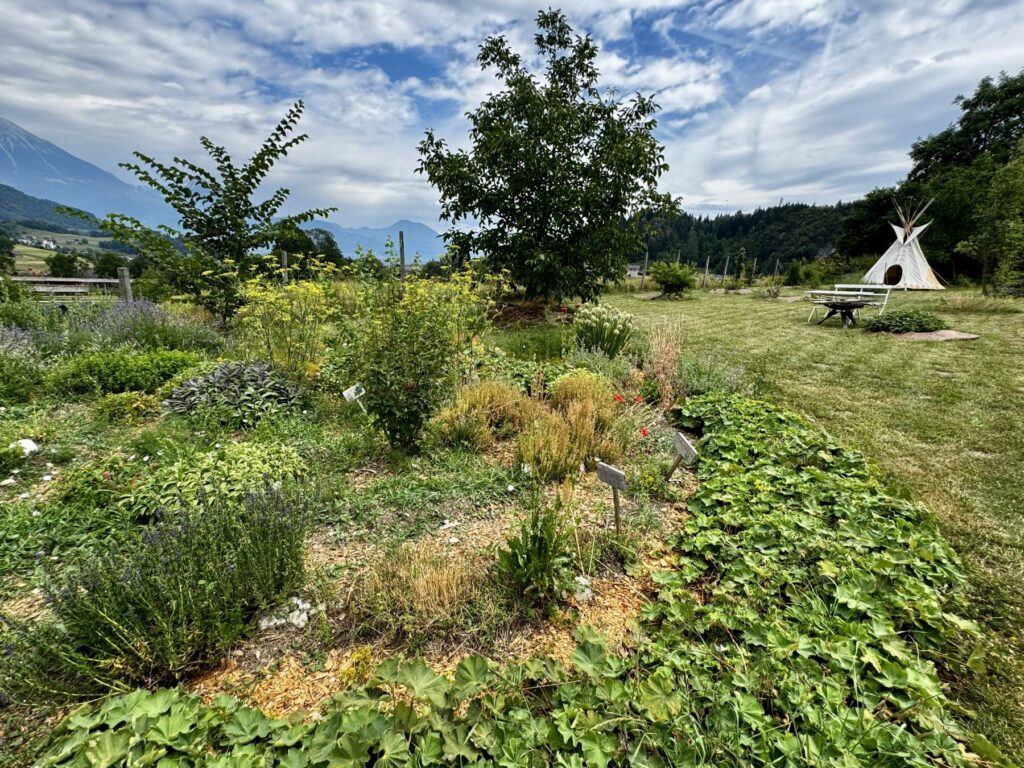
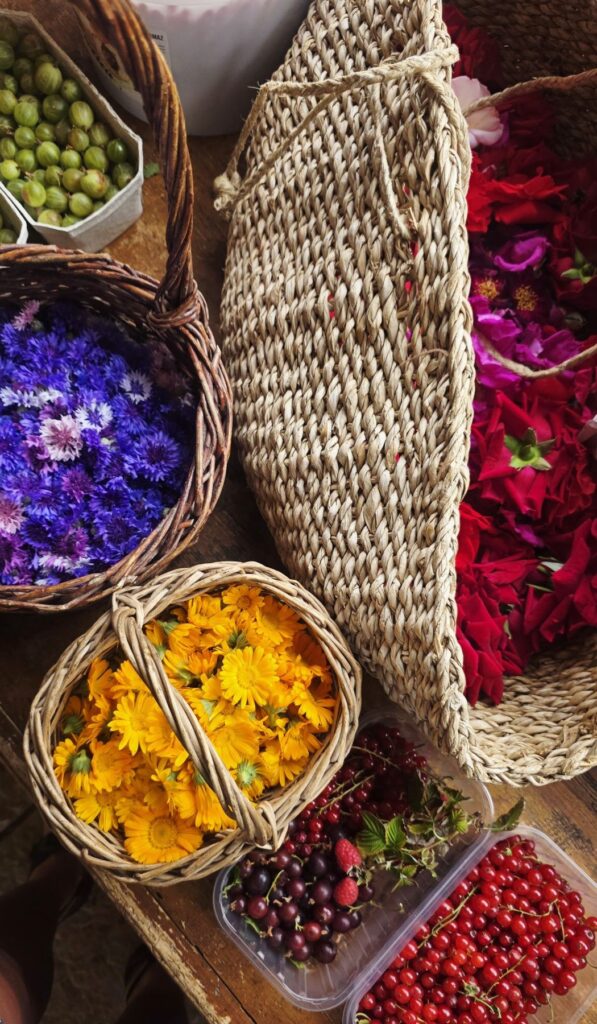
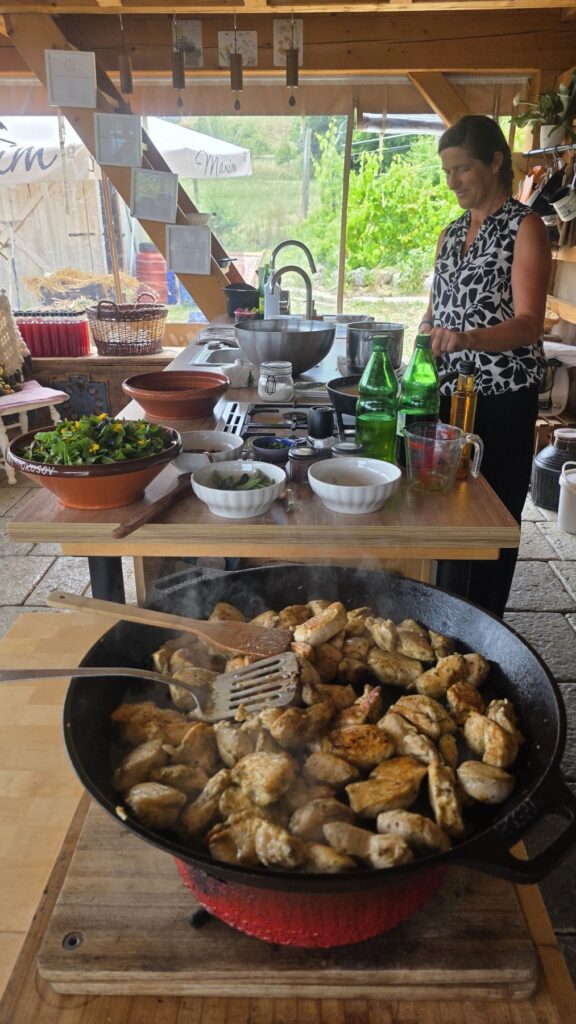
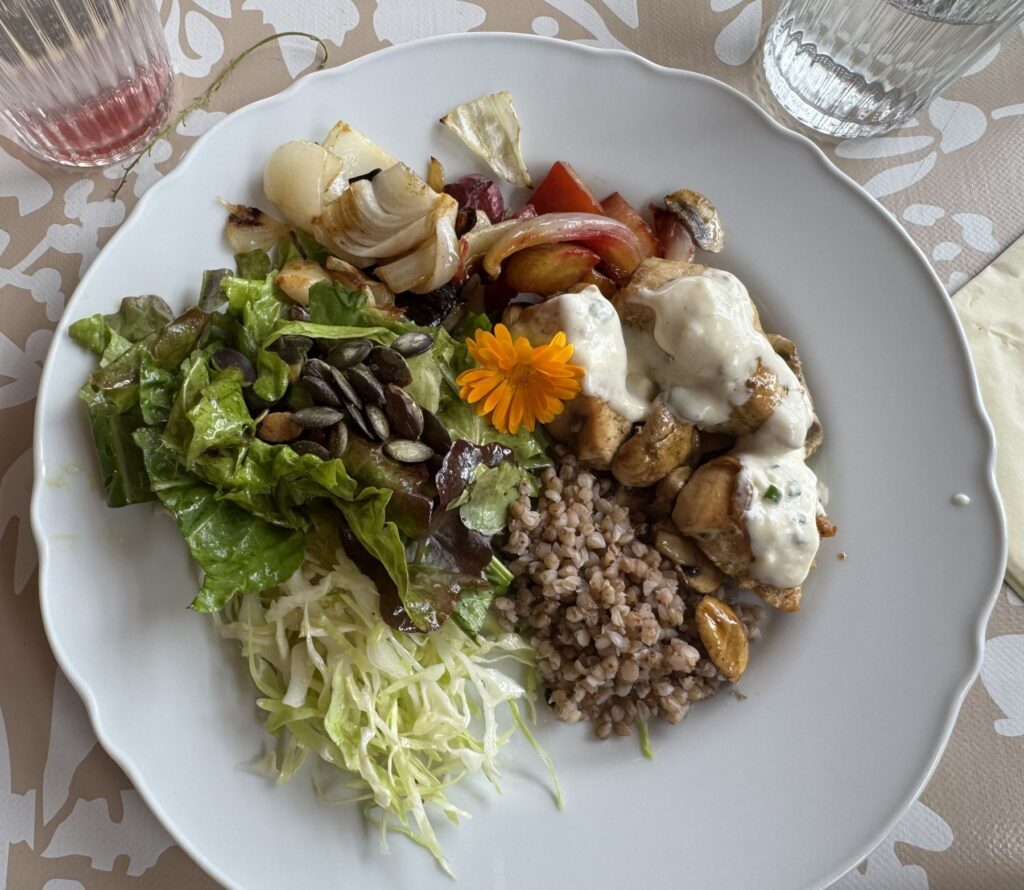
Our dining area consisted of a long, elegantly decorated picnic table overflowing with colorful flowers. At the entrance was a refreshing drink station where we could flavor our water with natural extracts of red currant, lavender, rose, or mint. We gathered around as Mateja demonstrated how to prepare a simple yet incredibly flavorful chicken dish with fresh herbs and a creamy sauce, accompanied by several fresh salads made from ingredients harvested just steps away. Dessert was homemade berry ice cream, the perfect ending to a memorable meal.
With full stomachs and happy hearts, we returned to Triglav National Park for a short hike to Slap Peričnik, one of Slovenia’s most spectacular waterfalls. This two-tiered waterfall plunges approximately 48 feet over its upper cascade before dropping another 156 feet in a dramatic lower fall. The trail was short but steep, consisting mostly of stairways. One of the highlights was being able to walk behind both cascades, though we emerged thoroughly soaked by the mist.
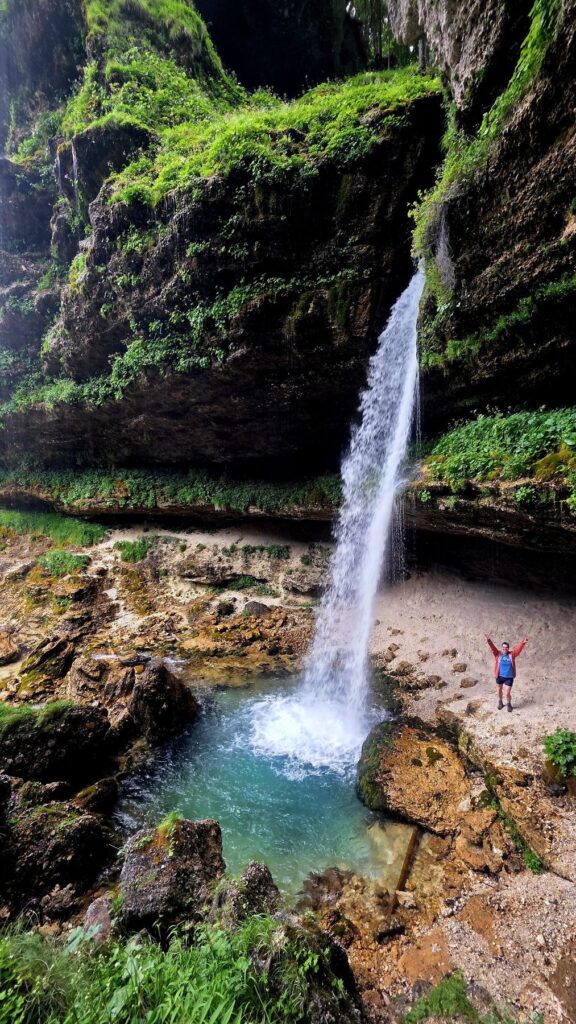
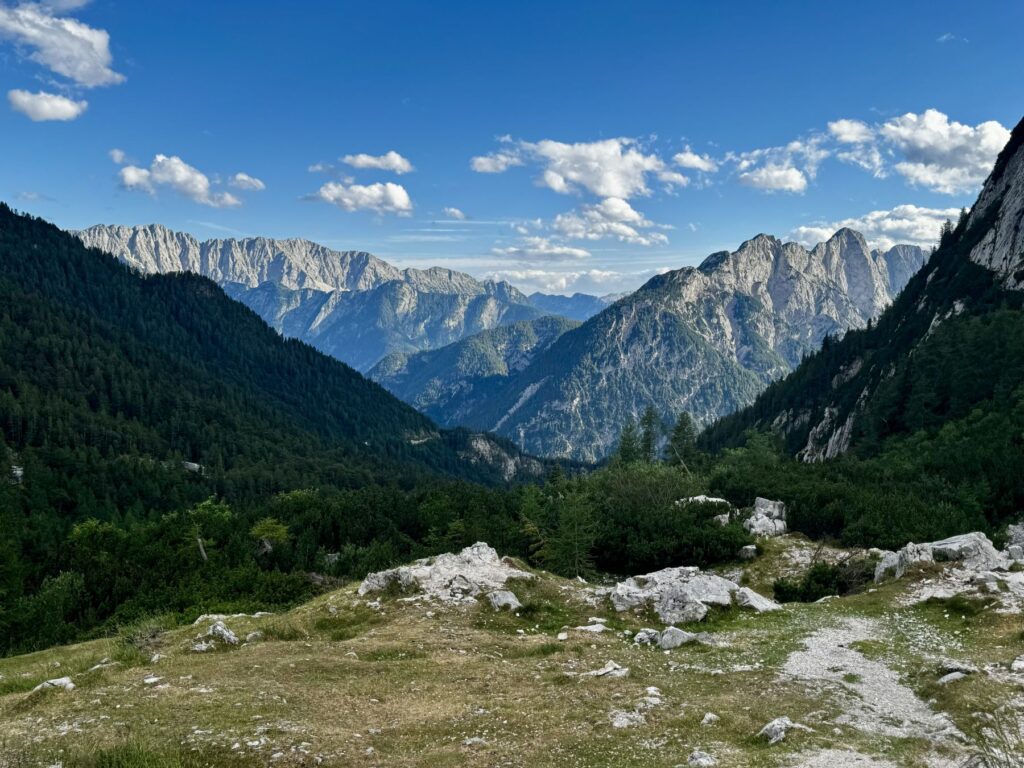
After enjoying the waterfall, we continued our drive through Triglav National Park along the historic Russian Road and over Vršič Pass, Slovenia’s highest mountain pass at 5,285 feet. The winding road connects Kranjska Gora with the Trenta Valley and features fifty hairpin turns—twenty-four climbing from Kranjska Gora and twenty-six descending toward Trenta. For anyone prone to motion sickness or uneasy with dramatic mountain roads, this would likely be a challenging drive. Personally, I loved every minute of it.
Our day concluded at what may have been my favorite accommodation of the entire trip: Kekčeva domačija (Kekec Homestead), an enchanting alpine farm stay nestled among the mountains. We had the entire property to ourselves. The property was simply magical, complete with a stone-lined swimming pool, beautifully landscaped grounds, and inviting outdoor spaces for relaxing and dining.
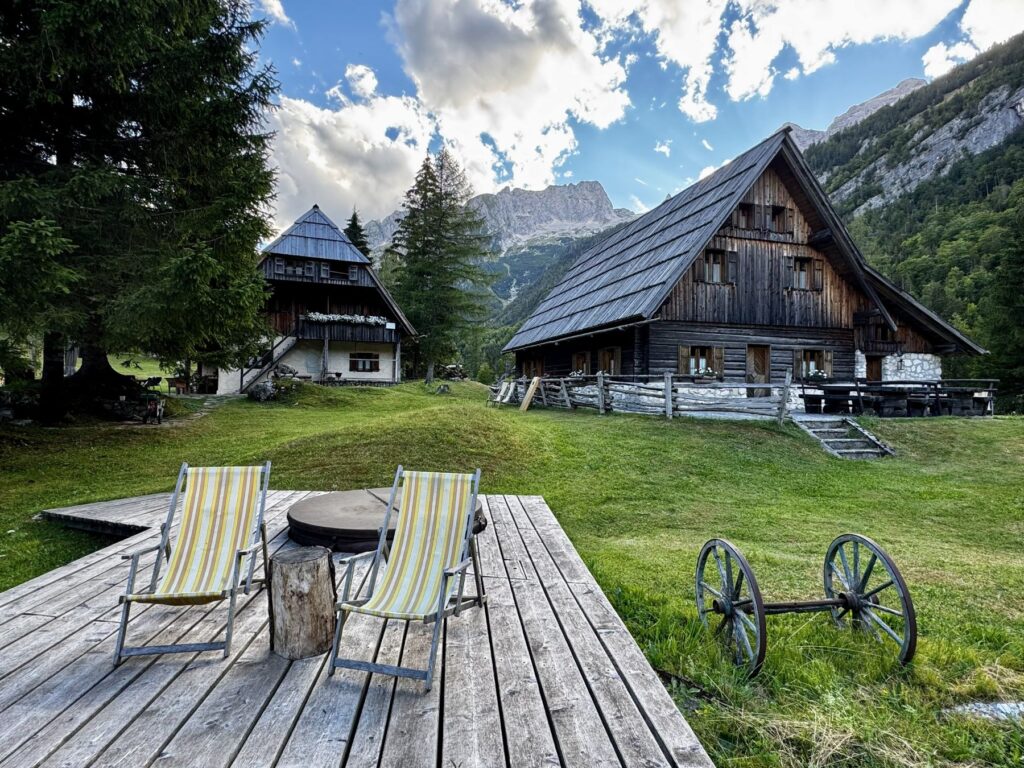
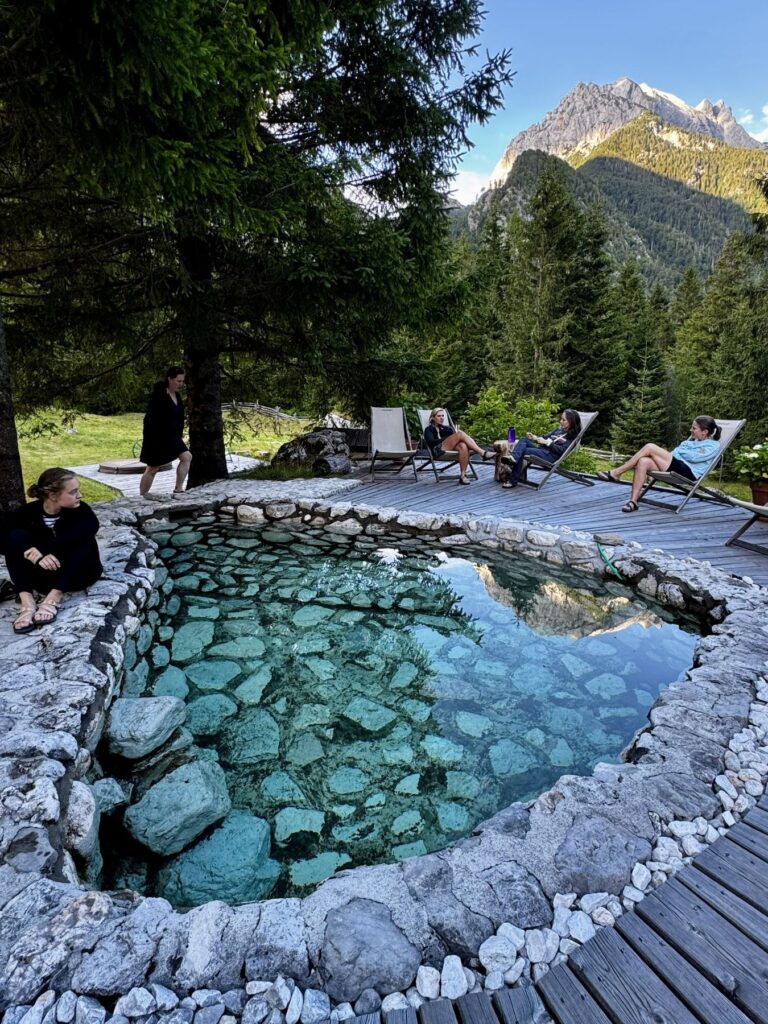
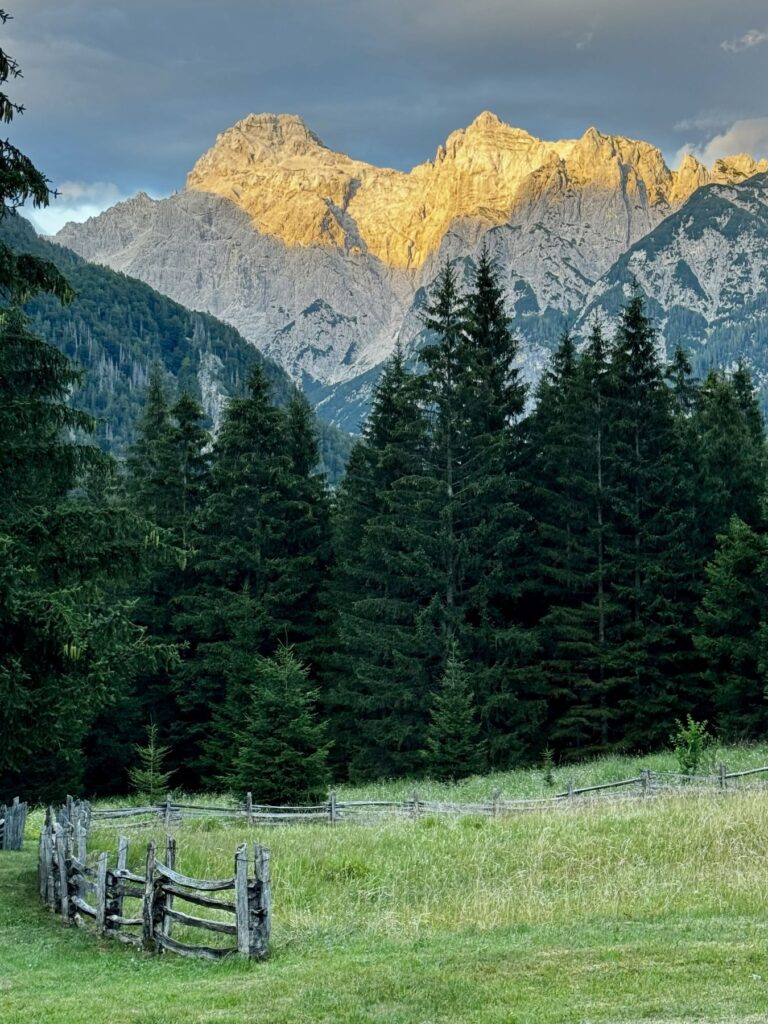
As evening settled over the mountains, we enjoyed dinner on the deck while the setting sun cast a warm golden glow across the peaks behind us. The meal began with sparkling wine—appropriate, as our hosts also own a vineyard in northeastern Slovenia—followed by a comforting spinach soup, an absolutely delicious lasagna, and a classic tiramisu for dessert. We lingered around the table long after dinner had ended, sharing stories, laughter, and conversation beneath the fading evening light. It was the perfect ending to another unforgettable day in Slovenia.
Day 7 Soča River
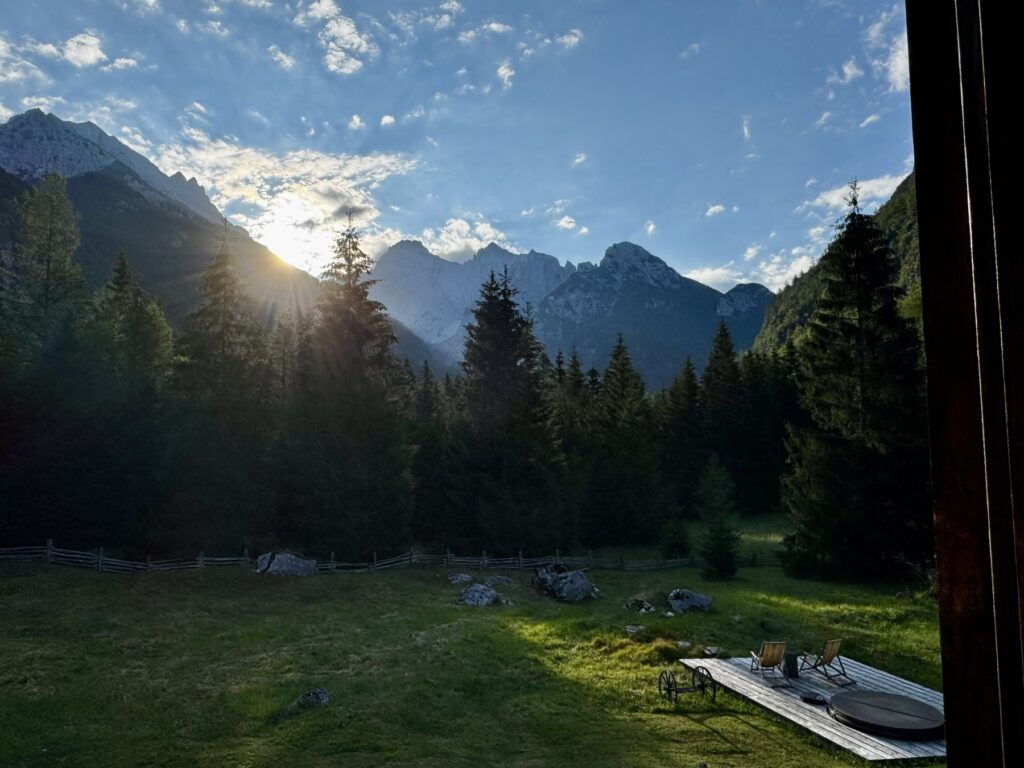
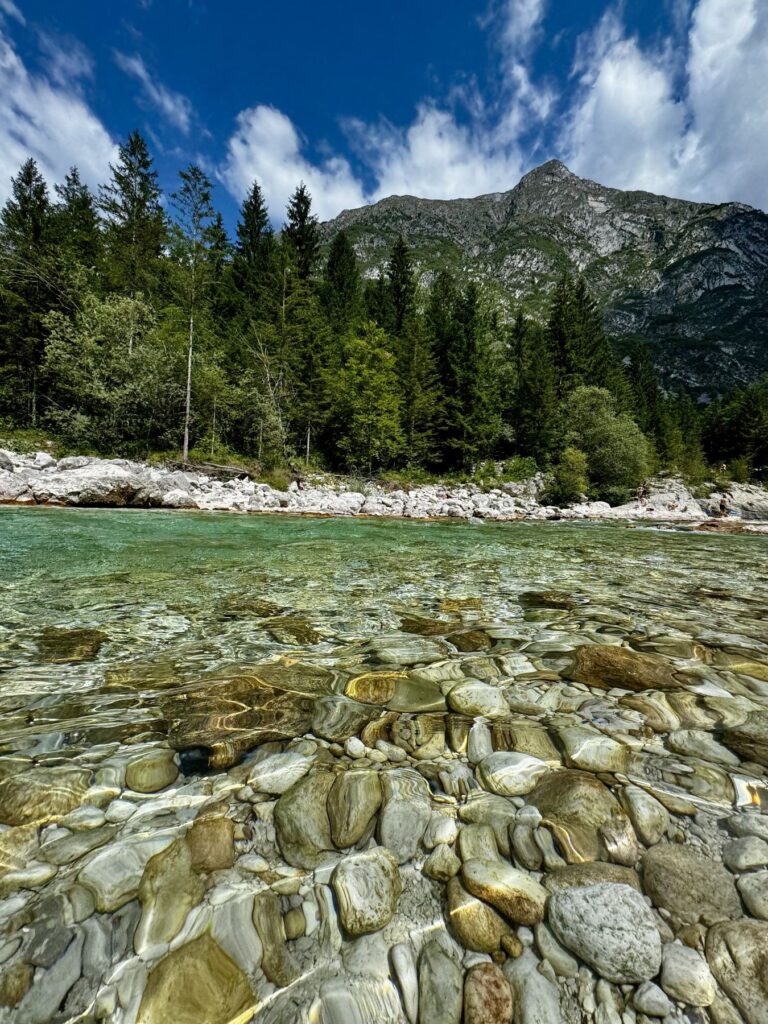
We enjoyed a leisurely start to the day, with breakfast not being served until 8:00 AM. Around 9:00 AM, we reluctantly departed our alpine paradise and drove approximately 30 minutes to our trailhead along the breathtaking Soča River. The section we hiked is part of the Alpe-Adria Trail, a remarkable 466-mile long-distance route that begins at the glaciers of Austria, winds through the mountains and valleys of Slovenia, and concludes on the Adriatic coast of Italy. Although we only covered about two miles, it was undoubtedly one of the most scenic stretches imaginable. The trail followed the brilliantly aquamarine waters of the Soča River and led us through a spectacular gorge before ending at a popular swimming area.
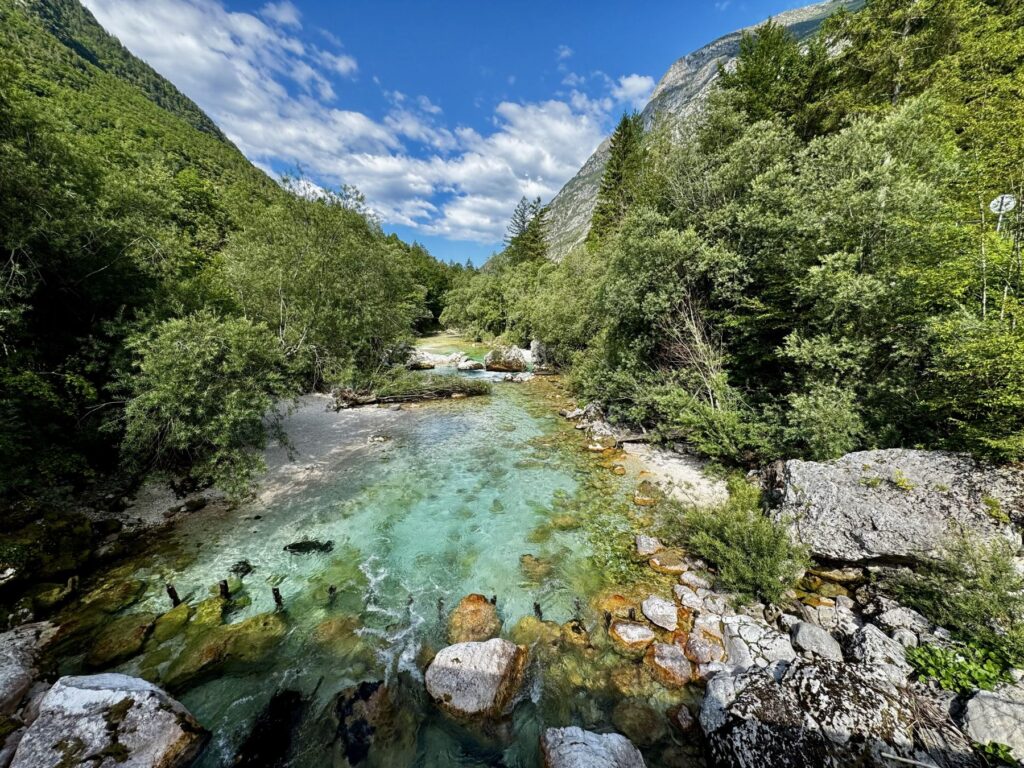
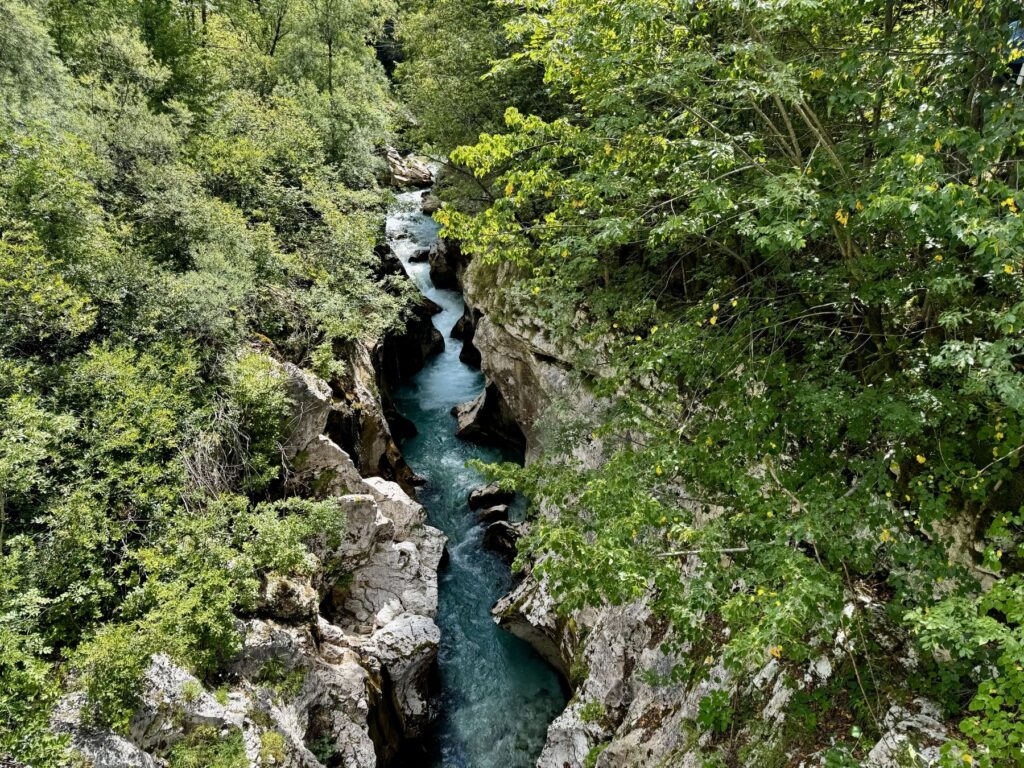
We spent about 45 minutes enjoying the river. The water temperature hovers in the low 50s even during the summer. Most of us were content to wade in ankle- to knee-deep, savoring the refreshing chill without committing to a full swim.
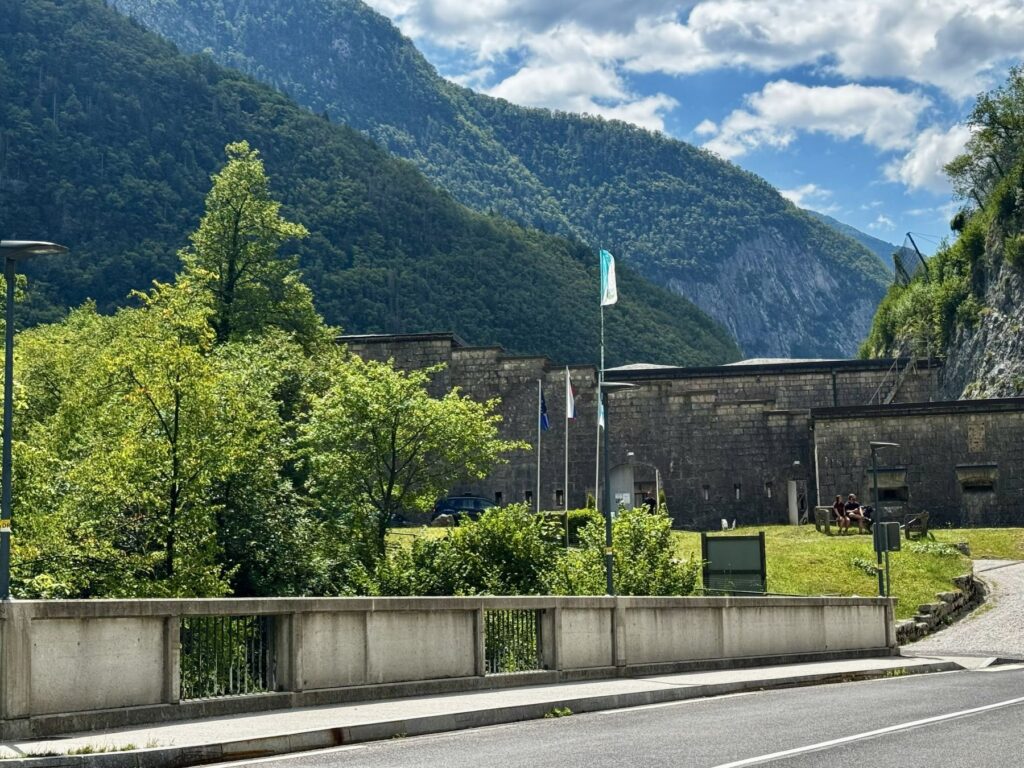
From there, we drove us a short distance to Fort Flitscher Klause, a fortress built in 1881. We were greeted by an elderly gentleman named Vladimir, whose passion for history was evident as he shared stories of the soldiers stationed there during World War I. He explained how they lived and cared for themselves under difficult conditions and proudly displayed many of the artifacts he has collected over the years.
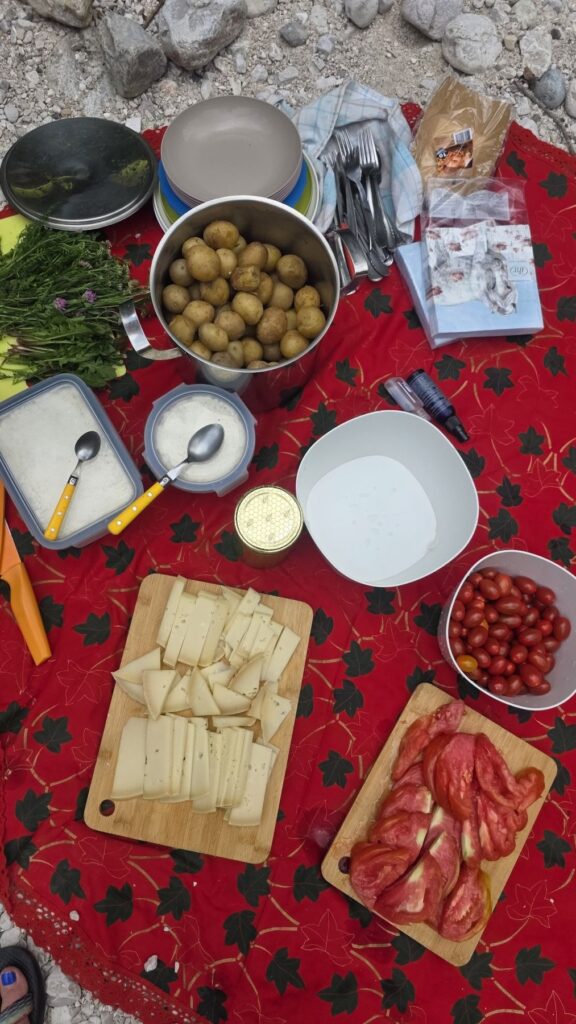
Following our history lesson, we met Natasha, a local pharmacist with a deep interest in herbal medicine and natural remedies. She guided us on a short nature walk, identifying a variety of medicinal flowers and plants that grow throughout the region. Our walk eventually brought us back to the banks of the Soča River, where Mary and Natasha had prepared a beautiful picnic. The spread featured boiled potatoes, ripe tomatoes, homemade cheese topped with a peanut-based pesto and an assortment of edible flowers. Aljaž carried down a large backpack cooler filled with beverages, including three local beers: a lager, an IPA, and a sour. The drinks were placed directly into the river to keep perfectly chilled, making for one of the most picturesque picnic settings imaginable.
After lunch, we hiked back to the vans and continued to the town of Bovec for an afternoon of rafting on the Class II rapids of the Soča River. At the rafting center, we were outfitted with sleeveless full-body wetsuits, booties, and helmets before being shuttled back to the river. After a thorough safety briefing, we launched onto the crystal-clear river. Before long, we pulled ashore beside a large boulder. Sy flipped our raft upside down and propped it against the rock, transforming it into an improvised waterslide.
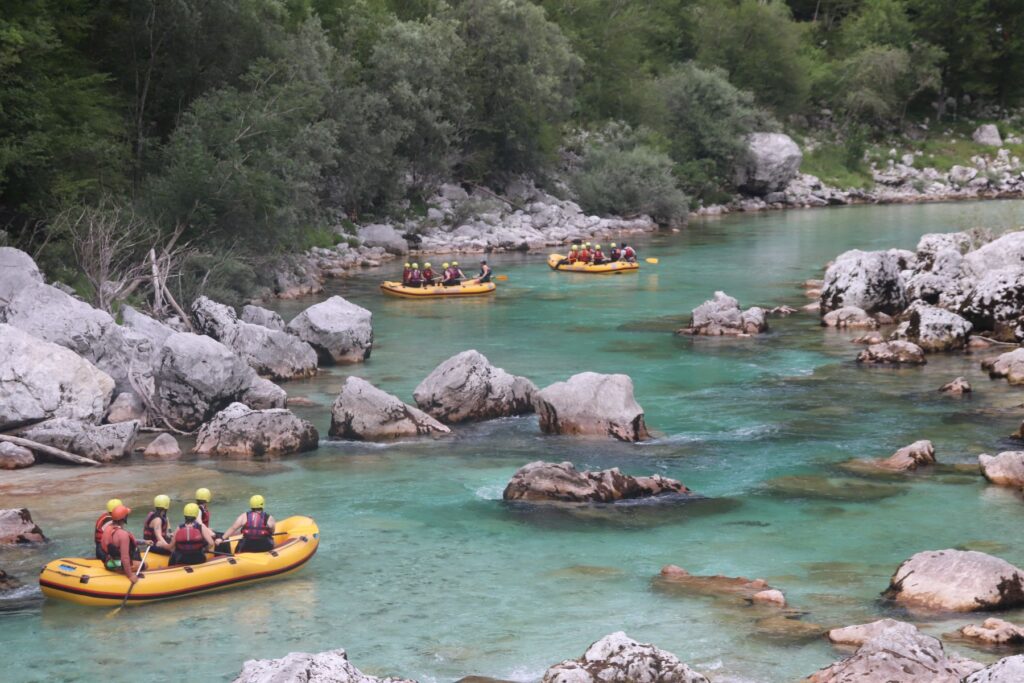
Other rafting groups were beginning to gather at the same spot, so we continued downstream. Sy explained that the Soča River was exceptionally low for this time of year and that, without significant rainfall in the coming weeks, rafting trips would likely have to be suspended. Farther along, we reached a massive boulder nicknamed Manhattan. According to Sy, it is the only boulder on this stretch of the river that never becomes completely submerged, regardless of water levels. The water surrounding it is exceptionally deep, making it a popular jumping spot. There was only one rule: if you climbed to the top, you had to jump. There was no safe way back down. Of the fifteen rafters in our group, only four accepted the challenge—I was one of them. Ironically, the climb up the slick rock proved far more intimidating than the jump itself.
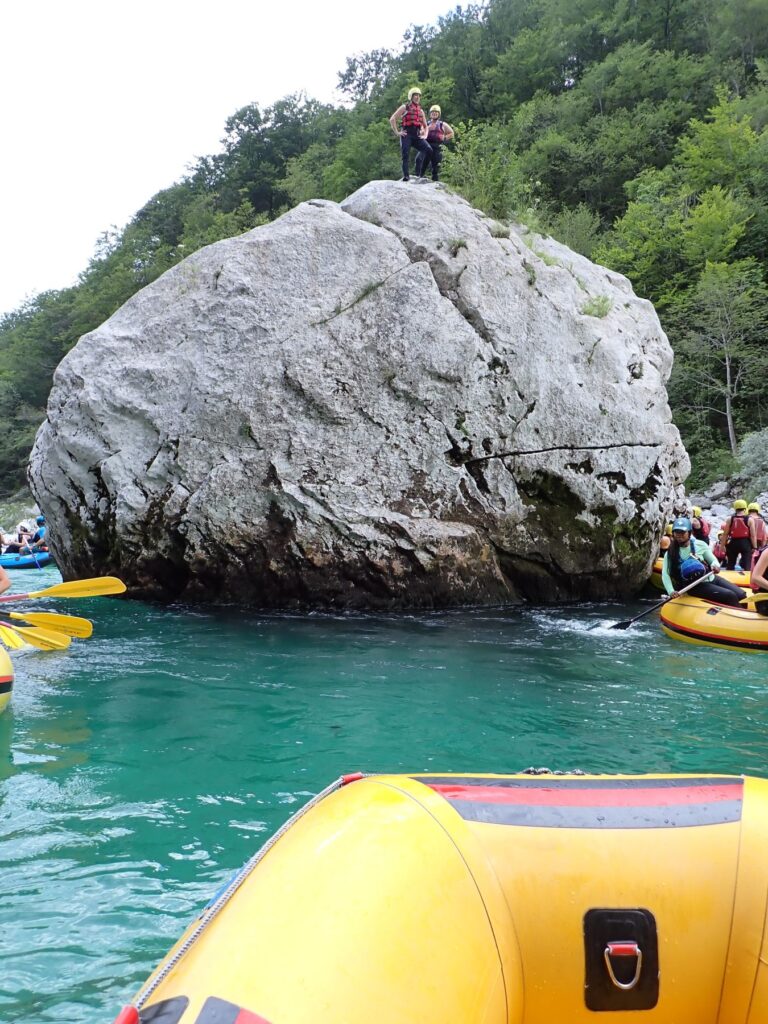
After navigating one final set of rapids, we all climbed out of our rafts and swam to shore. We quickly discovered that the most physically demanding part of the excursion still awaited us: carrying the heavy rafts back up the hill to their trailers. Fortunately, Aljaž was waiting for us with cold drinks and delicious Slovenian doughnuts, a welcome reward after our efforts. We changed clothes in the parking lot, where the Europeans around us seemed completely unfazed by changing in full view of everyone else—a level of comfort with public undressing that certainly differs from what we’re accustomed to in the United States.
Our adventure wasn’t quite over yet. The two vans drove us about an hour to Koršič, our dinner destination located just across the Slovenian border in San Floriano del Collio, Italy. Once again, dinner was served family-style, with an abundance of delicious dishes shared around the table. After dinner we drove to our lodging at Borgo Gradisciutta. Our accommodations were lovely—a spacious suite featuring a separate living room and kitchenette, a bedroom with two twin beds, and a large bathroom complete with a bidet. It had been another unforgettable day, seamlessly blending breathtaking scenery, fascinating history, outdoor adventure, wonderful food, and plenty of laughter—everything that has made this Slovenian journey so extraordinary.
Day 8 E-biking through the wine country of Slovenia and Italy
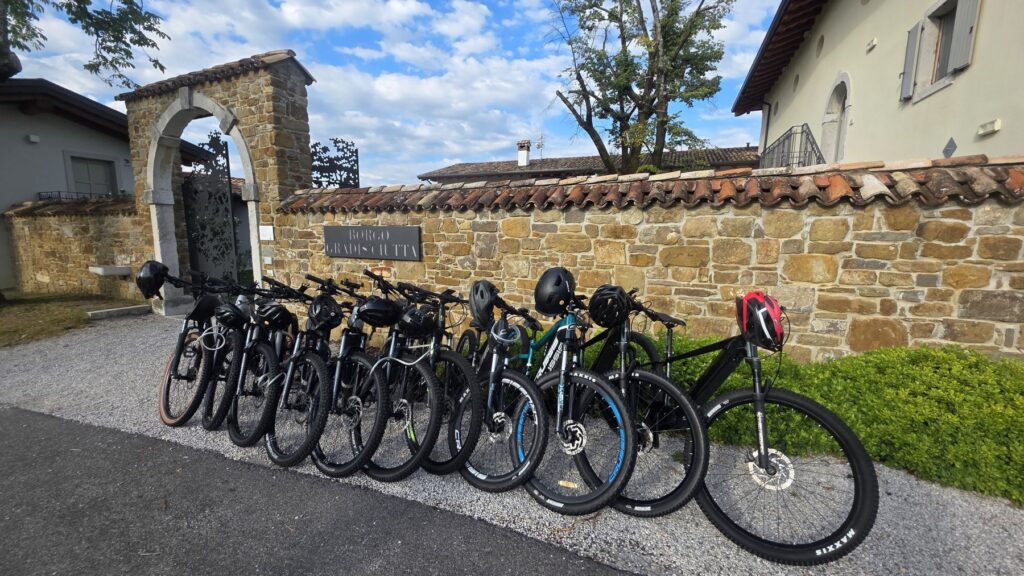
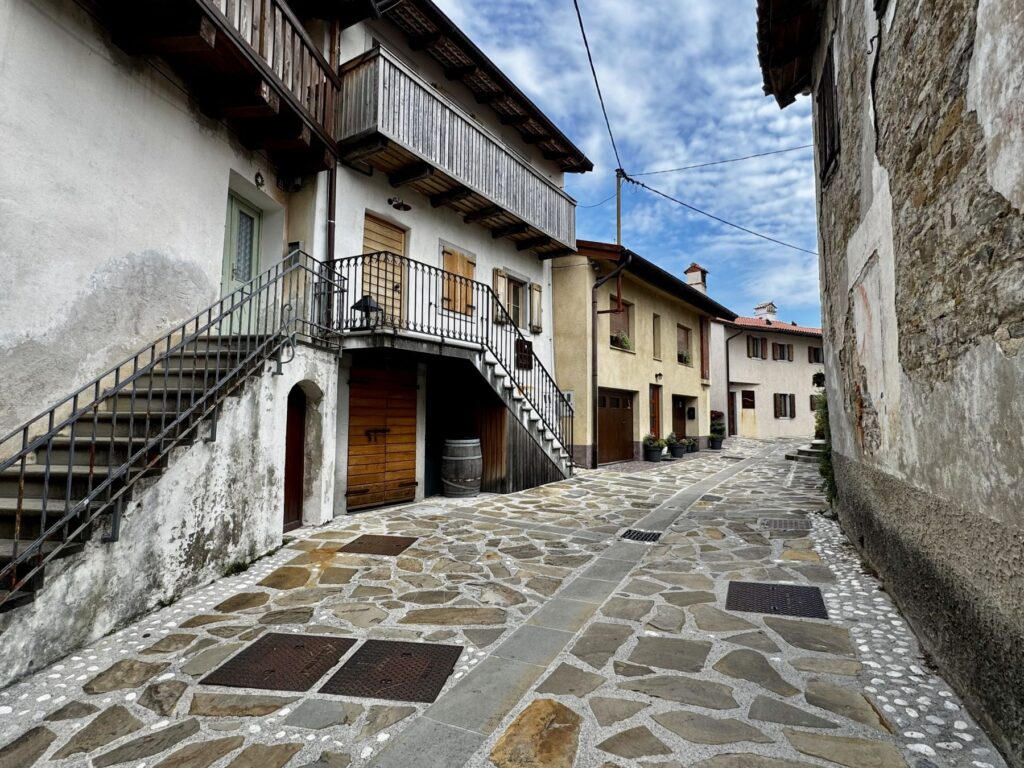
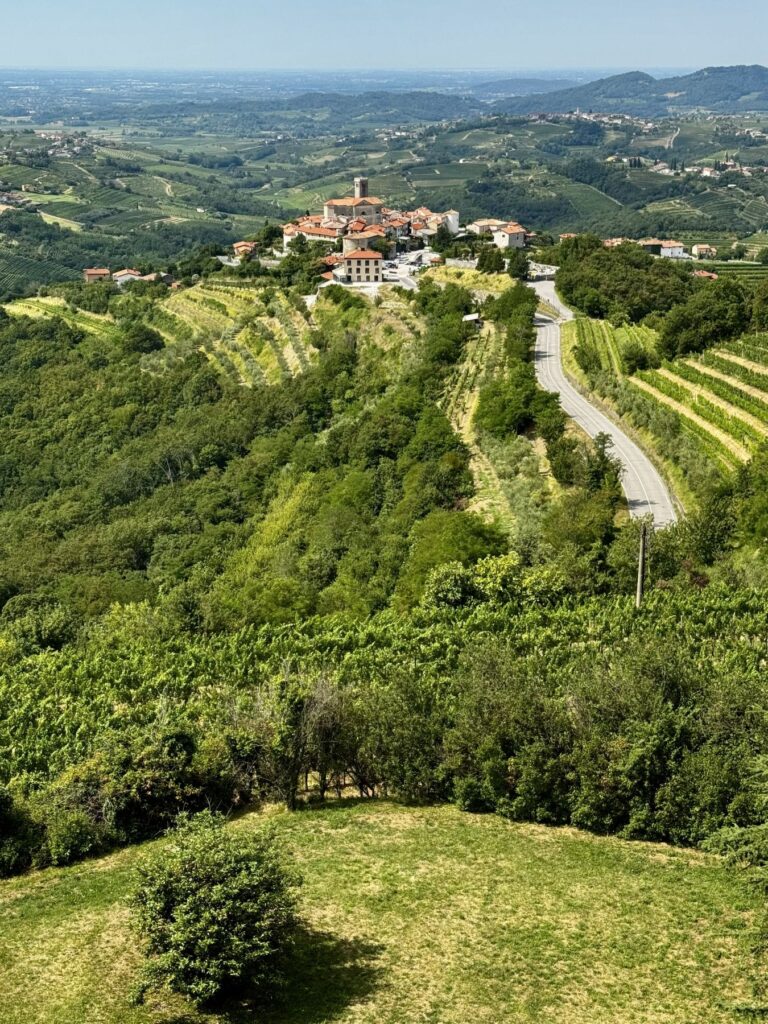
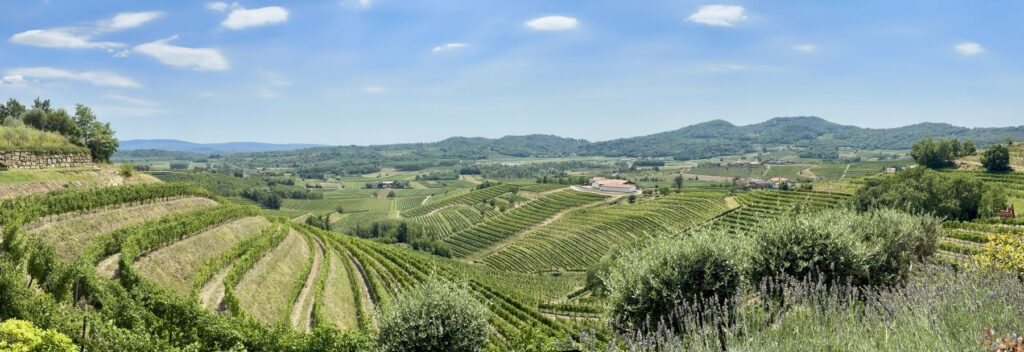
Another leisurely morning awaited us, with breakfast beginning at 8:00 a.m. While the buffet was not quite as elaborate as those at the City Hotel or Hotel Bohinj, it offered a satisfying selection, including made-to-order eggs. After breakfast, our group gathered outside the hotel where our e-bikes had been delivered. We spent a few minutes familiarizing ourselves with the bikes before setting off on a 26-mile loop through the rolling vineyards of the Goriška Brda wine region, winding seamlessly between Italy and Slovenia. The entire ride followed paved roads, requiring us to remain mindful of passing traffic as we pedaled through the picturesque countryside. We began our journey in Italy before crossing the border into Slovenia. Our first stop was Šmartno, a tiny medieval fortified village dating back to the 16th century. Built as a defensive stronghold against Ottoman invasions, the village has retained its historic charm, with narrow stone streets and centuries-old architecture. From its elevated position, we were rewarded with sweeping panoramic views of the vineyards stretching across the hills below.
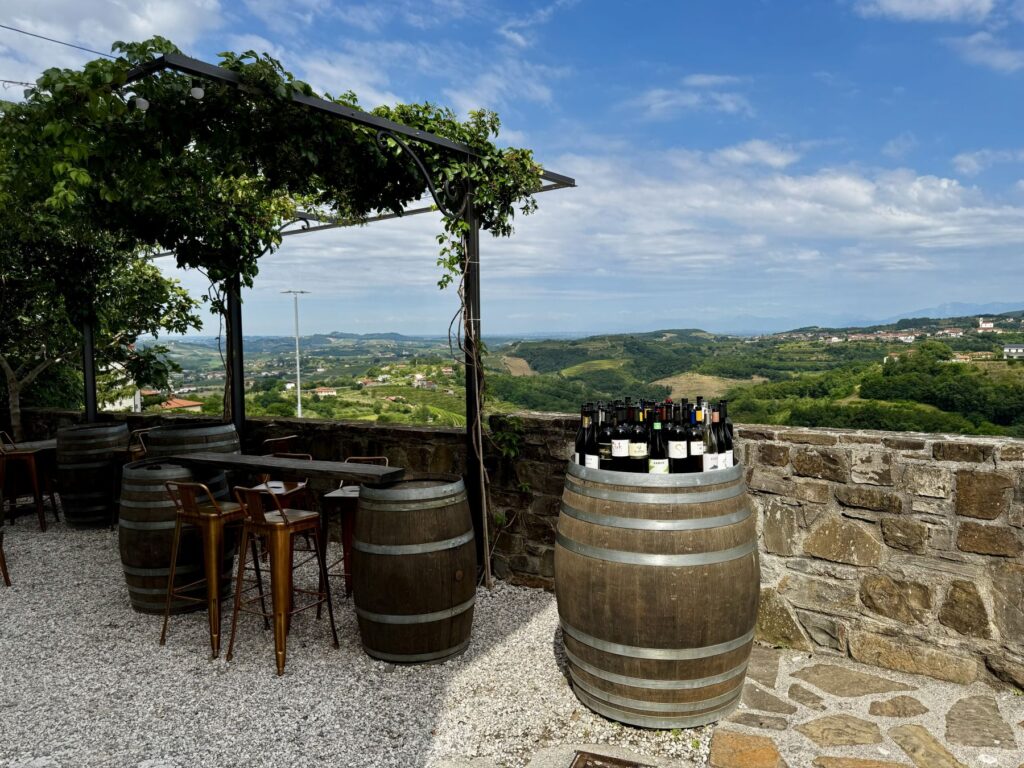
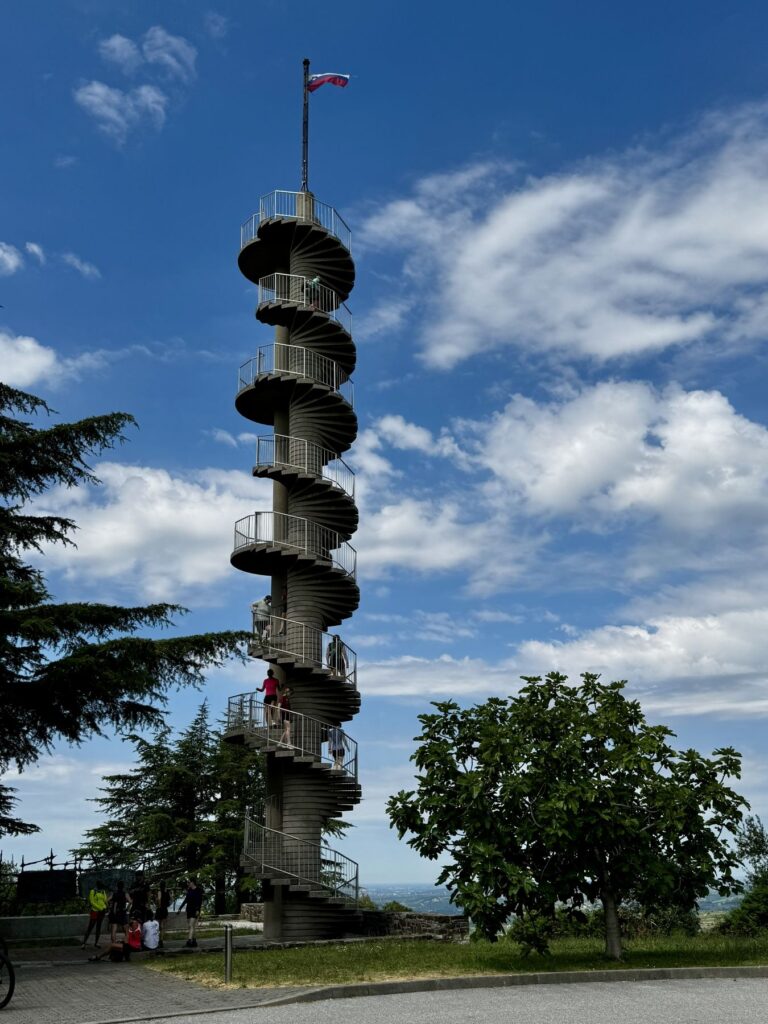
Just a short ride away stood the Gonjače Lookout Tower, where an even more spectacular panorama awaited us. After climbing to the top and taking in the breathtaking scenery, we continued our ride, crossing back into Italy. Before long, we reached another border crossing, where we paused to photograph the country signs and pose with one foot in each nation at the border marker—a fun reminder of how effortlessly this region blends two cultures.
Around 12:30 p.m., we arrived at Taverneta Estate in Dobrovo, Slovenia, for lunch. The estate features both a boutique hotel and restaurant, along with a stunning infinity pool overlooking the surrounding vineyards. Lunch was served family-style, with an abundant assortment of meat dishes accompanied by fresh vegetables. To finish, we chose between vanilla ice cream topped with rich chocolate sauce or fresh berries.
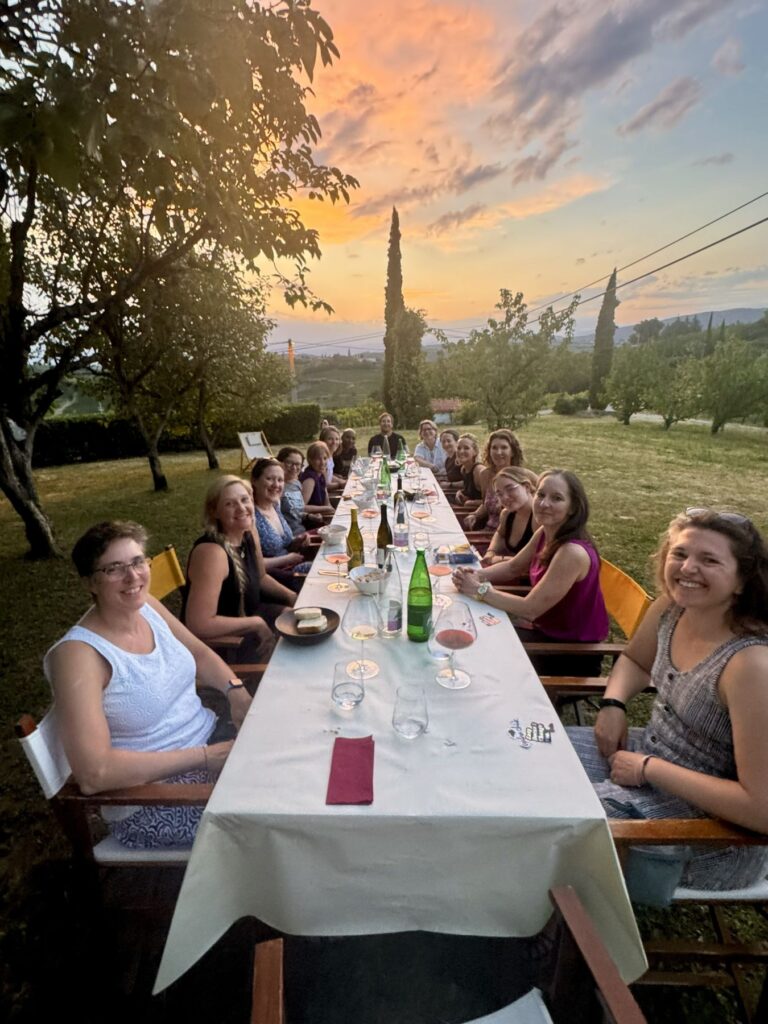
We returned to the hotel and had some time to relax before the evening’s festivities. A short five-minute shuttle ride brought us to Konvin Wine Bar, where we enjoyed a pre-dinner glass of local wine. Our farewell dinner was held at Mulit Winery, a family-owned Slovenian winery that has been bottling wines since 1997, producing two styles of wine from eight grape varieties. We dined outdoors at the owners’ home, where they, along with their two young daughters, graciously served our meal and welcomed us like family. Before dinner, we were given a tour of their intimate wine cellar.
Day 9 Transiting back to Lake Bled
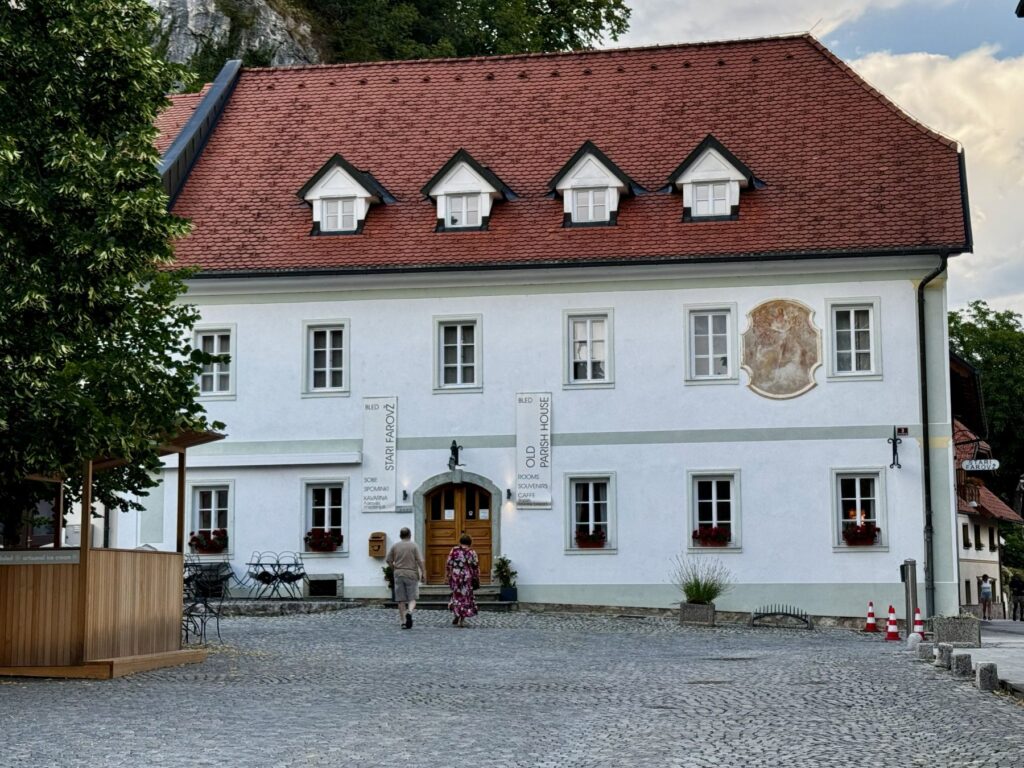
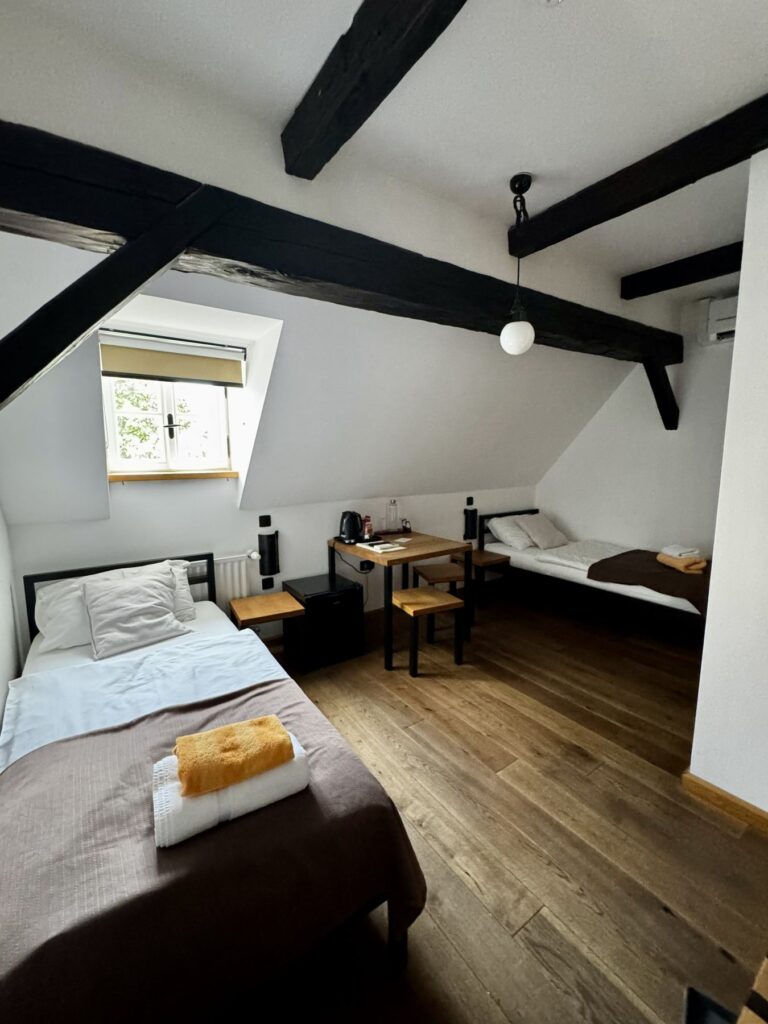
Today was primarily a transit day as our Explorer Chick group said our goodbyes and went our separate ways. I made my way back to Lake Bled and was dropped off at the Old Parish House. The Old Parish House is one of the oldest buildings in Bled. Nestled beside St. Martin’s Church and just steps from the path leading up to Bled Castle, it enjoys an ideal location in the heart of the historic town. My room was ready upon arrival and was located on the second floor The charming hotel has only ten guest rooms, each named after a notable citizen of Bled. I stayed in the Oblak Room, named in honor of Slavko Oblak, the renowned bronze sculptor who was born in Bled in 1934. About thirty minutes after I checked in, a powerful thunderstorm swept through the area. Surprisingly, I welcomed the interruption, as it gave me permission to simply stay in my room and unwind. After several days of hiking and constant activity, the downtime was exactly what I needed.
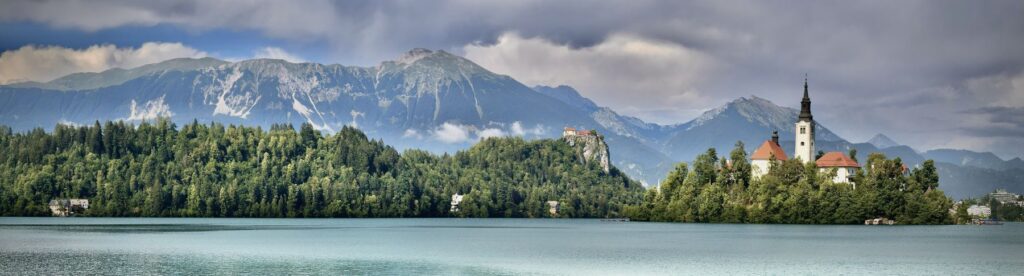
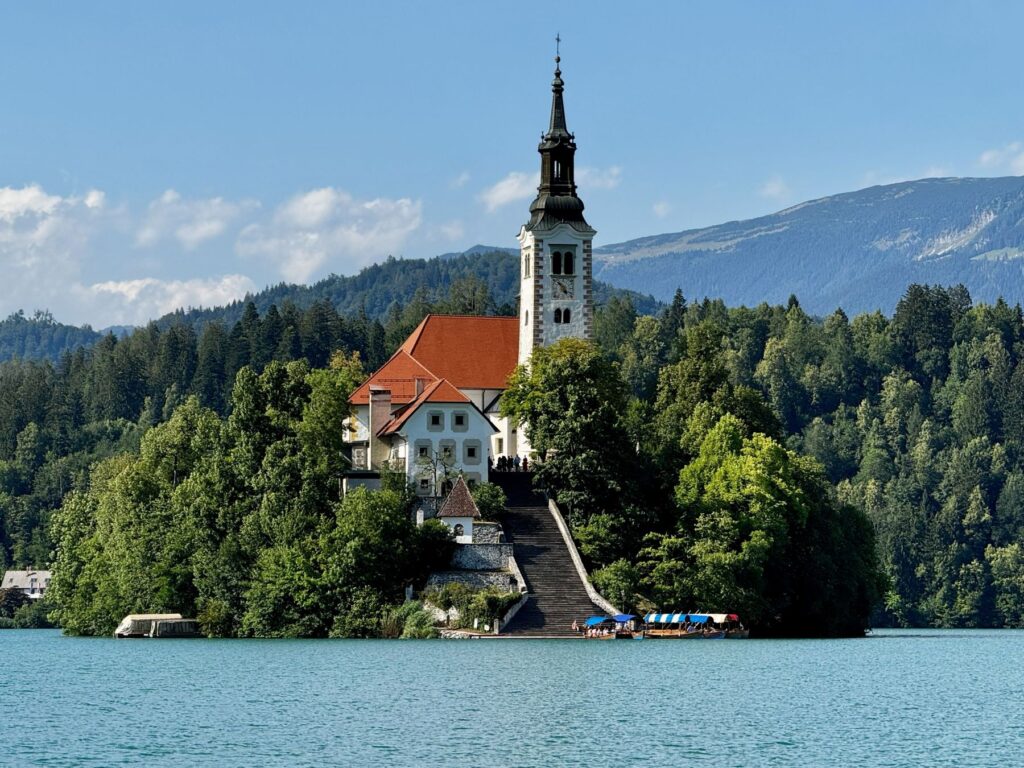
By late afternoon, the storm had passed, the skies had cleared, and the sunshine returned. I set out to walk the 3.75-mile path that circles Lake Bled, traveling in a counterclockwise direction. Along the way I passed several of the places our group had explored earlier in the week, but seeing them from a different perspective made them feel entirely new. The changing angles revealed fresh views of the iconic island church and Bled Castle perched dramatically atop its cliff. Although I had already taken countless photographs earlier in the week, I couldn’t resist stopping to capture even more images of the picturesque church rising from the middle of the lake.
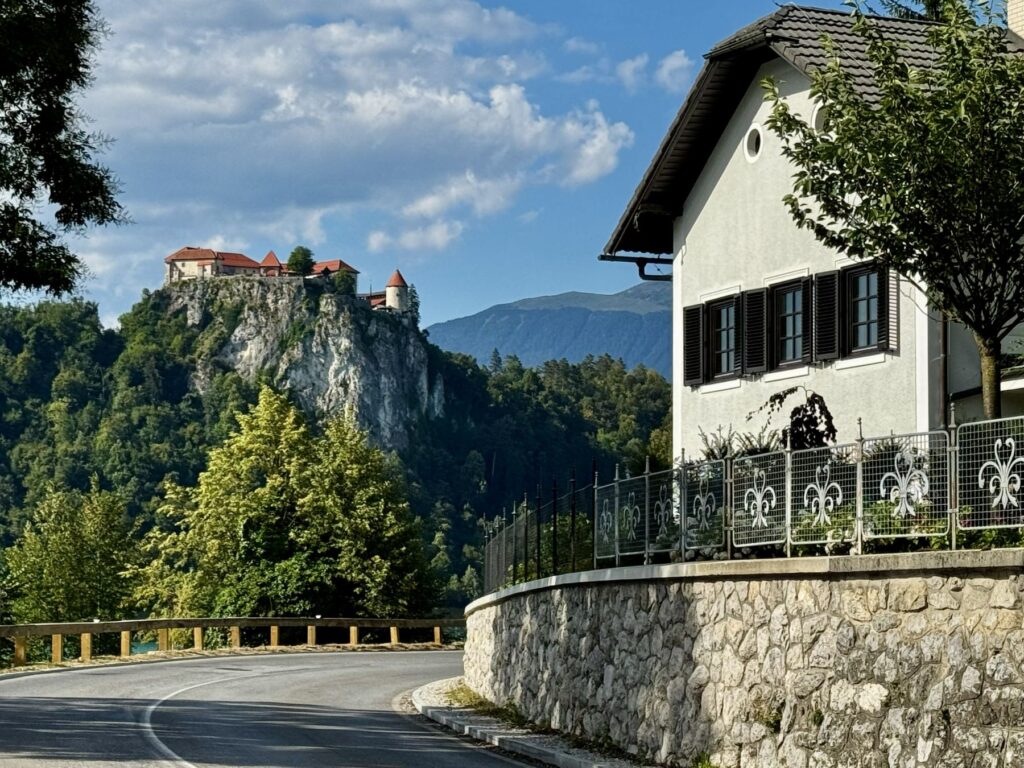
For dinner, I stopped at Vila Prešeren, a lakeside restaurant with beautiful views across the water. I enjoyed a rich mushroom risotto with beef before treating myself to Slovenia’s famous Bled Cream Cake, known locally as Blejska kremšnita. It was the perfect ending to a peaceful evening by the lake. Back at the hotel, I reorganized my luggage in preparation for my Mt. Triglav adventure the following day. I hoped to get to bed early since another early wake-up awaited me, but nature had other plans. Around 10:00 p.m., another thunderstorm rolled through Bled, providing a fitting soundtrack to my final evening before the next chapter of my Slovenian adventure.
Day 10 Krma Valley to Triglavski dom na Kredarici (5.36 miles, 3133′ gain)
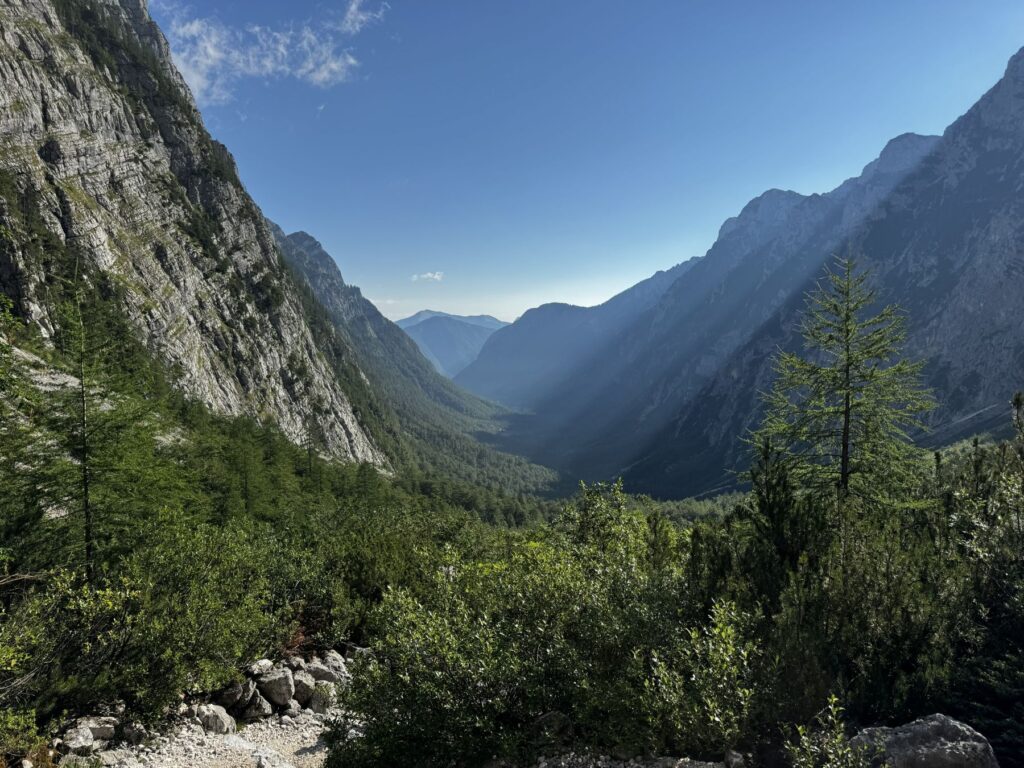
The day began with another early alarm, this time at 5:15 a.m. At 6:05 a.m., my guide, Mitja Šorn of Vertical Adventures (booked through the Explorer-Share online platform), picked me up for a two-day guided ascent of Mount Triglav, Slovenia’s highest peak. The adventure included an overnight stay at Triglavski dom na Kredarici, the country’s highest mountain hut. Our small group consisted of eight hikers. I was the only American. The other hikers were from Canada, the Netherlands, England, Austria, and Germany.
We set off shortly after 7:00 a.m from the Krma Valley. The trail began gently, winding through a peaceful forest as it followed the valley floor. Before long, however, the climbing began—and from that point forward, it was a continuous ascent with virtually no downhill sections. We passed through a beautiful alpine meadow before reaching slopes carpeted with colorful wildflowers.
Around 10:15 a.m., we arrived at the Shepherd’s Hut, roughly the halfway point between the trailhead and the summit hut. Our pace throughout the morning had been unhurried. One of the hikers was much slower than the rest of the group so we had to stop and wait every 20 minutes or so.
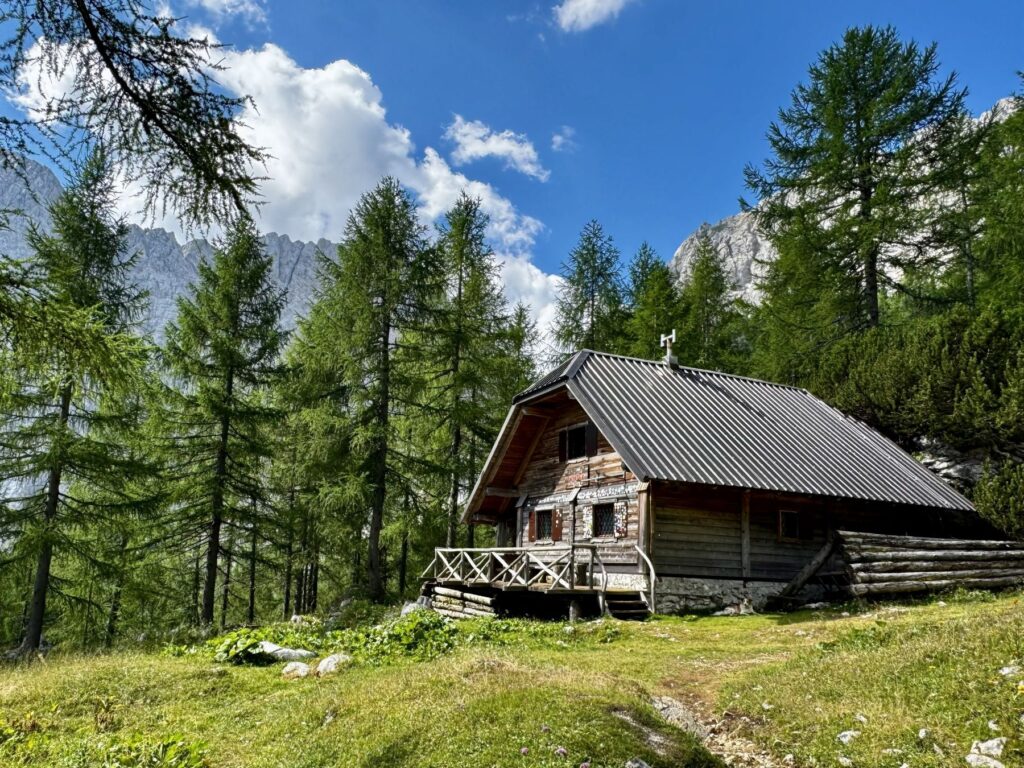
Beyond the Shepherd’s Hut, the trail grew steeper, but the scenery became even more spectacular. We climbed above the tree line, where expansive alpine vistas stretched in every direction. Along the way, we were fortunate enough to spot several ibex gracefully navigating the rocky slopes. The trail climbed relentlessly through a series of switchbacks, making for slow but steady progress.
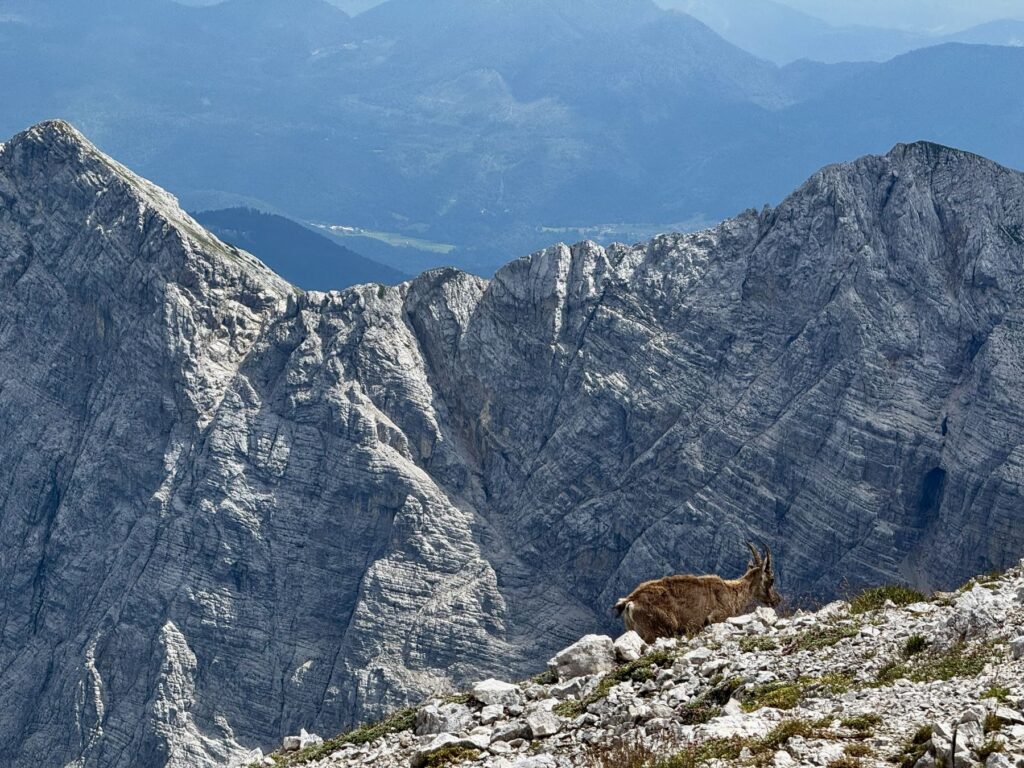
We finally reached Triglavski dom na Kredarici around 2:15 p.m. Again, without the slower hiker, I think our group would have arrived much earlier. From the hut, Mount Triglav’s iconic summit stood clearly in view. Unfortunately, towering cumulus clouds had begun to build, and the forecast now called for a 30 percent chance of afternoon thunderstorms. Taking both the weather and the group’s pace into consideration, Mitja decided to postpone our summit attempt until the following morning.
The unexpected free time made for a wonderfully relaxing afternoon. I explored a short trail on the opposite side of the pass while others rested around the hut. We gathered for dinner at 6:30 p.m., where I enjoyed pasta with meat sauce followed by apple strudel for dessert. After dinner, Mitja distributed our helmets and climbing harnesses in preparation for the next day’s summit ascent. As evening settled over the Julian Alps, I wandered a short distance from the hut and found a secluded spot to myself. There, I watched one of the most breathtaking sunsets I have ever witnessed.
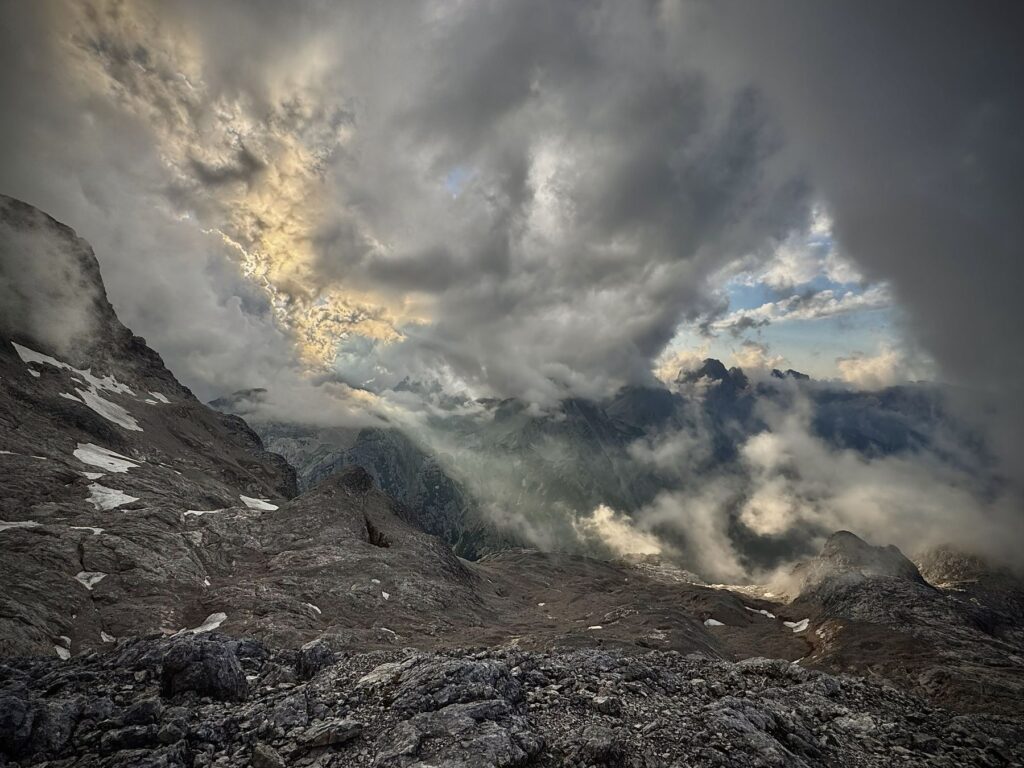
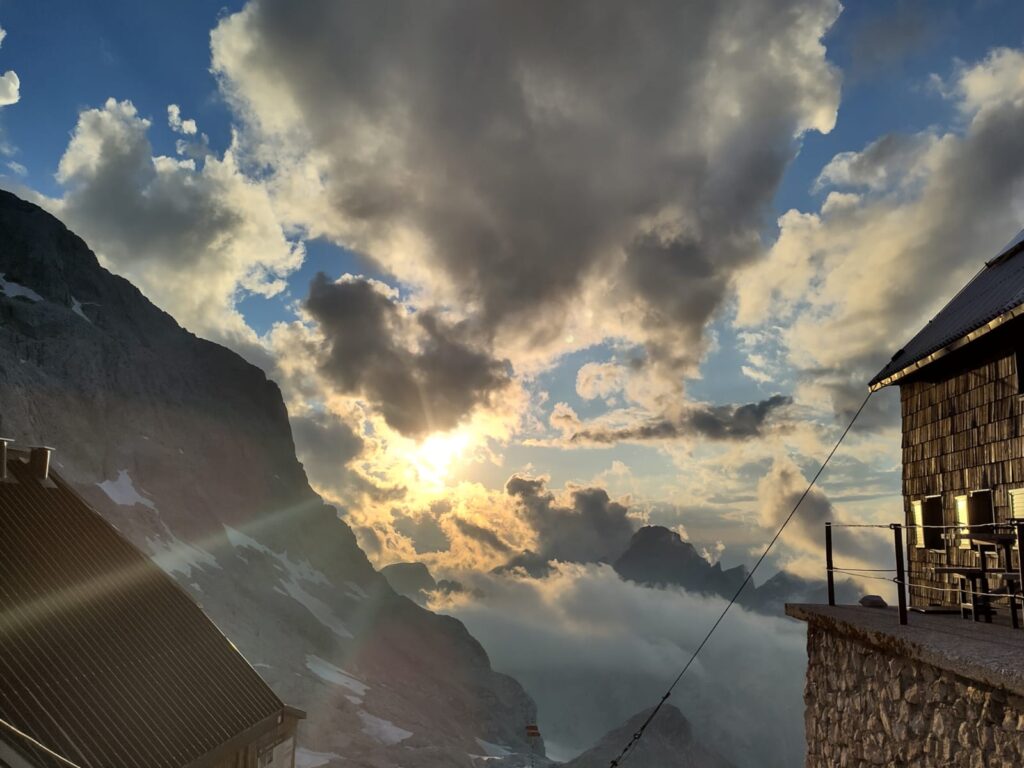
Our accommodations were simple but comfortable by mountain hut standards. The room contained two sets of bunk beds, while the hut itself has the capacity to accommodate up to 304 hikers. We turned in early, knowing that another pre-dawn wake-up call awaited us before our summit attempt.
Day 11 Mt Triglav summit
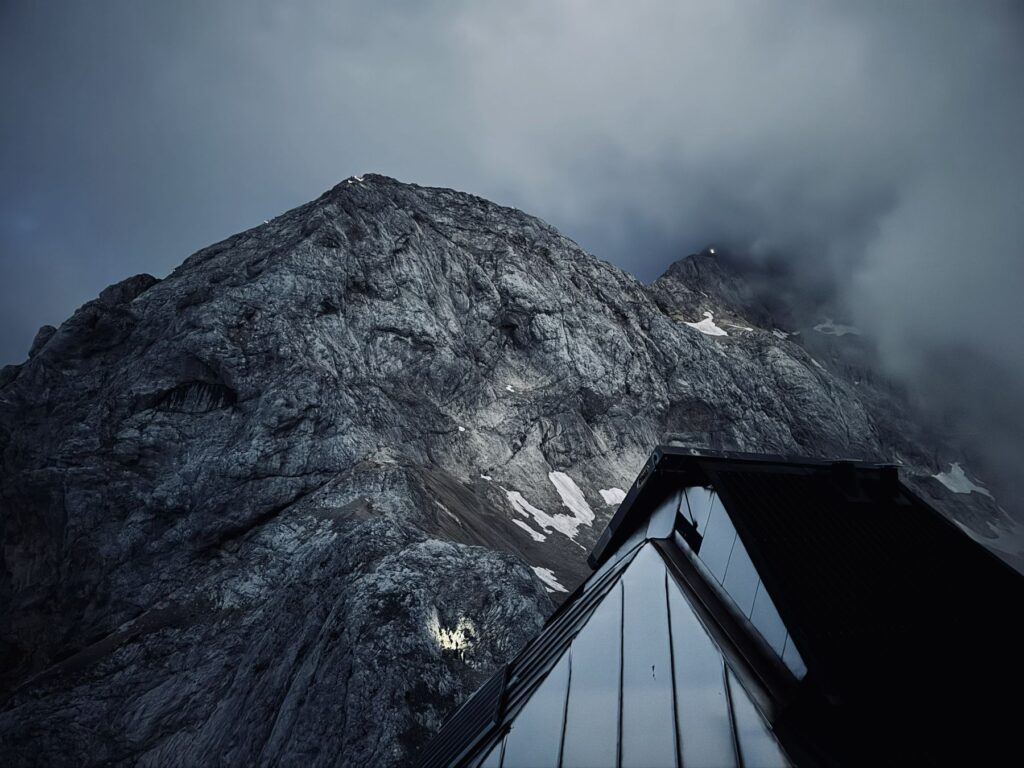
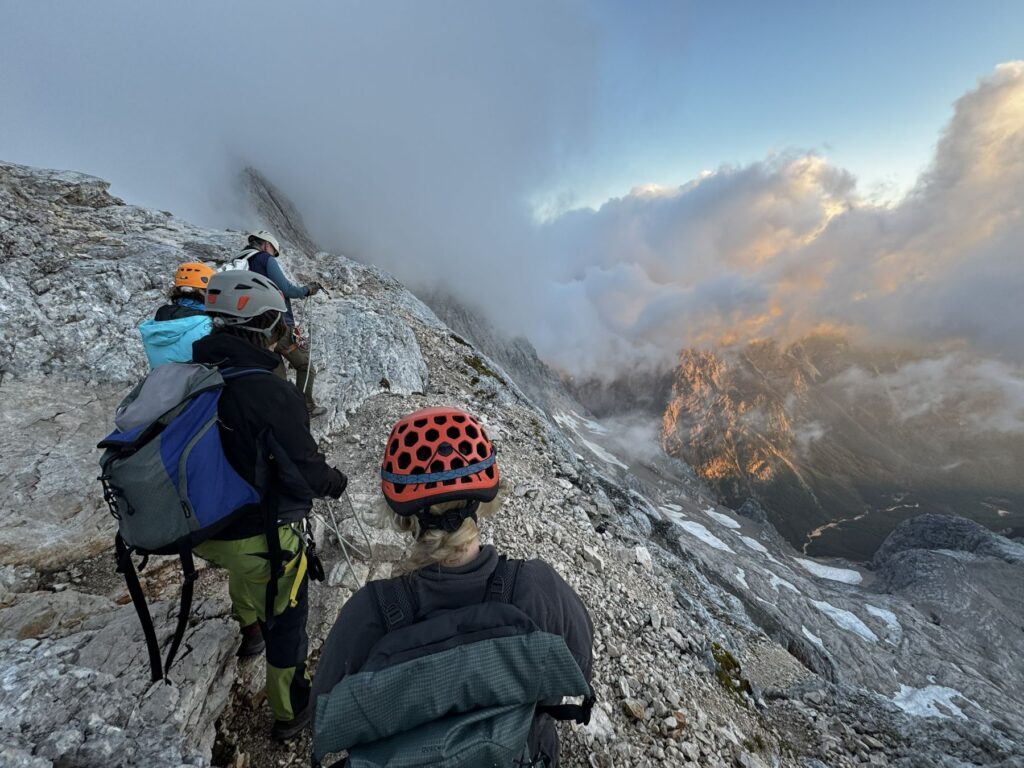
It was hard to believe I was on vacation as my alarm sounded at 4:10 a.m. I have never seen four women get ready so quickly—within twenty minutes we were all dressed, geared up, and ready to head for the summit. Before setting off, Mitja divided us into two groups for the summit climb and via ferrata. The four of us were roped together behind our guide, with me bringing up the rear. We began our ascent in darkness, though the line of headlamps already snaking along the ridge above hinted at the number of climbers making the same early morning pilgrimage.
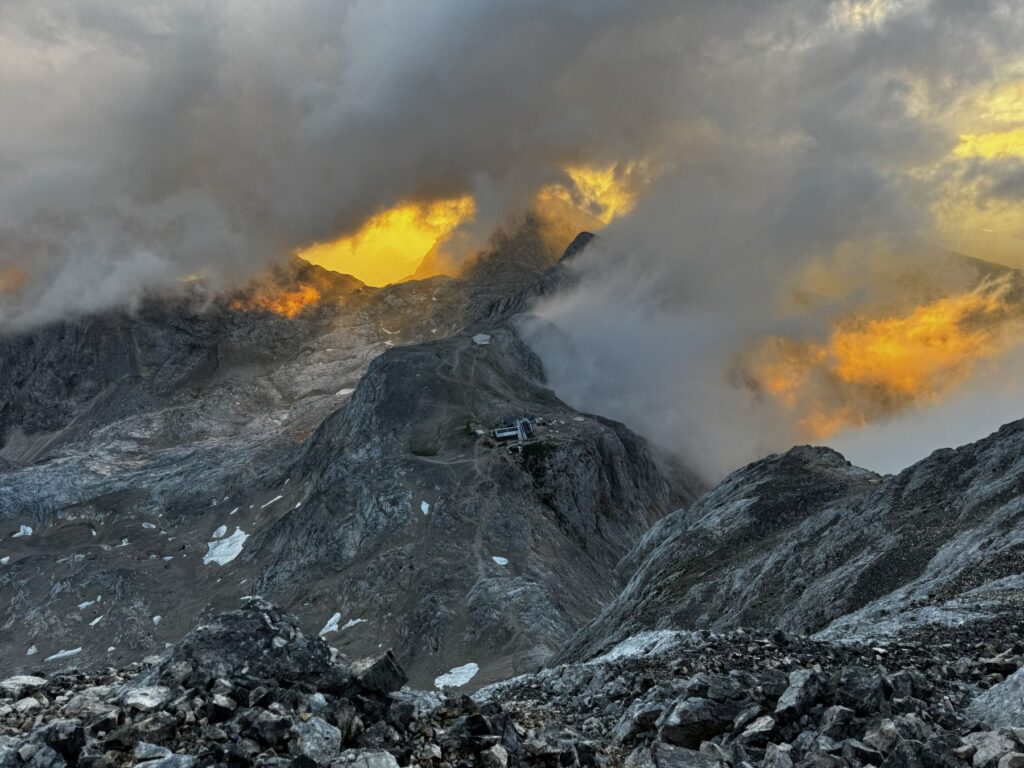
Low clouds clung stubbornly to the mountain, limiting the panoramic views I had hoped for. Still, the occasional breaks in the clouds revealed fleeting glimpses of the surrounding Julian Alps, making the climb feel almost dreamlike. The lower portion of the route required frequent clipping into the fixed cables, but once we reached the ridge, the terrain became more straightforward and enjoyable.
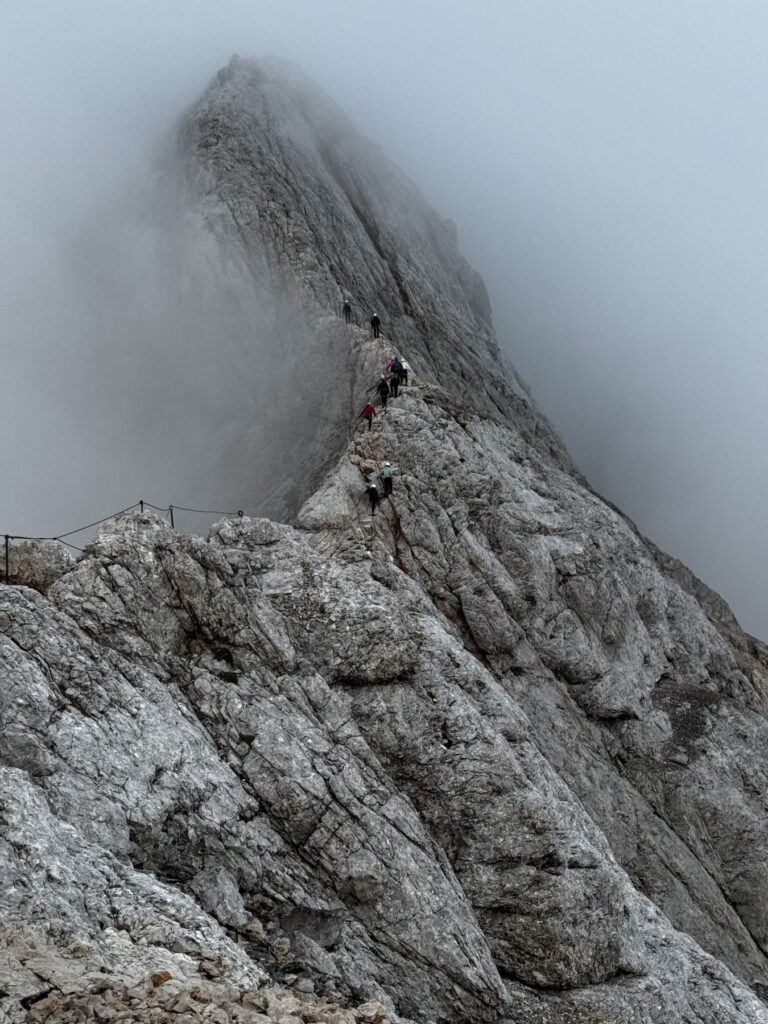
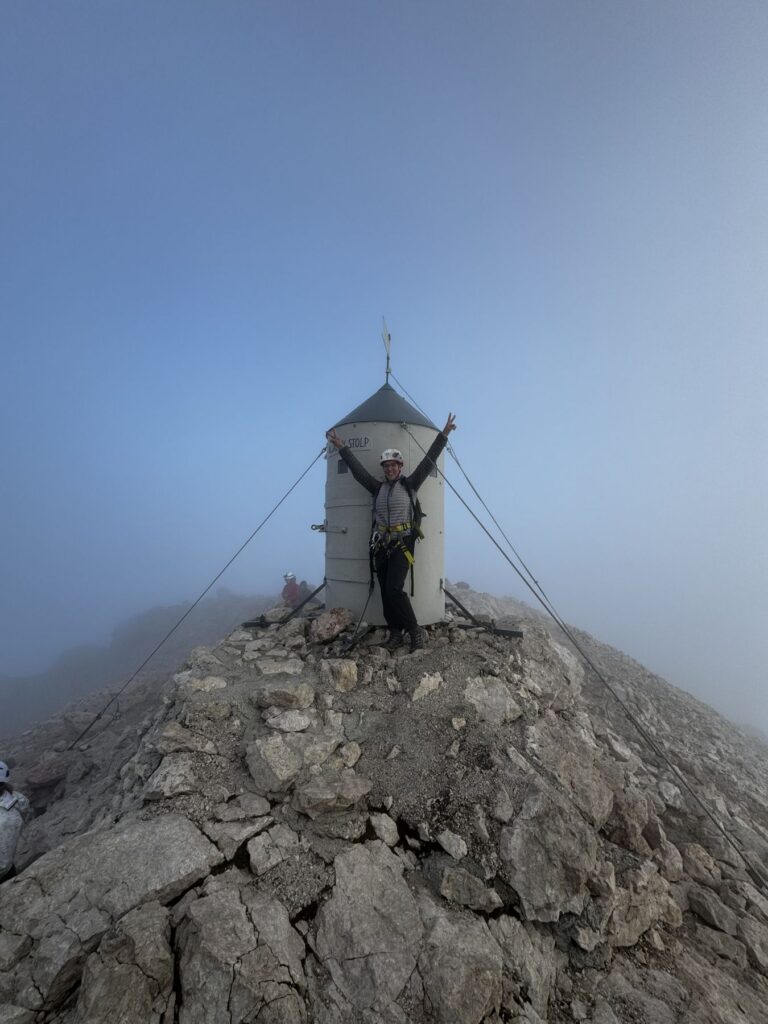
The summit itself was completely enveloped in clouds, denying us the sweeping vistas that Mt. Triglav is famous for. Even so, standing atop Slovenia’s highest peak felt incredibly rewarding. We celebrated by taking numerous photos beside the iconic Aljaž Tower. Perched at 9,396 feet, the tower serves as a storm shelter, triangulation point, and enduring national symbol. It was built in 1895 by the priest Jakob Aljaž, and in 1999 both the tower and its immediate surroundings were designated a site of national cultural significance. Slovenians often say that every true citizen should stand atop Mt. Triglav at least once in their lifetime. Another long-standing tradition dictates that first-time summiteers receive a playful swat with a knotted rope to mark their achievement. While I escaped that particular rite of passage, we did witness a group of women enthusiastically carrying on the tradition.
I actually found the descent back to the hut more challenging than the climb up, largely because the route had become much more congested with hikers. We returned shortly after 8:00 a.m., packed up our room, and enjoyed a well-earned breakfast before beginning the long trek back to the Krma Valley parking lot at 9:30.
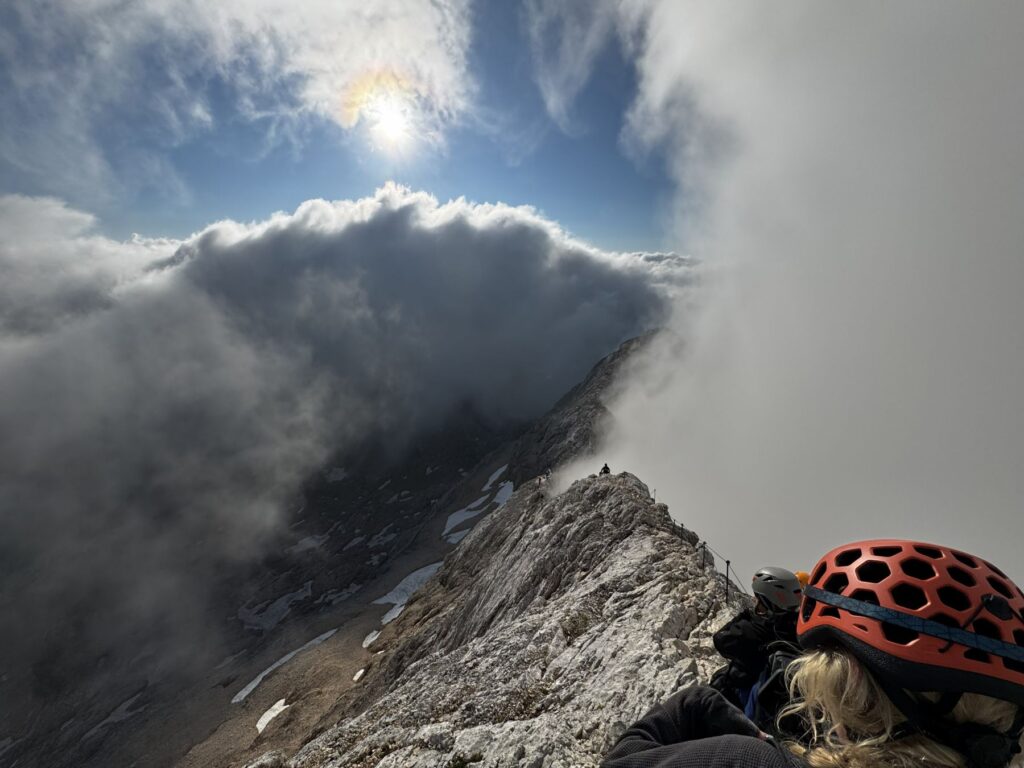
The descent into the valley passed much more quickly than the previous day’s climb, but it was relentless on the knees. Along the way we were fortunate to spot several chamois gracefully navigating the rocky slopes. We departed the Krma Valley around 2:15 p.m and I returned to The Old Parish House at 3:15 p.m. This time I was assigned the Milavec Room, another second-floor room, but with a comfortable double bed instead of two singles. The room is named after Ivan Milavec, who designed the pipe organ installed in neighboring St. Martin’s Church in 1910. After a much-needed hot shower, I walked just a block away to Pizzeria Rustika for dinner. I ordered the Kraška pizza, topped with smoked ham and green olives, and it was the perfect way to end an unforgettable adventure. The rest of the evening was blissfully quiet as I relaxed in my room, edited photos, shared memories from the trip, and reflected on the incredible experience of standing atop Slovenia’s highest mountain.
Summit hike distance: 1.7 miles (roundtrip)
Summit Elevation gain: 1,023 ft
Summit elevation loss: 1,023 ft
Hiking distance to Krma Valley: 5.36 miles
Elevation loss to Krma Valley: 3,133 ft
Day 12 Transfer back to Ljubljana
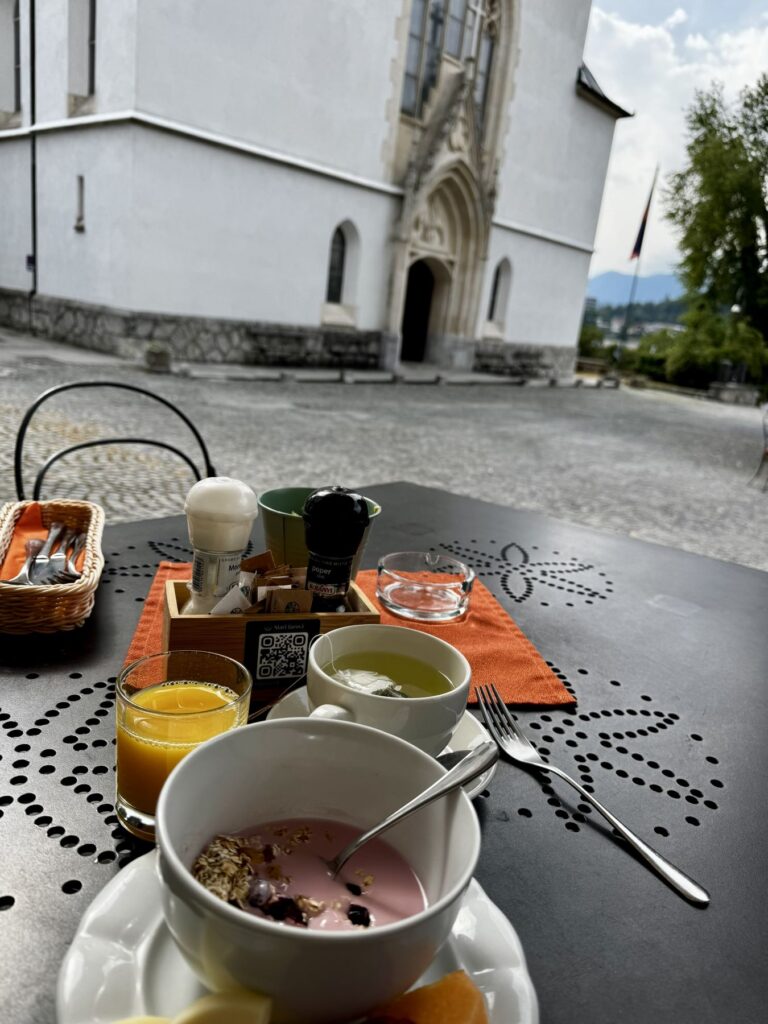
Today was, by far, the most relaxing day of the trip. My only scheduled activity was a 12:15 PM shuttle back to Ljubljana. I had hoped to make the walk up to Bled Castle, but my knee had other plans, so I opted for a much slower pace instead. I enjoyed a leisurely breakfast—included with my stay—on the patio outside The Old Parish House. The staff there were the friendliest I encountered during my entire trip. I interacted with three different employees over the course of my stay, and each one went out of their way to make me feel welcome and comfortable. Their genuine hospitality made a lasting impression.
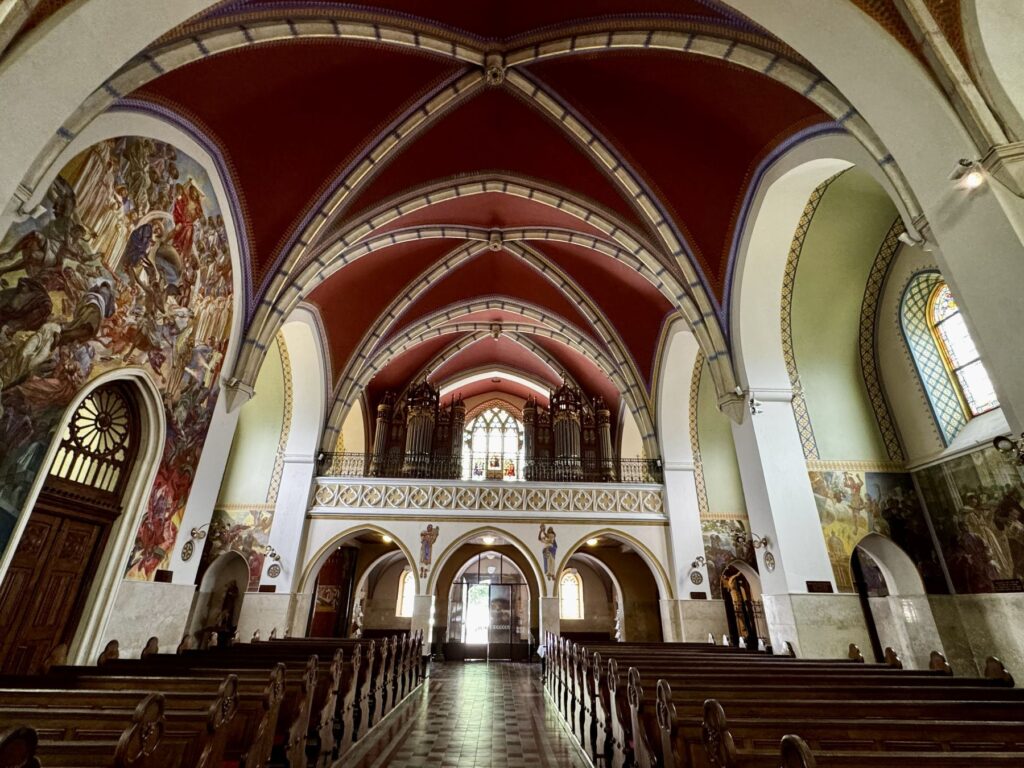
After breakfast, I wandered over to St. Martin’s Church to admire the interior and take a few photographs. The ornate ceilings in these centuries-old European churches never cease to amaze me. Every one seems to have its own unique masterpiece overhead. I checked out of the hotel at 11:00 AM, then spent the next 45 minutes relaxing on the patio and taking advantage of the hotel’s Wi-Fi before walking the short 300 meters to the bus station. My shuttle arrived only five minutes behind schedule. I arrived back at the City Hotel around 1:30 PM, but my room wasn’t quite ready. I stored my luggage and headed back out to spend a few more hours exploring Ljubljana’s charming Old Town and picking up some souvenirs.
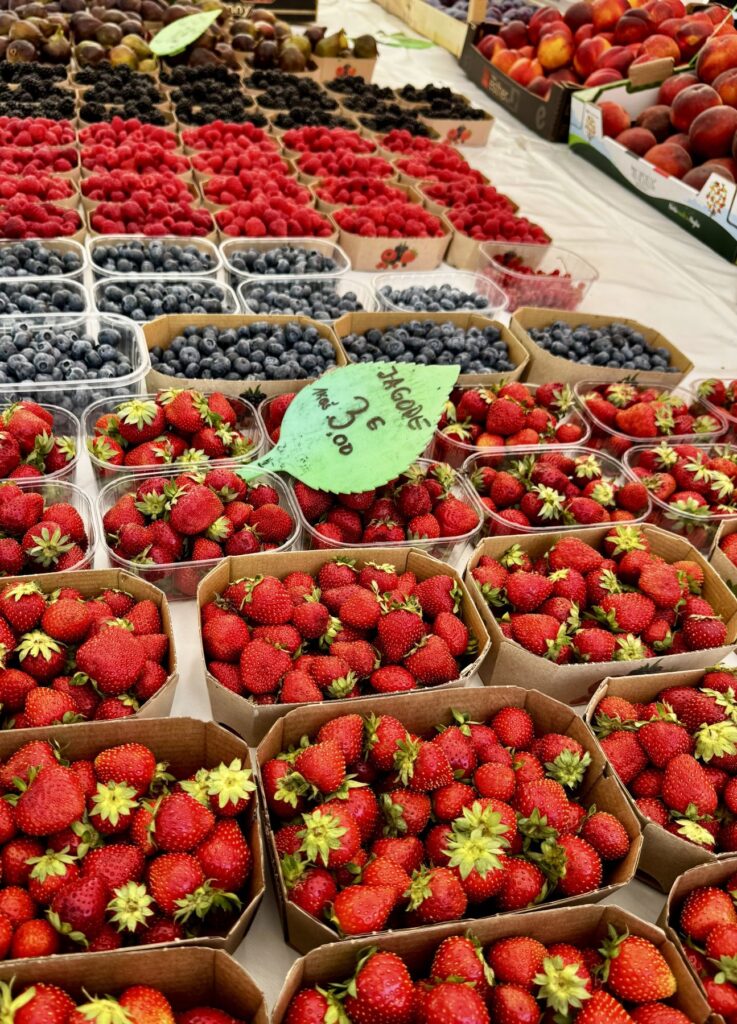
I wandered through the Central Market, located in the same square where the Open Kitchen had been held the previous Friday. The market was bustling with vendors selling fresh produce, cheeses, cured meats, fish and seafood, honey, jams, baked goods, herbs, nuts, olives, quail eggs, pumpkin seed oil, and an impressive assortment of dried meats. Mixed among the food stalls was what I could only describe as an outdoor department store, with vendors selling clothing, shoes, handbags, and other everyday goods.
I couldn’t resist buying a large plastic cup overflowing with raspberries, blackberries, strawberries, cherries, and grapes. It felt a bit ironic, considering those same fruits were being avoided back home in the United States because of an ongoing Cyclospora outbreak. The vendor reminded me that the fruit needed to be washed and pointed me toward a nearby public fountain, where several other shoppers were doing the same. Once rinsed, the fruit was absolutely delicious and, paired with a scoop of chocolate chip caffè gelato, made for a perfect lunch.
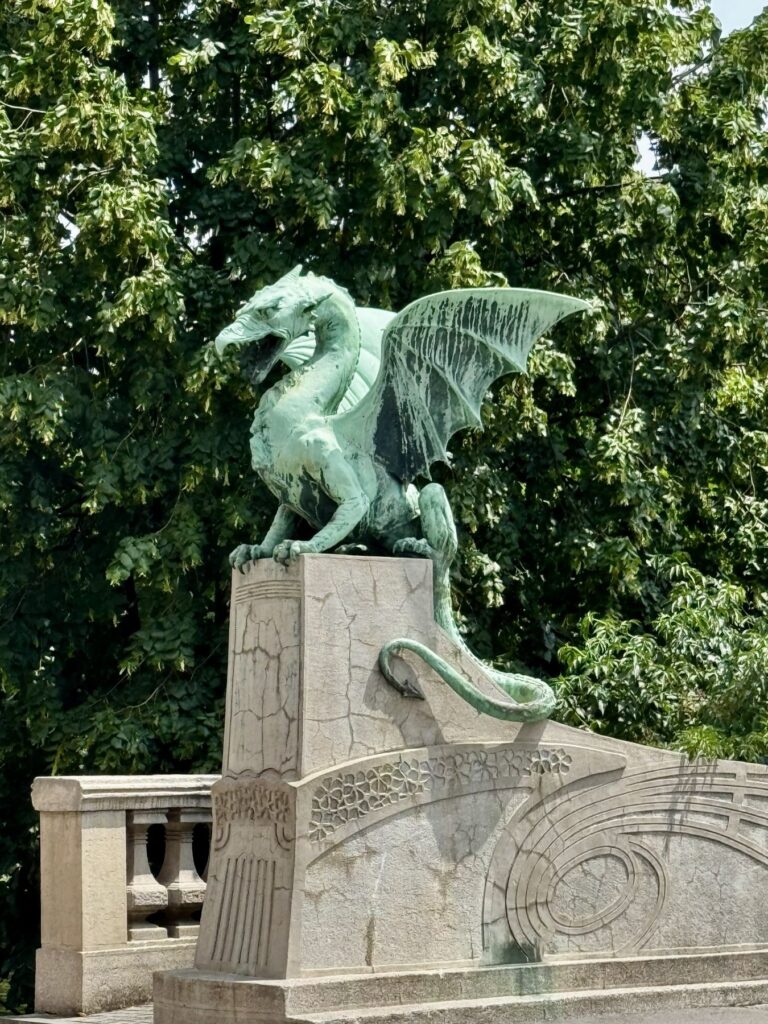
I don’t think I’ve mentioned this before, but Ljubljana’s Old Town is entirely pedestrian-friendly. Without cars, it’s wonderfully peaceful to explore, though you do have to keep an eye out for the steady stream of bicycles weaving through the streets. When I returned to the City Hotel, my room was finally ready. It was small but comfortable, located on the top (eighth) floor. My view overlooked the modern part of the city rather than the Old Town, although I could still see Ljubljana Castle in the distance. During the evening, a rainstorm rolled through, followed by a rainbow. It wasn’t the most scenic setting for a rainbow, but a rainbow is a rainbow.
Day 13 Škocjan Caves and Piran
I began the day once again with breakfast at the City Hotel’s excellent buffet before meeting my Škocjan Caves and Piran Day Tour (booked through GetYourGuide) at 8:05 a.m. outside the hotel entrance. The City Hotel seemed to be the pickup point of choice for nearly every tour company in Ljubljana. The forecast called for a chance of afternoon rain, so I packed my stowaway backpack with my rain jacket. I was also expecting a dramatic change in temperature between the cool cave interior and the warm Adriatic coast, so I wore my favorite Vuori travel pants and packed a lightweight RipSkirt to change into, along with my fleece jacket. Right on schedule, we were picked up in a comfortable shuttle bus. Our group consisted of sixteen travelers from a variety of countries. While I never learned where everyone was from, I quickly found myself spending the day with three fellow solo travelers from the state of Georgia, London, and Hong Kong.
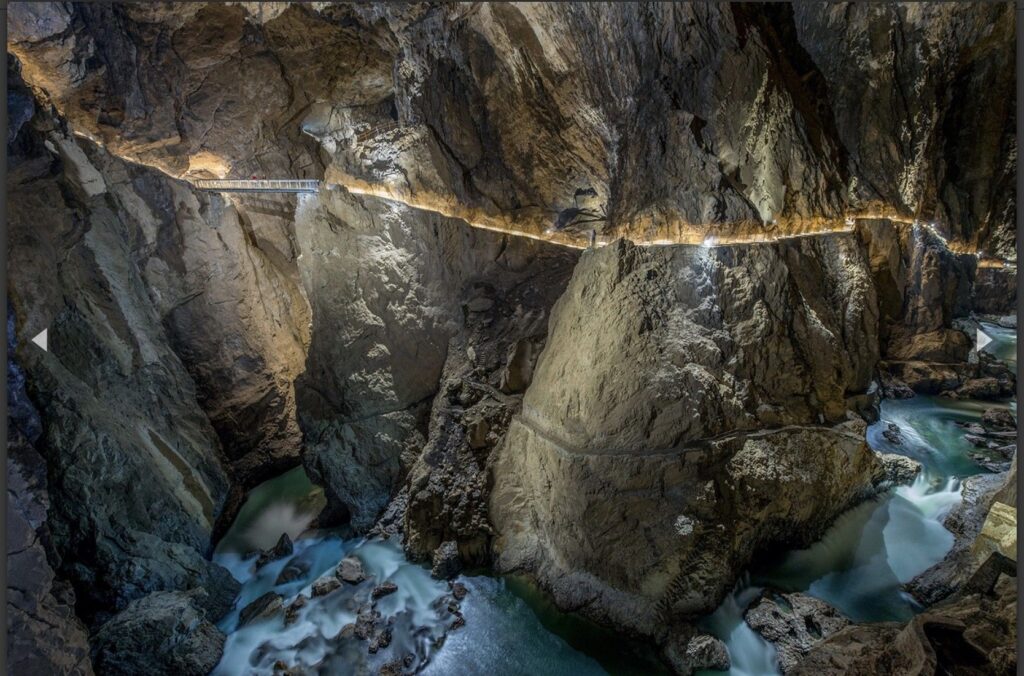
We arrived at Škocjan Caves at 9:45 a.m. Designated a UNESCO World Heritage Site in 1986, the cave system required a separate admission fee of €24, which was not included with the tour. Our guided tour began promptly at 10:00 a.m. and lasted about ninety minutes. Visitors were divided into groups of approximately forty-five people, each led by one of four guides. Photography is prohibited throughout the guided portion of the cave. The tour began in the “Silent Cave,” home to the majority of the cave’s stalactites and stalagmites. Having previously visited Carlsbad Caverns, I initially found this section somewhat underwhelming and was admittedly a bit disappointed. Fortunately, the Silent Cave is not what makes Škocjan extraordinary. Škocjan is renowned for its immense subterranean river canyon. The Reka River flows through two spectacular underground chambers, the first being Šumeča Jama, or the “Murmuring Cave,” where the river has carved an astonishing underground gorge. It then continues into Martel’s Chamber (Martelova Dvorana), the largest underground chamber in Europe and one of the largest in the world, encompassing more than 2.2 million cubic meters. The canyon terminates at a narrow siphon that cannot accommodate excessive rainfall, making the area prone to flooding.
The highlight of the tour was crossing the Cerkvenik Bridge, suspended high above the roaring river canyon. It is certainly not a place for anyone uncomfortable with heights. The scale of the canyon was breathtaking, and the dizzying depth below made me feel slightly lightheaded as I carefully made my way across. As we exited the cave system, photography was finally permitted in an area where numerous bats were nesting.
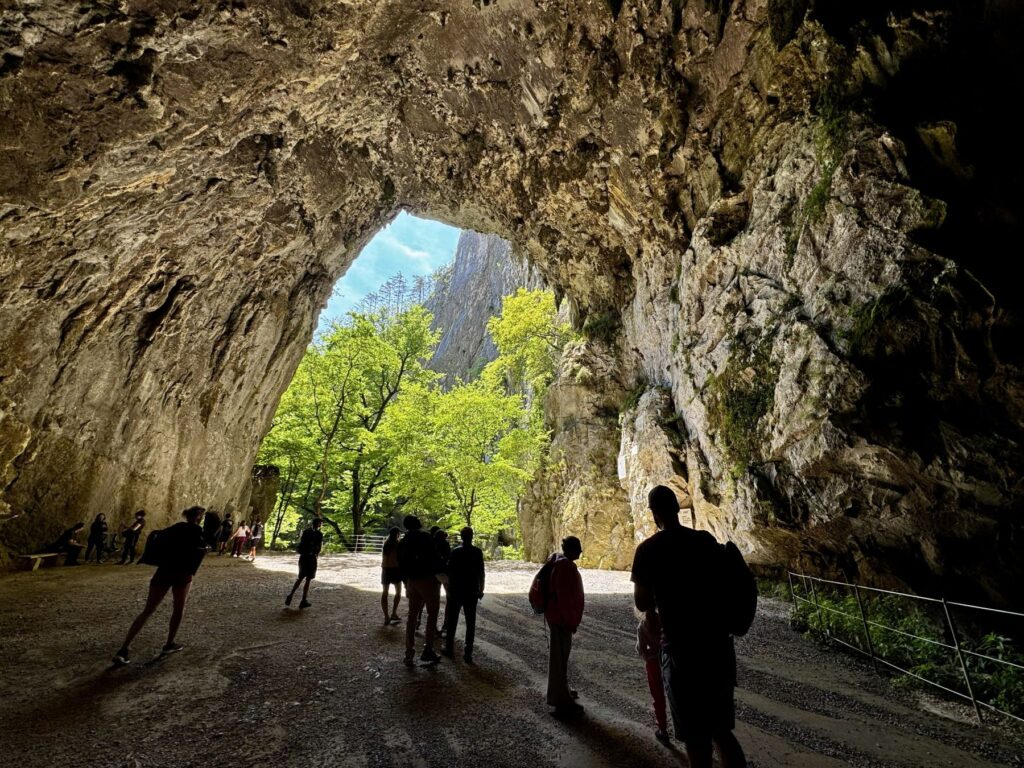
Once outside, visitors could return to the information center via one of three exit routes. Our day tour guide recommended Exits 1 or 2 because of our limited schedule, while our cave guide enthusiastically suggested Exit 3. Since we had been fortunate enough to secure the earlier 10:00 a.m. tour rather than the 11:00 a.m. departure, and our shuttle wasn’t scheduled until 1:00 p.m., my fellow solo travelers and I decided to take Exit 3. It proved to be one of the best decisions of the day.
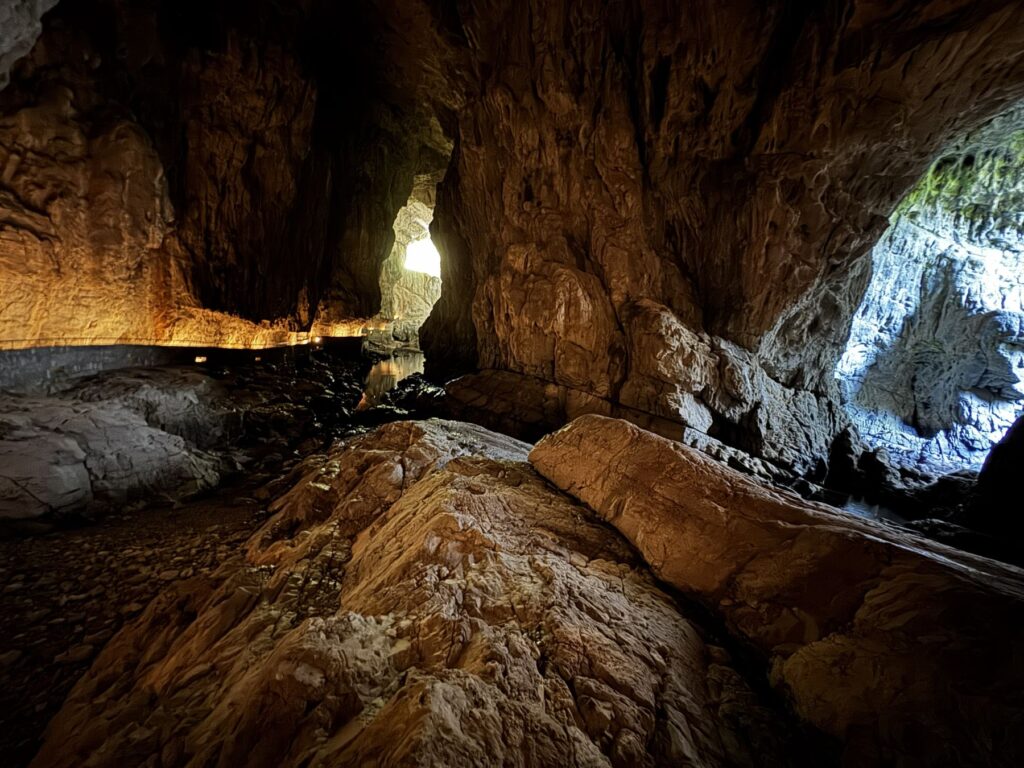
Exit 3 added roughly 1.2 miles and more than 300 steps, but it showcased some of the most spectacular scenery in the entire park. We continued along the rim of the Big Collapse Doline (Velika dolina), one of Slovenia’s largest collapse dolines, before passing through Tominc Cave (Tominčeva jama), an important archaeological site. The trail wound beneath a natural bridge into the Little Collapse Doline (Mala dolina), then crossed another bridge whose shape resembles the proteus, Europe’s unique cave salamander. From there we entered Mahorčič and Marinič Cave, located beneath the village of Škocjan, for which the entire cave system is named. After emerging from the caves, we climbed to the village of Matavun, crossed the road, and followed the signs back to the visitor center.
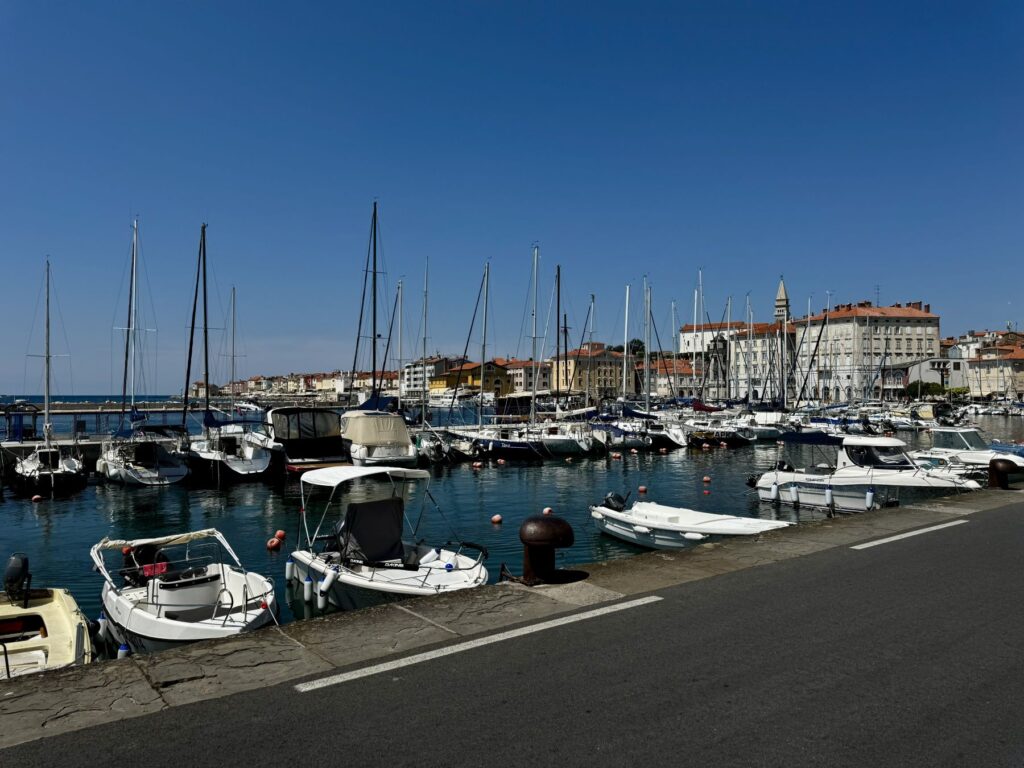
We arrived back at 12:40 p.m., leaving just enough time to reward ourselves with Magnum ice cream bars before boarding the shuttle. I also changed into my skirt, as the cave maintains a constant temperature of 56°F while the afternoon heat outside had climbed to a sweltering 94°F. Our shuttle arrived about thirty minutes behind schedule, but rather than shortening our time in Piran, the company simply extended the tour. After a forty-five-minute drive, we reached the charming coastal town at approximately 2:15 p.m.
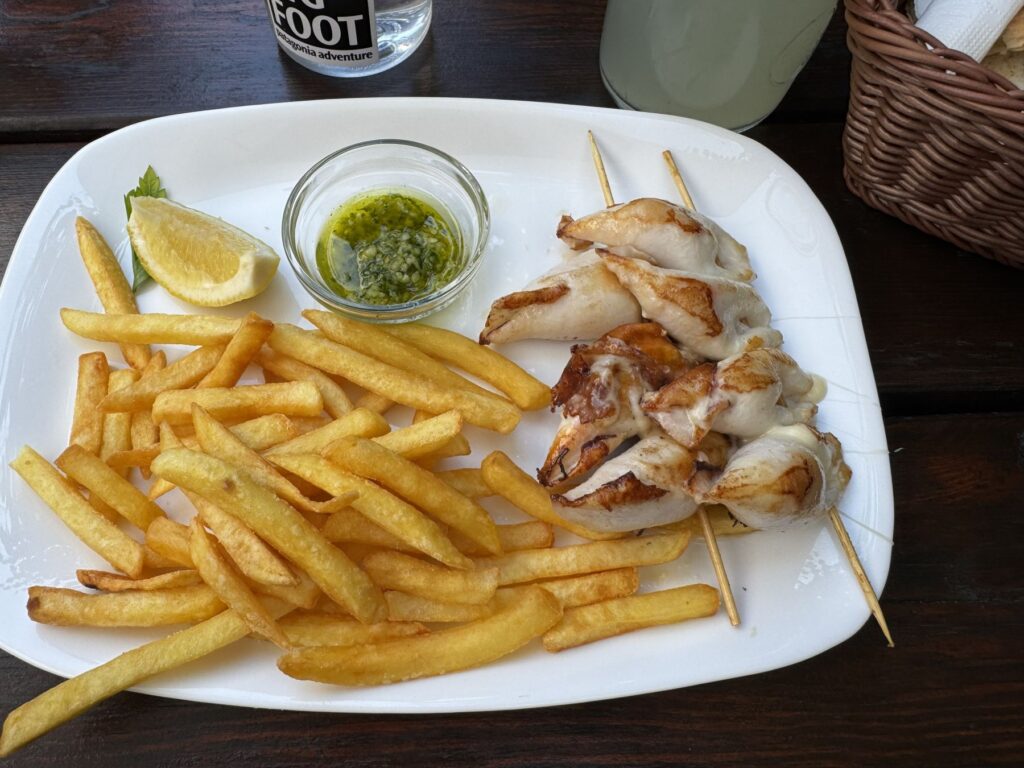
Following our guide Mario’s recommendation, the four of us headed to Fritolin pri Cantini, a beloved local seafood restaurant, where we were joined by two other Americans in the group. It was a casual counter-service establishment where each order was assigned a large decorative shell bearing a number. When the food was ready, a bell rang and a wooden fish displaying the matching number was clipped to a clothesline—a delightfully quirky system. We claimed a shaded picnic table outdoors, although the afternoon heat was still intense. I ordered stuffed calamari filled with ham and cheese, accompanied by French fries and a wonderfully refreshing ginger lemonade.
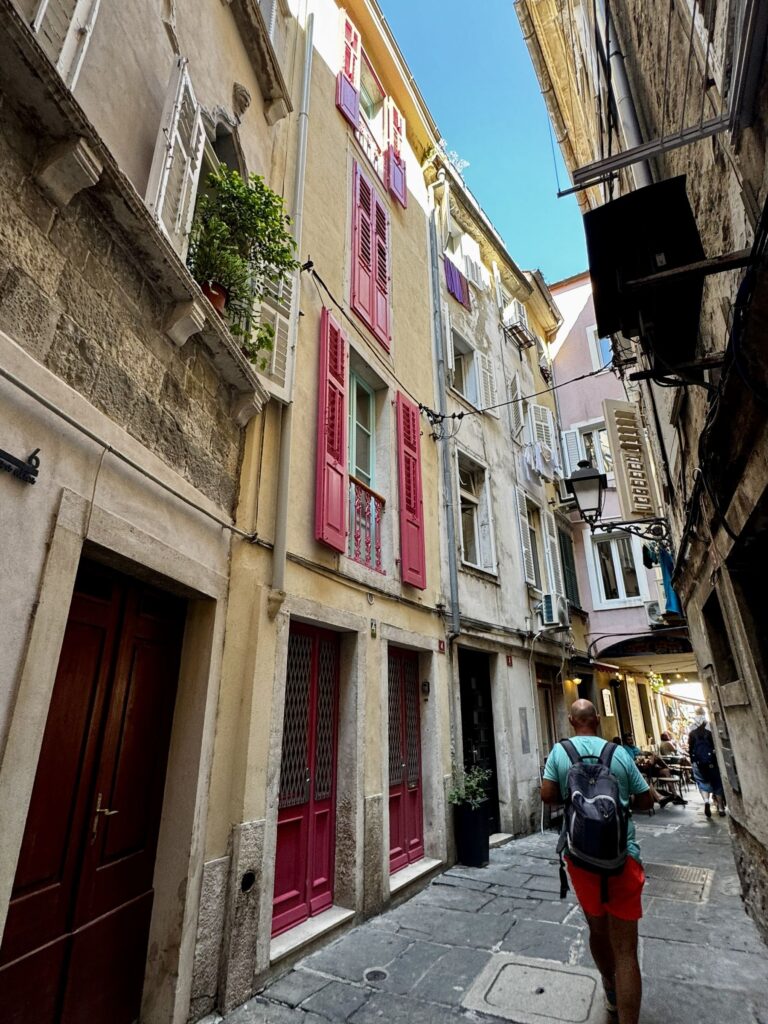
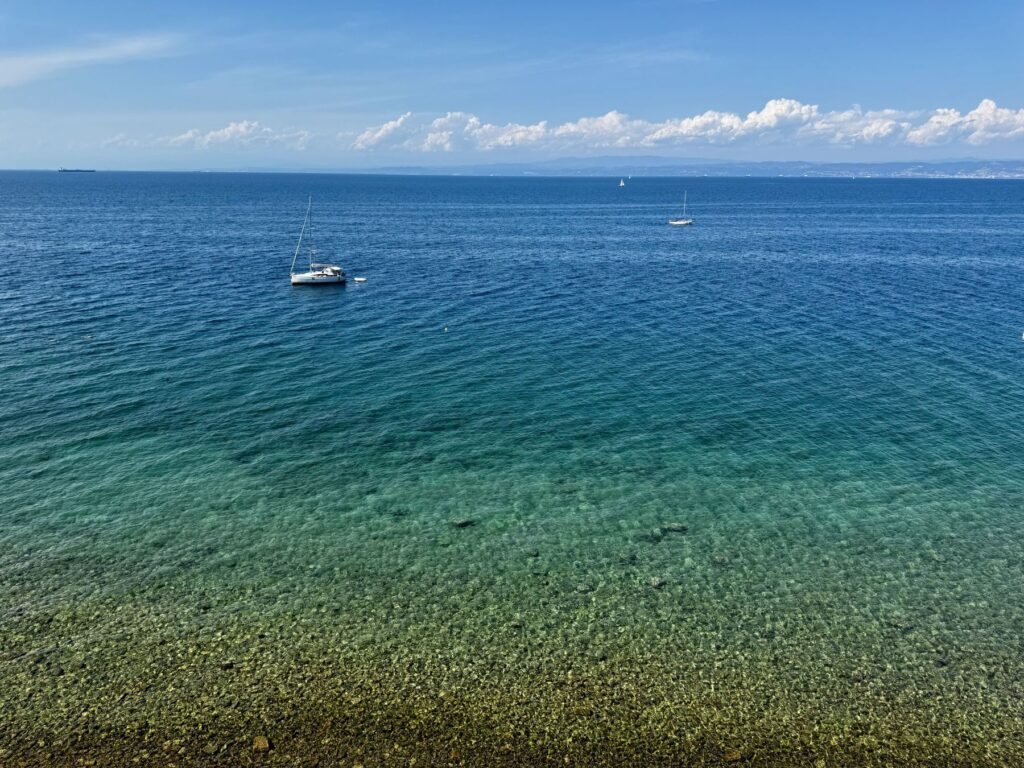
Lunch was so enjoyable that we decided to skip the optional thirty-minute guided walking tour and instead explore Piran at our own pace. We wandered through the town’s narrow medieval streets before following a scenic coastal promenade. Slovenia has just 29 miles of coastline, sandwiched between Italy to the north—with the bustling port city of Trieste—and Croatia to the south. Piran bears a distinctly Venetian character, with elegant architecture reflecting centuries of Italian influence.
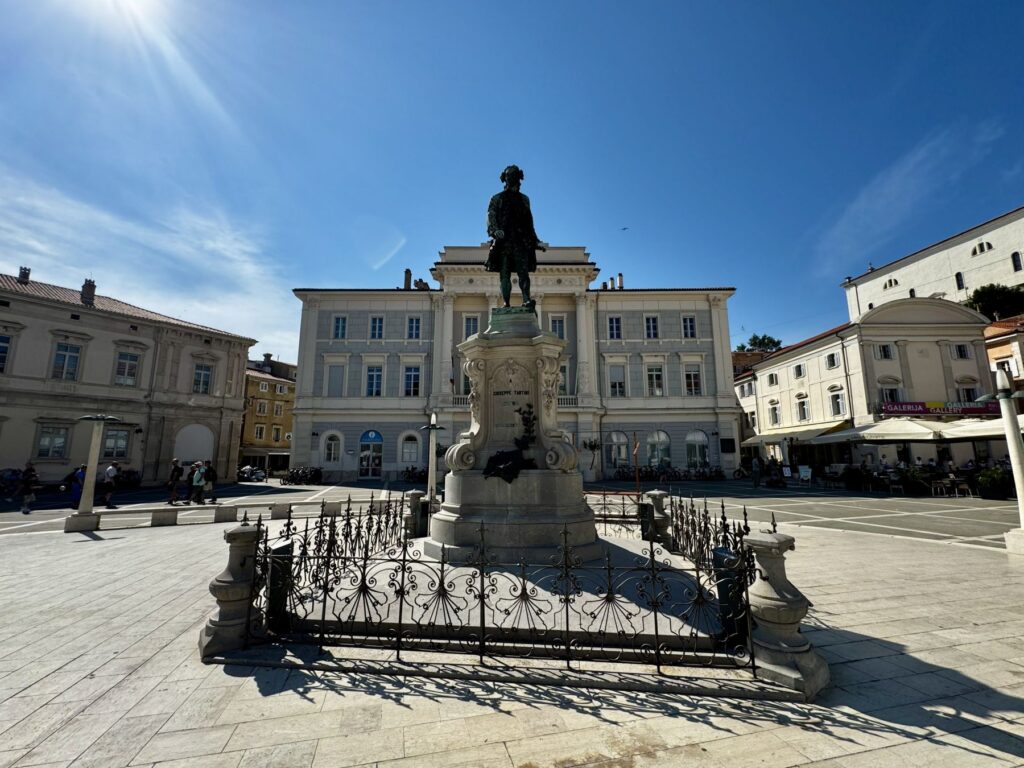
The town’s central plaza, Tartini Square, honors the celebrated violinist and composer Giuseppe Tartini, who was born in Piran. The streets were lined with charming boutiques selling locally crafted souvenirs, beautiful clothing, and artwork. I purchased a lovely hand-painted postcard depicting the town, paying €2 through an honesty box. Although Piran has no traditional beaches, people were happily swimming from the many piers that extend into the Adriatic. Watching them made me wish I had packed my swimsuit.
We reunited with the rest of our group at 4:45 p.m. and began the drive back to Ljubljana, arriving at the City Hotel around 6:15 p.m. After such a late lunch, I had no appetite for dinner, and a simple Snickers bar was more than enough. I spent the evening reorganizing my luggage for my flight home the following day, planning to check most of my bags so I would only need to carry my small stowaway backpack while in transit.
Day 14 Return flight
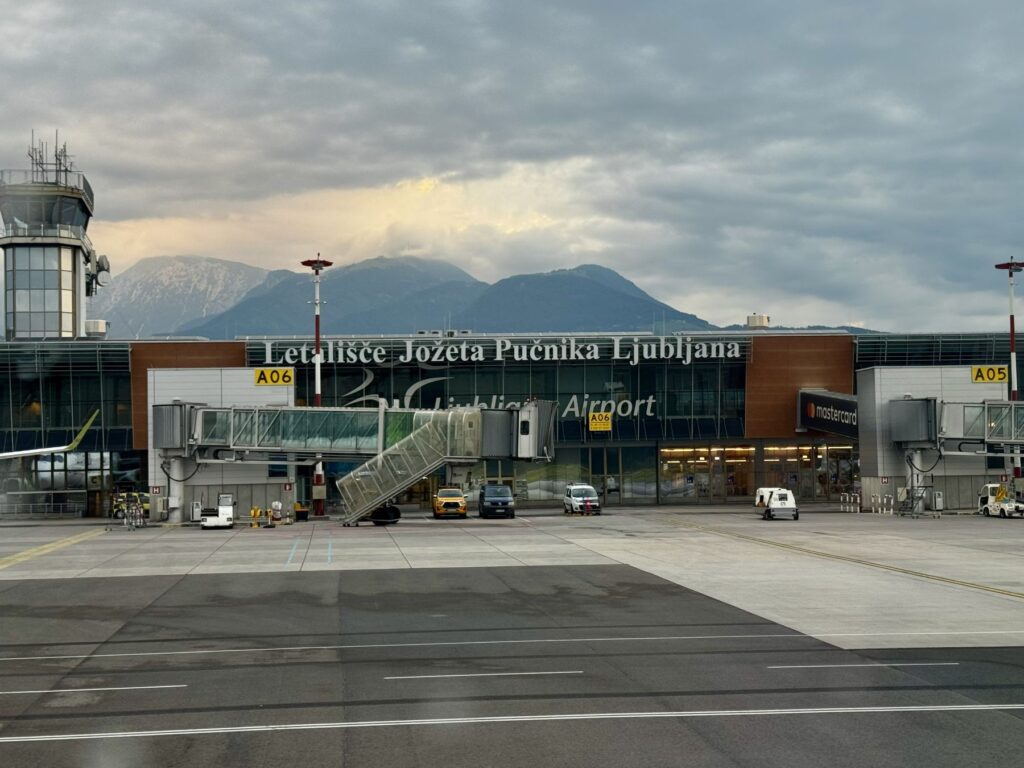
My 3:15 a.m. alarm arrived far sooner than I would have liked. I was packed, ready, and checked out of the City Hotel by 3:45 a.m. We landed in Amsterdam on time and breezed through immigration using the self-service kiosks. My photo was taken, but my fingerprints were not, so I’m still not entirely convinced that I experienced the new Entry/Exit System (EES) in its entirety. With a leisurely three-and-a-half-hour layover, I settled into the seating area near Terminal E, took advantage of the complimentary Wi-Fi, and treated myself to a delicious chocolate pastry and a pot of fresh mint tea from Amsterdam Bread Co. Since I wasn’t concerned about overhead bin space, I waited until one of the last boarding groups before making my way onto the plane.
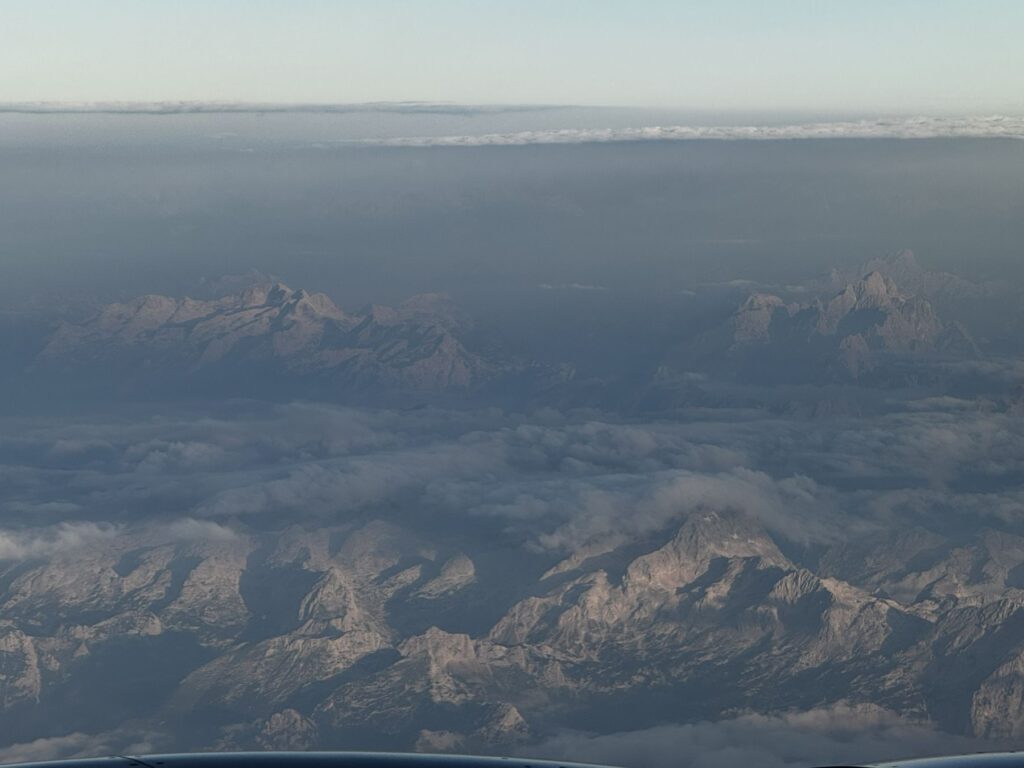
Another unforgettable adventure was in the books—filled with breathtaking scenery, incredible outdoor experiences, delicious food, and, perhaps most importantly, wonderful new friendships. Slovenia exceeded every expectation, and I left with countless memories, an iPad full of photographs, and a deep appreciation for this remarkably beautiful corner of the world.